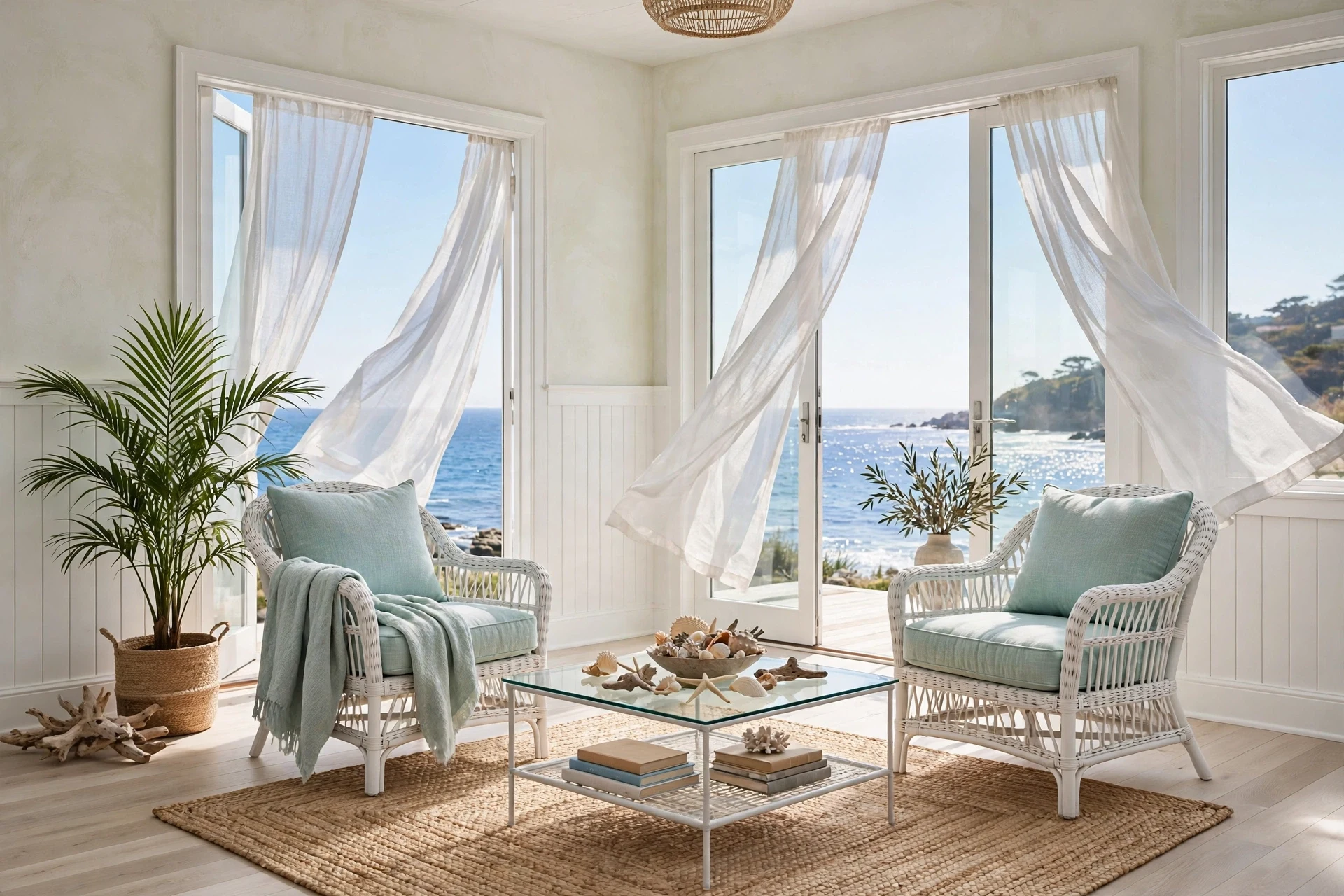
Coastal wainscoting is wood or moisture-proof PVC paneling — beadboard, vertical shiplap, or flat panels capped with a chair rail — finished in sun-washed whites and sea-glass tones so walls carry the relaxed texture of a beach house. These 32 coastal wainscoting ideas show you exactly where and how to use it, from full-height shiplap bedrooms and driftwood-capped hallways to powder rooms, sunrooms, and open verandas.
It feels like a door left open to the sea: salt on the breeze, bare feet on cool painted floors, light sliding across grooved boards the way water moves over sand. Coastal wainscoting never shouts — it murmurs, all whitewashed grain and soft shadow lines, the kind of backdrop that makes a rattan chair and a linen curtain feel inevitable. Save the ones that make your shoulders drop. Here are 32 ideas worth saving — and stealing.
Why Coastal Wainscoting Ideas Work So Well
Coastal wainscoting grew from late-1800s New England and Carolina beach cottages, where pine sheathing shielded plaster from sea air. It borrowed the tall beadboard of Lowcountry porches and the clean lines of Nantucket homes, then dropped Victorian fuss. Unlike rustic farmhouse wainscot, the coastal version reads maritime: lighter, airier, a breath from the water.
The palette is specific: whitewashed pine, clear cypress, and vertical-grain fir for dry rooms; moisture-proof PVC for wet zones. Colors stay sun-bleached — Benjamin Moore White Dove OC-17, Sherwin-Williams Sea Salt SW 6204, Farrow & Ball Skylight, driftwood gray, warm sand, soft navy. Cap rails are weathered-stained white oak; hardware is unlacquered brass.
It is trending because life changed — remote work moved households to the shore, rentals proved breezy white walls book better, and nesting made texture the new luxury. Coastal wainscoting delivers that texture for less than stone or plaster, and photographs calmer than flat drywall ever will.
Small spaces can pull it off: vertical grooves draw the eye up and lift low ceilings, while a 32-to-36-inch chair rail keeps proportions honest and satin sheen bounces light around windowless baths. One limit: deep navy or saturated seafoam without natural light reads heavy — keep small dark rooms near-white.
| Element | Seaside Cottage Heritage | Breezy Modern Ease |
|---|---|---|
| Philosophy | Walls that weather gracefully | Calm rooms that breathe |
| Key materials | Whitewashed pine, cypress, rattan | PVC wainscot, linen, sea glass |
| Key colors | Crisp white, seafoam, sand | Driftwood gray, soft navy, pale aqua |
32 Coastal Wainscoting Ideas
1. Crisp White Full-Height Shiplap Wainscot
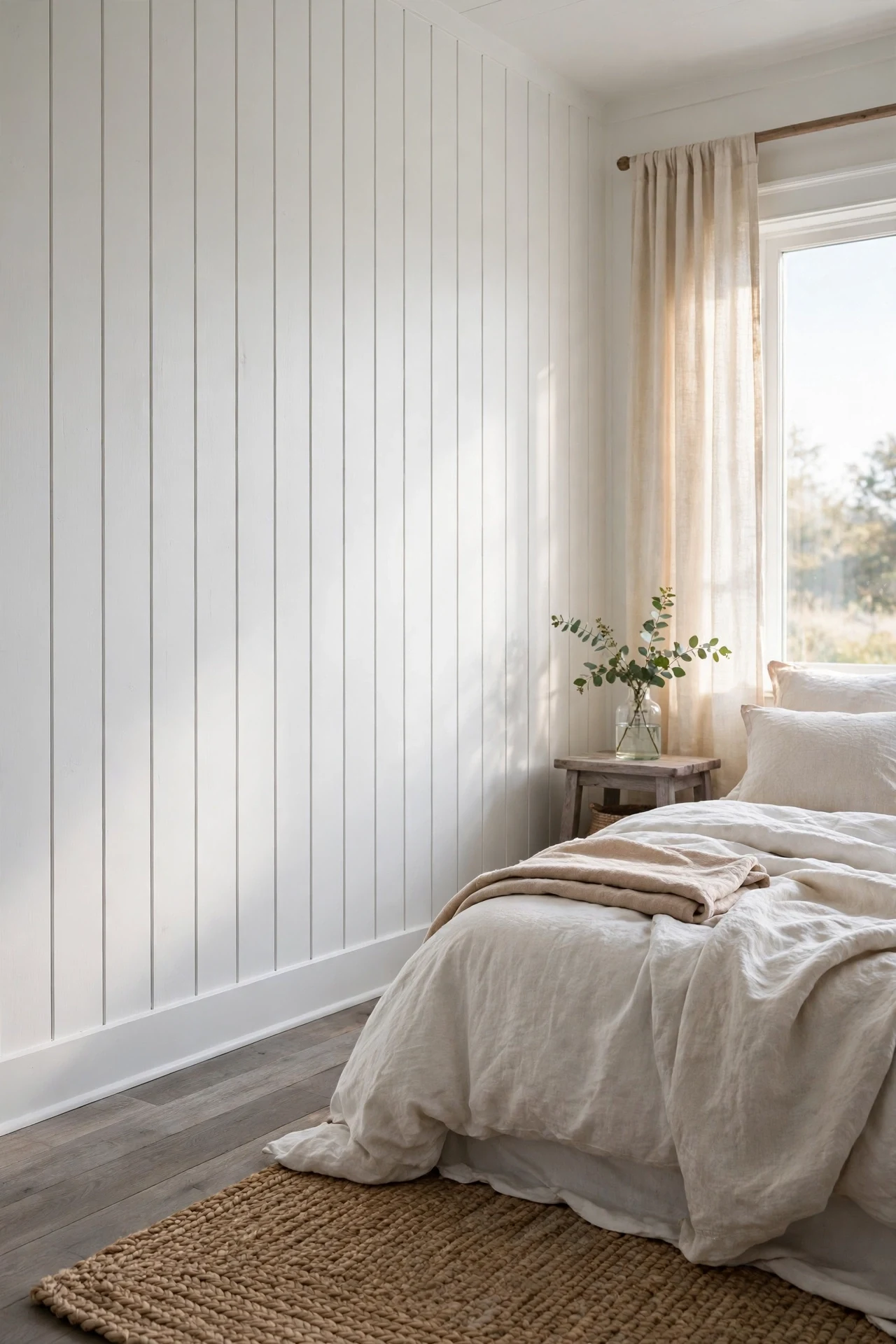
The room feels sun-warmed and weightless, as if the walls exhale.
Full-height vertical boards draw the eye upward, making eight-foot ceilings read nearly a foot taller — a proportion trick made for low beach cottages. Crisp white throws daylight deep into the room, and narrow shadow gaps add texture without clutter, so the wall feels crafted rather than flat.
Install 1×6 tongue-and-groove boards vertically over drywall with a 1/16-inch reveal between courses. Finish with two coats of Benjamin Moore White Dove in satin, then cap the ceiling joint with a painted 1×2 rail.
💡 Quick Win: One gallon of satin white paint brushed over existing flat-paneled wainscot reads instantly coastal.
2. Whitewashed Pine Beadboard — Timeless Coastal Wainscoting Ideas
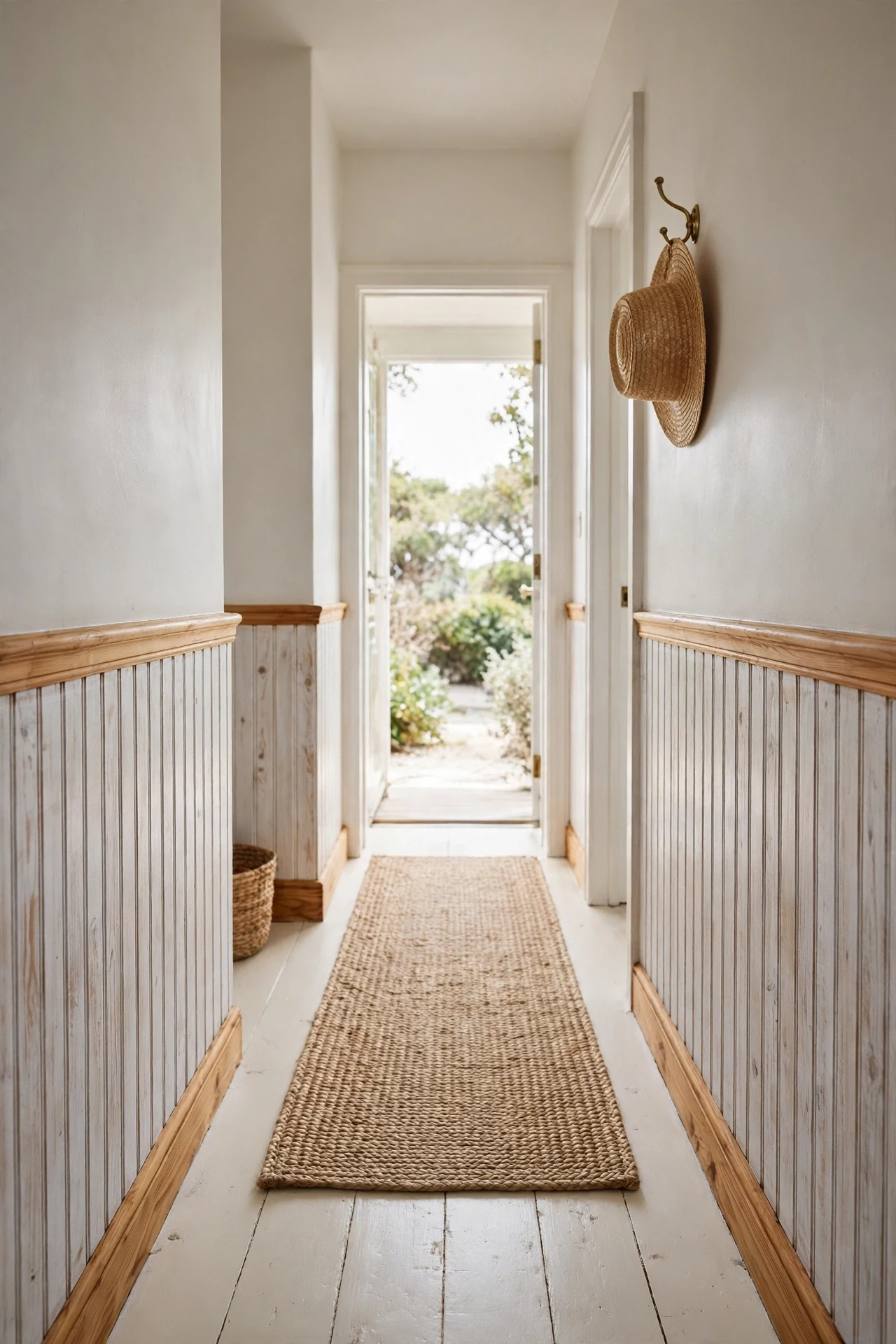
The hallway feels hushed and barefoot-friendly, like a passageway in a weathered shore inn.
Whitewash keeps the pine grain visible, and that grain is the entire point — opaque paint flattens bead grooves into plain stripes, while a translucent wash lets texture layering do the work. Tonal variation between boards adds movement, so a narrow hall never feels like a tunnel.
Mix one part Benjamin Moore Simply White with one part water, brush onto pre-primed pine beadboard, and wipe the excess within sixty seconds. Seal with matte water-based polyurethane so the wash never yellows.
3. Seafoam Chair-Rail Wainscot Below, White Above

The room glows tidal and luminous — green-tinged light at the walls, warmth at the table.
Dividing the wall at thirty-six inches applies the 60-30-10 rule vertically: seafoam holds the bottom third as a grounding band while white above keeps ceilings high. The split also forgives scuffs, since the darker tone sits where chairs and feet make contact.
Run the division at a true 36 inches, using Sherwin-Williams Sea Salt SW 6204 in eggshell below and White Dove above. Cut the chair rail from poplar and miter corners instead of butting them.
💡 Quick Win: Painting only the inside of an existing chair-rail wainscot takes one quart and one afternoon.
4. Sun-Washed Wainscot with Sheer Linen Panels
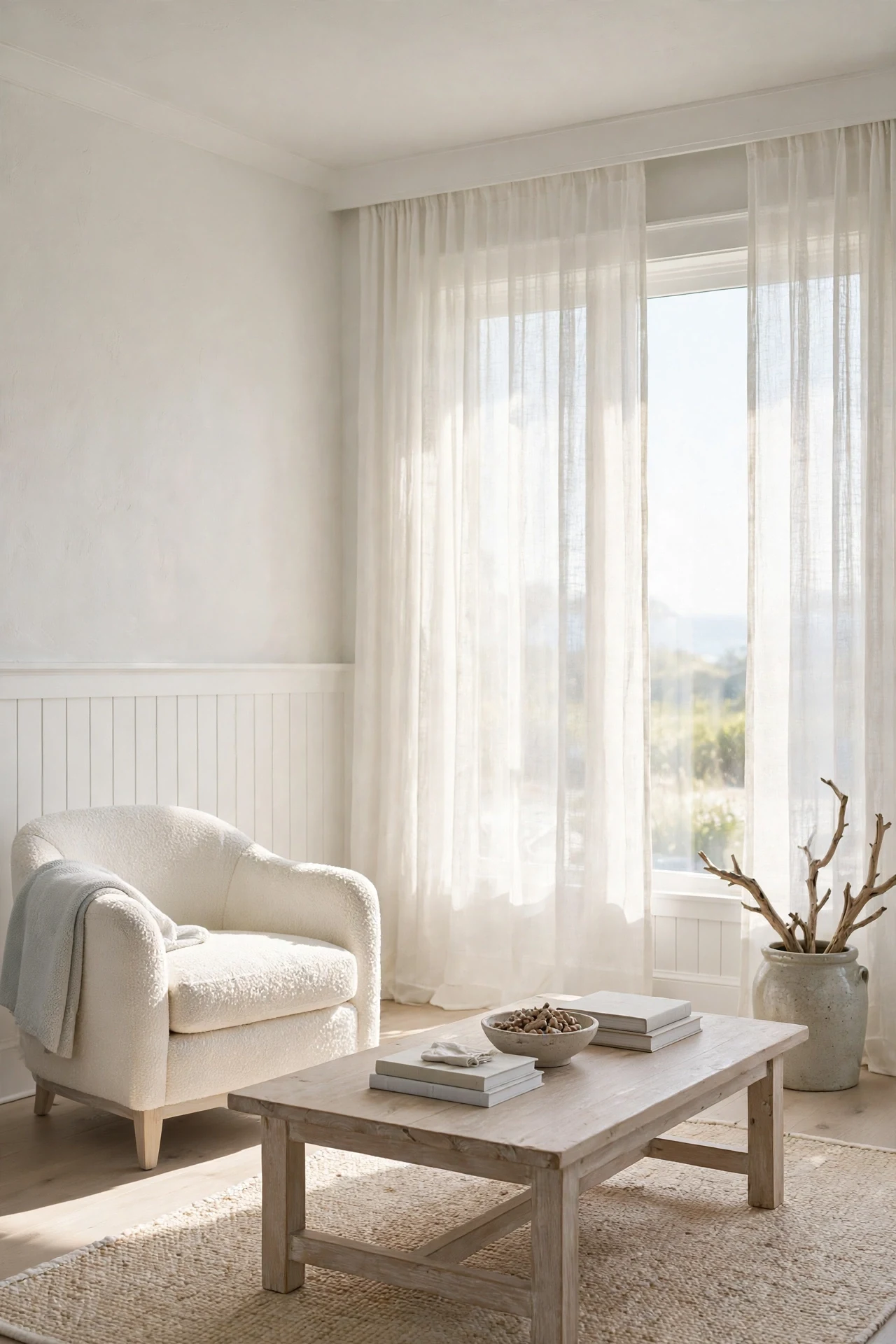
The space feels dissolved in light, every edge softened as if seen through sea mist.
Sheers turn harsh sun into a giant softbox, and that diffused light makes white wainscot glow instead of glare. Crisp board lines below against blurred fabric above is pure texture layering — hard against soft — keeping an all-white room from feeling sterile.
Mount linen panels on a ceiling track so they hang floor to ceiling, choosing a 3-percent openness weave that filters UV without blocking the view. Keep the wainscot at two-thirds of the wall height so sheers and boards meet at a pleasing horizon.
5. Driftwood Gray Cap Rail and Baseboard

The wall feels anchored and storm-weathered, like timber pulled from the tide line.
A darker cap rail frames the white field like a picture mat and gives the eye a horizontal resting line, while hiding scuffs where daily life meets the wall. The gray undertone connects pale walls to wood floors, solving the floating look of disconnected furniture.
Stain white-oak cap rails and baseboards with Varathane Weathered Wood Accelerator — over raw oak it reads authentically driftwood. Topcoat with satin polyurethane once dry so the gray resists fingerprints.
💡 Quick Win: Stain just the cap rail — one gray line frames the wall in an afternoon.
6. Rattan Daybed Against a Shiplap Wainscot Wall
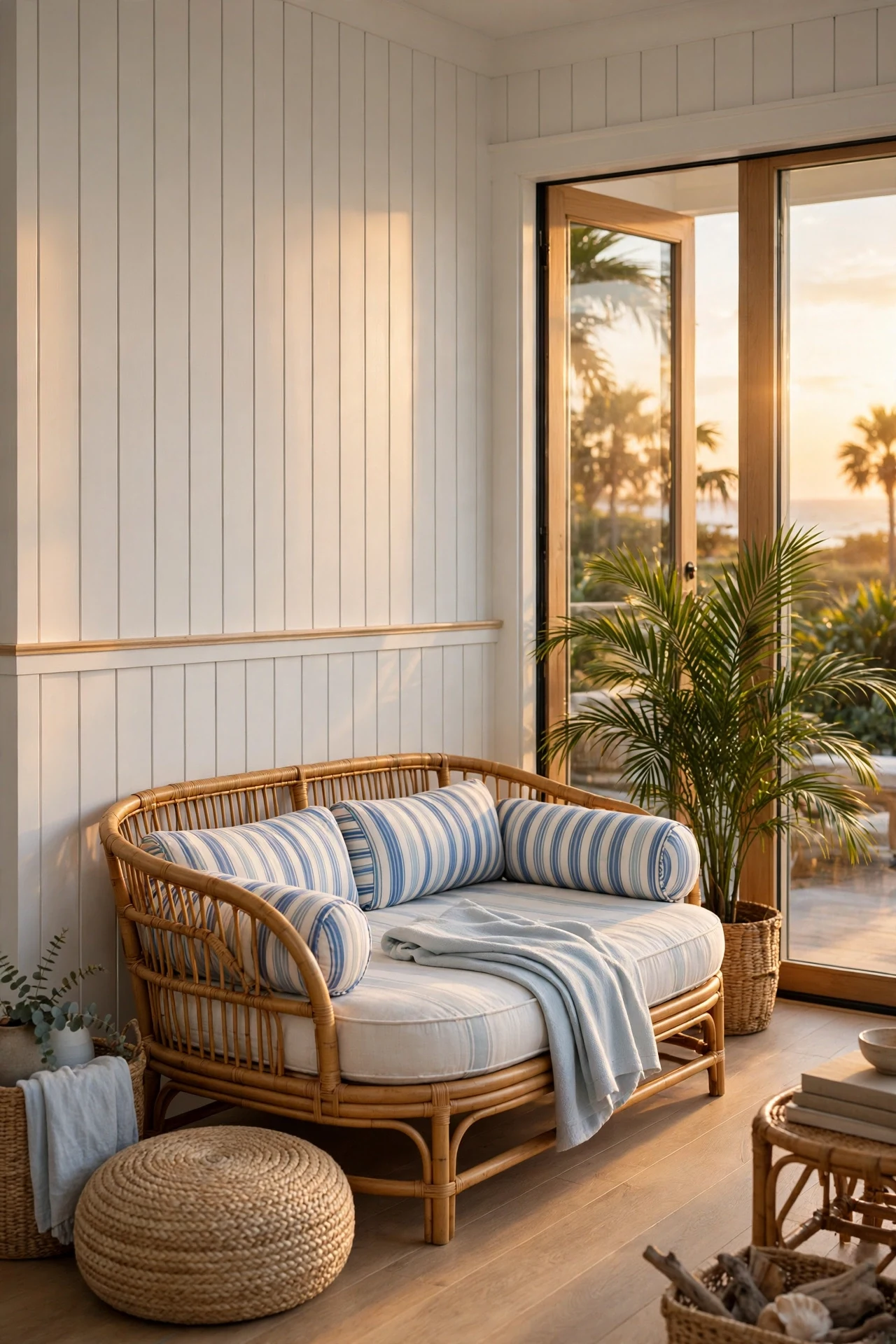
The corner feels drowsy in the best way — an afternoon nap announcing itself.
The open weave of rattan lets shiplap lines show through the furniture silhouette, so two textured surfaces coexist without competing. That transparency matters: a solid upholstered daybed would block the wainscot entirely, but rattan keeps the wall's vertical rhythm visible and the room feeling twice as deep.
Float the daybed six inches off the wall so the shiplap reads as a backdrop, not a collision. Choose a frame with a back under thirty inches tall, then layer bolsters in undyed cotton with one pale-blue lumbar for the sea reference.
7. Soft Navy Wainscot — Bold Coastal Wainscoting Ideas
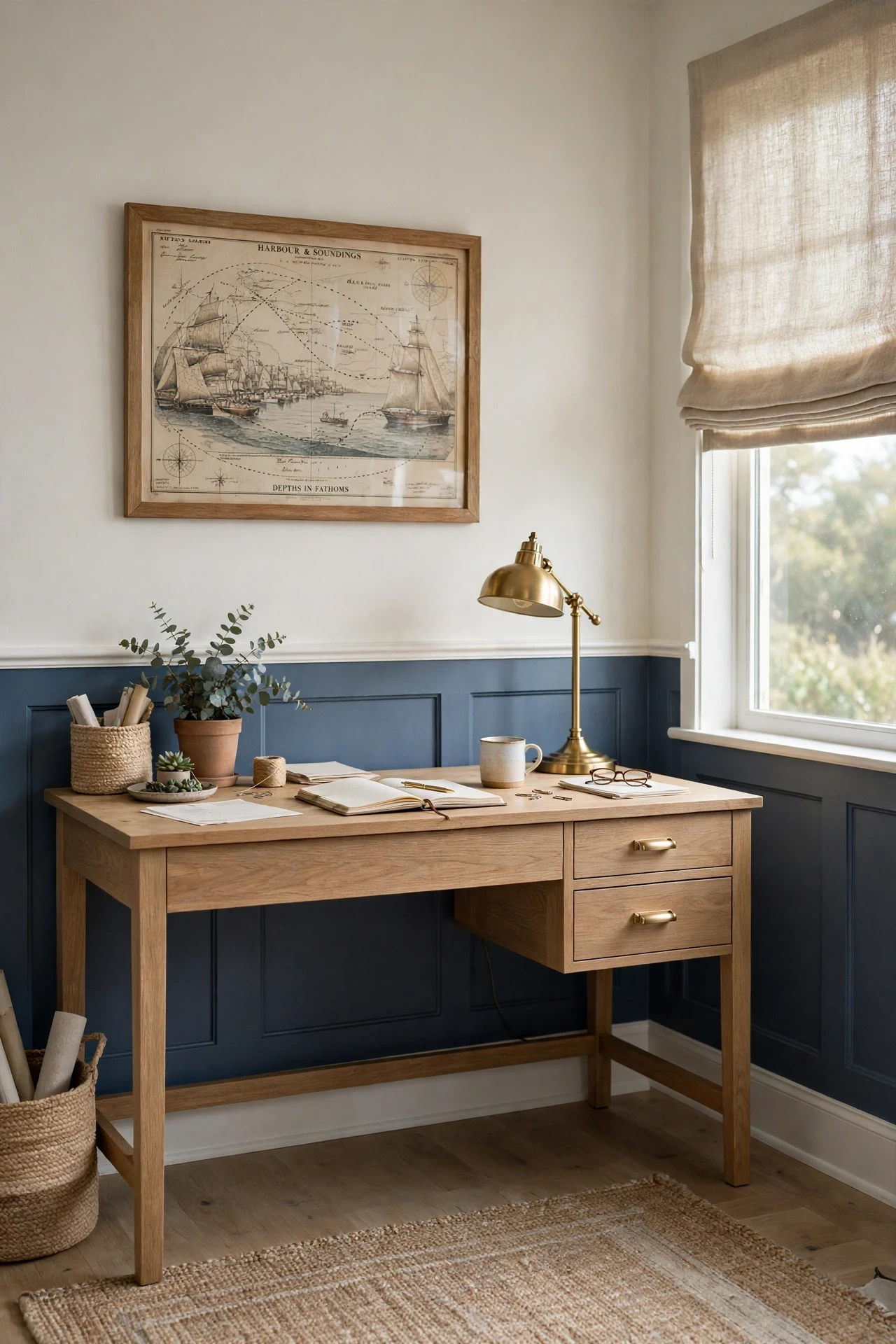
The room feels like deep water — still, assured, quietly dramatic.
Navy below, white above exploits visual weight: the dark band grounds furniture like a hull grounds a boat, while pale upper walls keep the ceiling lifted. In an all-white scheme, one saturated element makes the whites look brighter by contrast.
Paint the wainscot Farrow & Ball Stiffkey Blue or Benjamin Moore Hale Navy in eggshell, keeping the cap rail and all above in White Dove. Limit navy to one wall or a chair-rail band — full-room navy needs south-facing light.
💡 Quick Win: Paint only the inset panels navy — custom joinery for the cost of a quart.
8. Sea Glass and Driftwood Styling on the Chair Rail Ledge
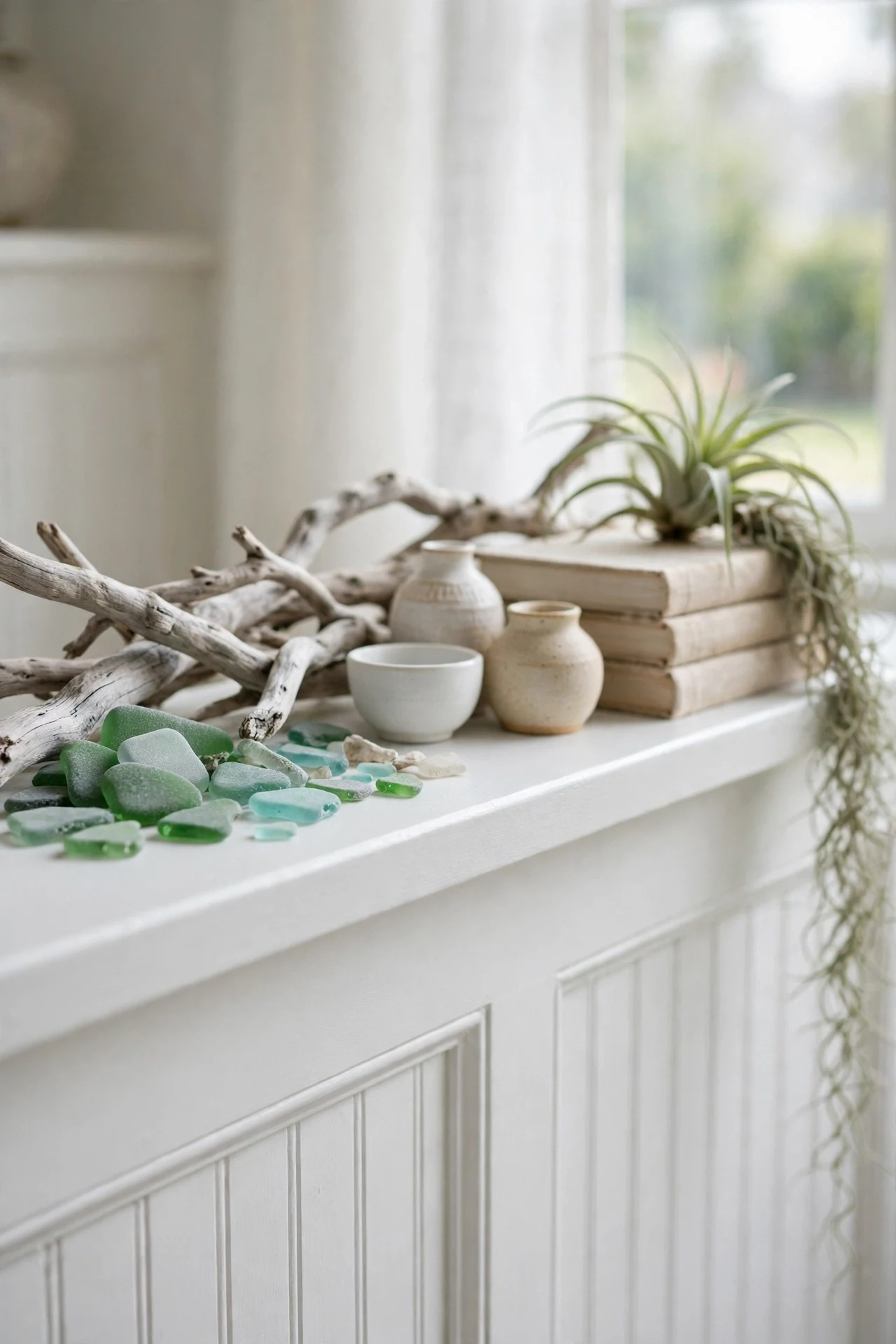
The ledge feels like a tide line of treasures — personal, unhurried, collected over years.
A deep chair rail works as a continuous shelf: texture needs display space, but cluttered surfaces kill the calm. Grouping small finds in odd clusters keeps texture where the wainscot draws the eye, leaving tables and floors breathing room.
Specify a cap rail at least three and a half inches deep with a bullnose profile. Style in clusters of three and five — one tall driftwood branch with low glass pieces, leaving a third of the ledge empty so the collection reads curated.
9. Undyed Belgian Linen Panels Above White Wainscot
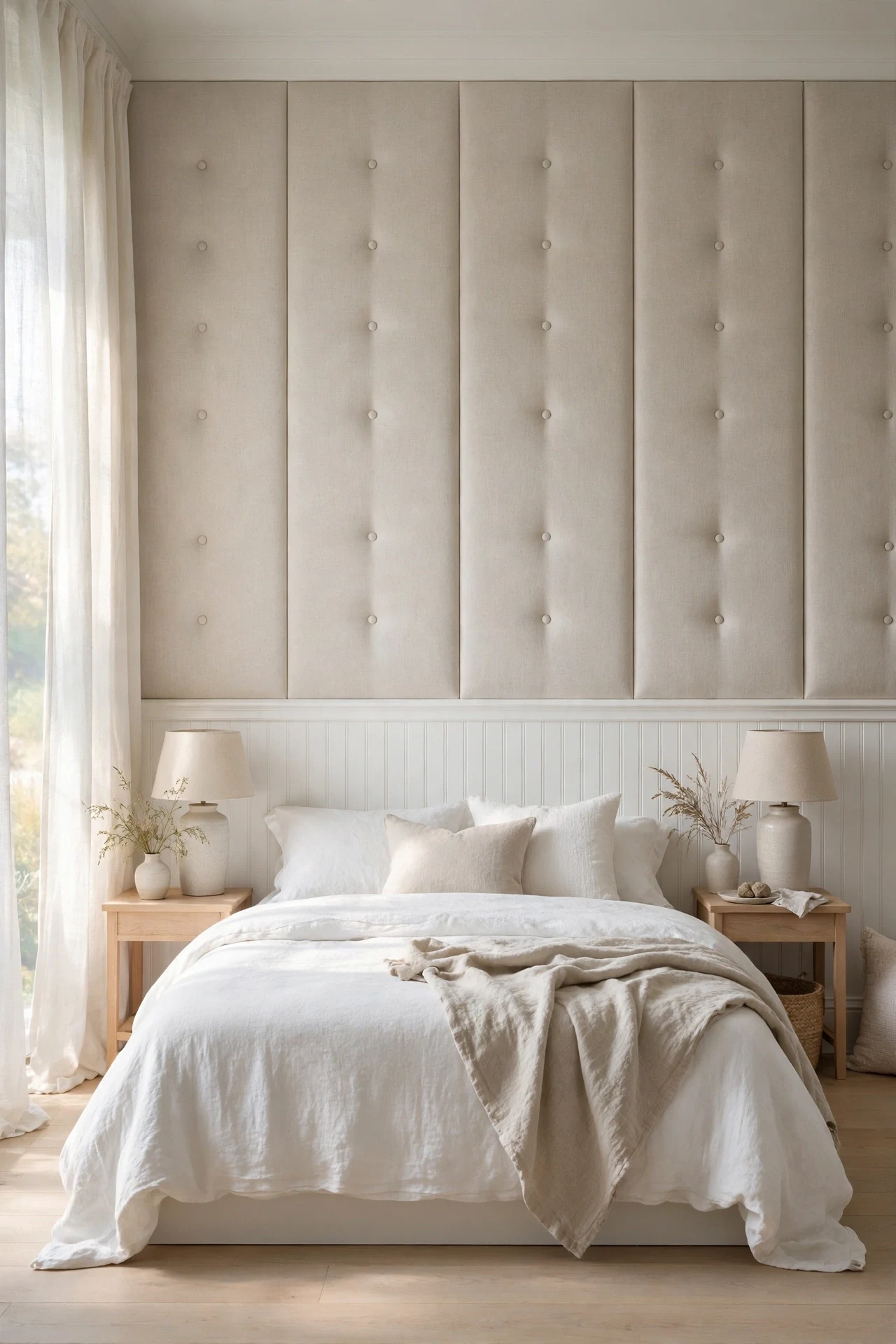
The wall feels like a held breath — soft above, crisp below, entirely at ease.
Pairing hard wainscot with upholstered panels is deliberate contrast: linen softens acoustics, which matters in bedrooms with hard floors. The tonal shift from bright white boards to oatmeal fabric adds depth, so the wall reads in two planes instead of one flat surface.
Build simple frames from 1×3 pine, wrap in undyed Belgian linen, and hang on a French cleat above the chair rail, spaced two inches apart. Choose a medium-weight 10-ounce linen so panels hold their shape without sagging.
💡 Quick Win: Stretch linen over 24×36-inch canvases — instant upholstered panels, no sewing.
10. Warm Sand Tonal Walls Above White Wainscot

The room holds the warmth of late afternoon on dunes — golden, enveloping, unhurried.
Warm sand and white share the same light-value family, so the contrast stays gentle rather than graphic — tonal layering at its simplest. The sand tone borrows the beach directly, while the white wainscot below keeps the palette from turning muddy, the way foam keeps wet sand looking fresh.
Paint upper walls Benjamin Moore Manchester Tan in flat and keep the wainscot in White Dove satin, so the sheen difference adds subtle separation. Extend the sand onto the ceiling at half strength for a cocoon effect in north-facing rooms.
11. Unlacquered Brass Sconces on the Chair Rail

Evening arrives early here, in the kindest light — everything gilded, nothing harsh.
Sconces on the chair rail put light at seated eye level, washing the wainscot in raking light that exaggerates every groove. That raking effect is the payoff: texture you barely notice by day becomes the room's entire evening personality.
Center each sconce on the cap rail at sixty inches from the floor and wire to a dimmer — full brightness for dinner, low for lingering. Choose unlacquered brass, which develops a patina that harmonizes with coastal woods better than chrome.
💡 Quick Win: Battery-powered brass picture lights clip onto the cap rail — no electrician.
12. Weathered Oak Bench in a Wainscoted Entry
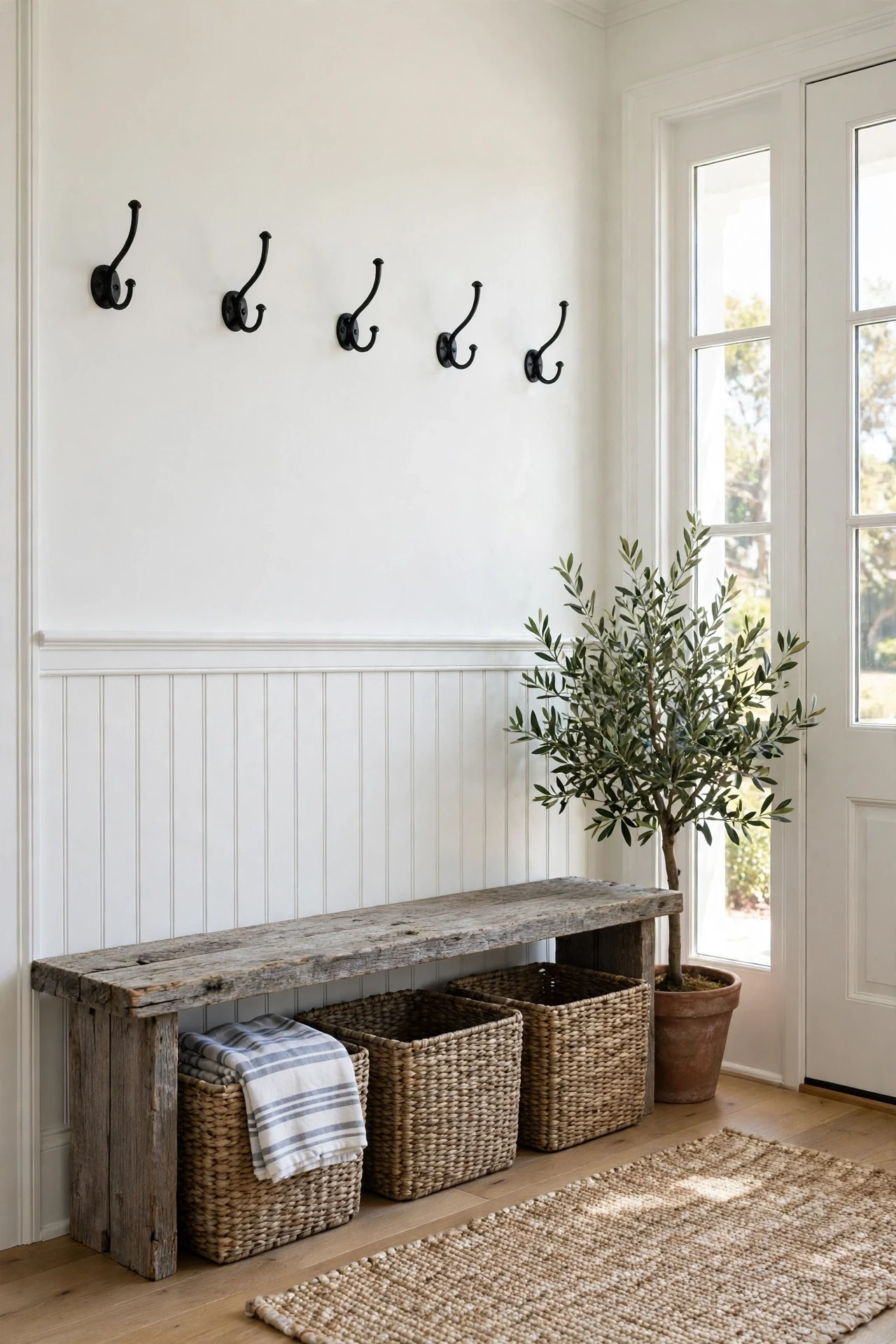
The entry feels like a deep breath before the house — orderly, sunlit, ready.
A bench against wainscot solves the drop-zone problem with proportion: the horizontal furniture echoes the horizontal chair rail, and the weathered oak introduces the one warm, aged material a white entry needs to feel lived-in rather than staged. The beadboard behind it also takes abuse gracefully, hiding the scuffs of shoes and bags.
Choose a bench sixteen to eighteen inches deep so it sits flush against the wainscot, and keep its top at eighteen inches for comfortable seating. Tuck two lidded seagrass baskets beneath for shoes and leashes.
13. Jute Runner Layered Along a Wainscoted Hallway
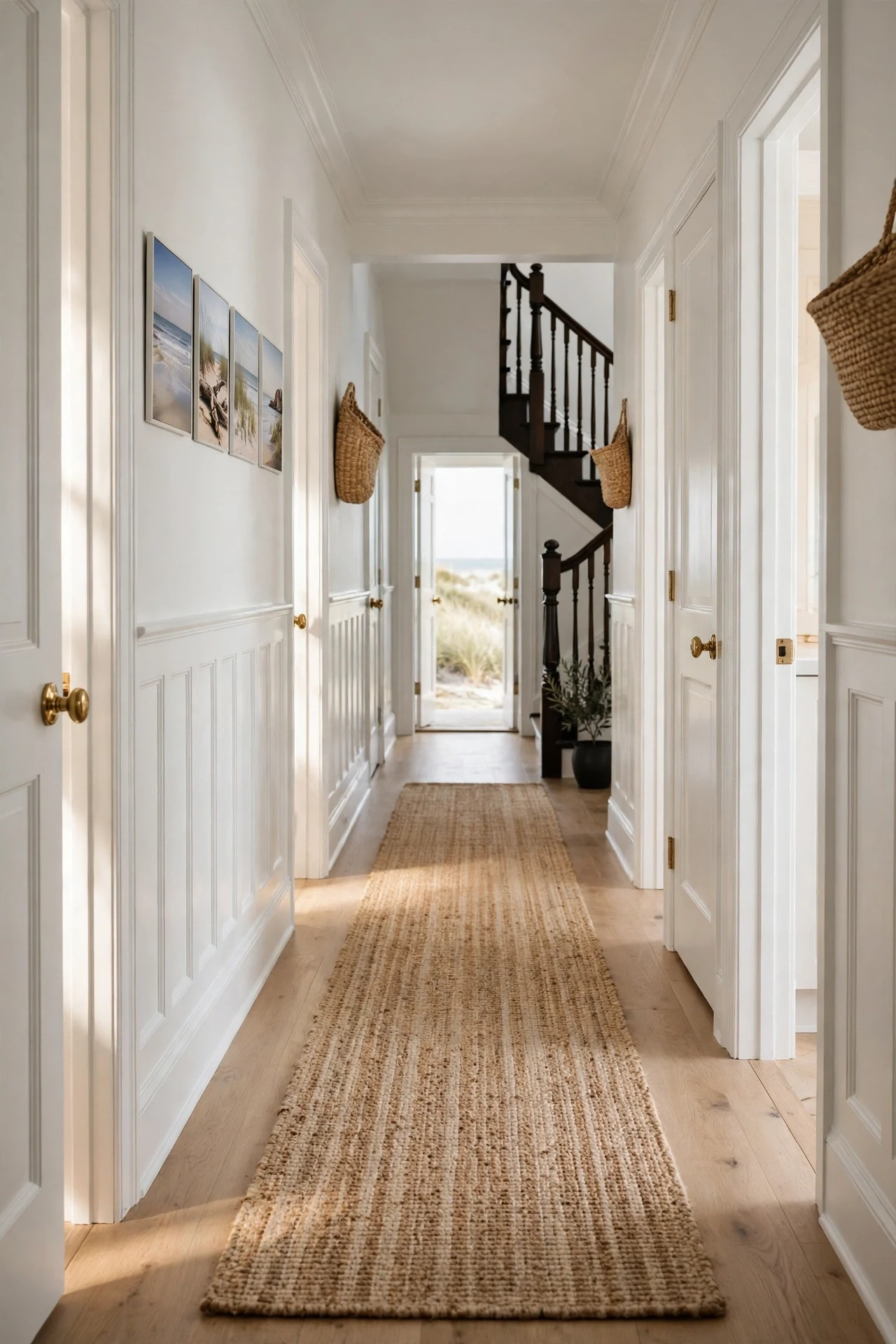
Walking this hall feels like crossing a dune path — textured underfoot, quiet, directional.
A natural-fiber runner does double duty: it deadens footstep echo off hard paneling, and its warm tan stripe connects white walls to the floor. The long rectangle exaggerates the hallway's perspective, pulling the eye toward whatever waits at the end.
Order a runner eight inches narrower than the hall, leaving four inches of floor visible per side. Lay a felt rug pad underneath — jute slides on smooth floors and the pad protects the finish.
💡 Quick Win: Layer a washable cotton runner over the jute at the doorway to catch sand.
14. Wainscot as a Soft Zone Divider in an Open-Plan Room
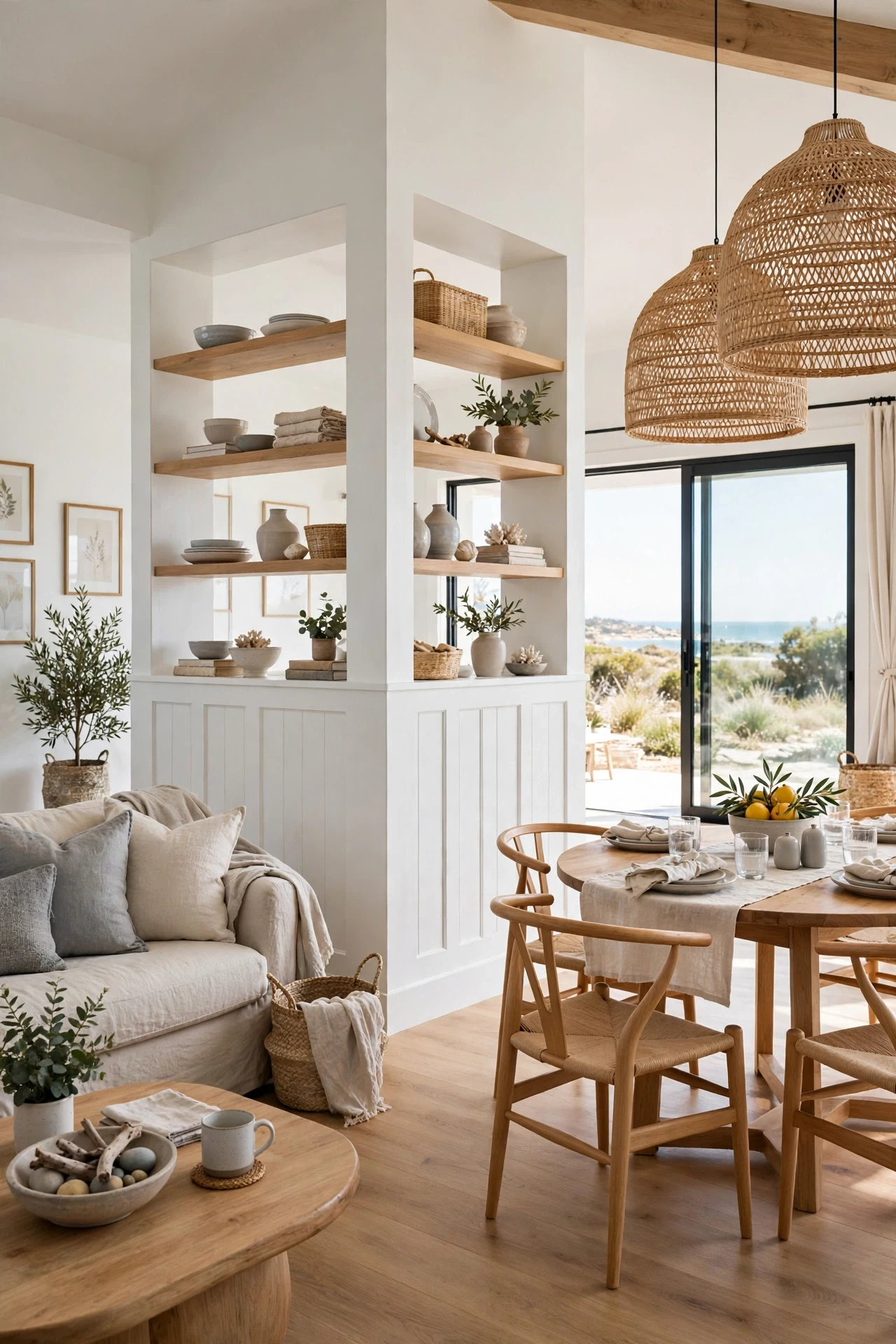
The space flows like shoreline — one continuous room with gentle coves for different moods.
A half-height wainscoted divider defines zones without the visual stop of a full wall, so sightlines and daylight keep traveling. The paneled faces give each side a finished, architectural backrest for furniture, which makes the open plan feel designed rather than accidental.
Build a framed pony wall at forty-two inches, case both faces with wainscot, and cap it with a six-inch serving ledge. Run the same flooring through both zones so the divider reads as furniture, not architecture.
15. Reclaimed Dock Wood Wainscot
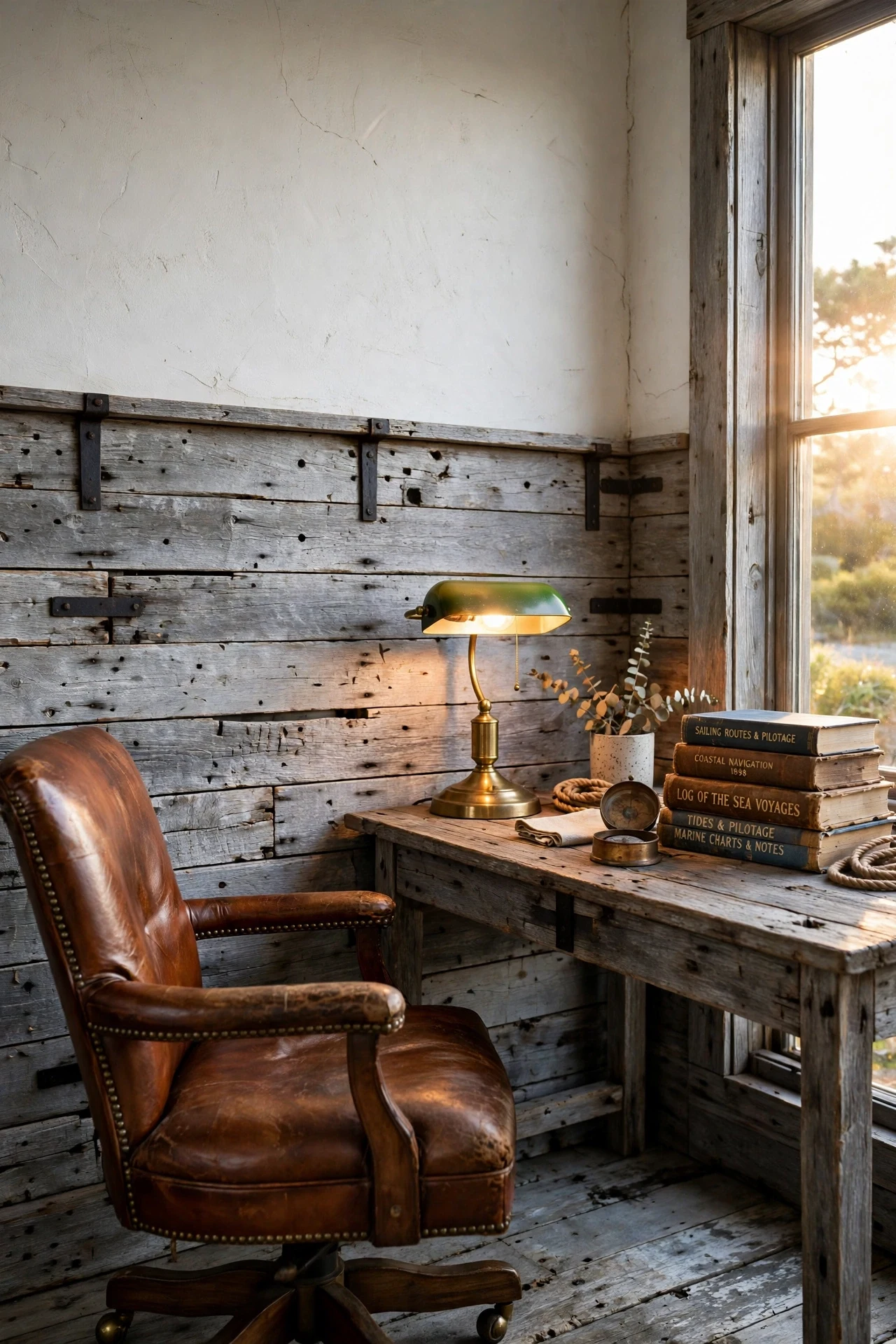
The wall carries its history openly — every nail hole a tide, every saw mark a season.
Reclaimed boards bring patina no stain imitates: the silver-gray oxidation of dock wood comes from decades of salt, sun, and weather. As wainscot below a clean white upper wall, the rough texture gets a gallery frame, so the room reads curated rather than cabin-rustic.
Source boards from salvage yards, then scrub, kiln-dry, and seal every face with matte marine-grade sealant against salt and moisture. Install horizontally with 1/8-inch gaps so the irregular edges show.
💡 Quick Win: Ask for offcut bundles — short boards cost less and suit staggered patterns.
16. Two-Tone Wainscot — Fresh Coastal Wainscoting Ideas
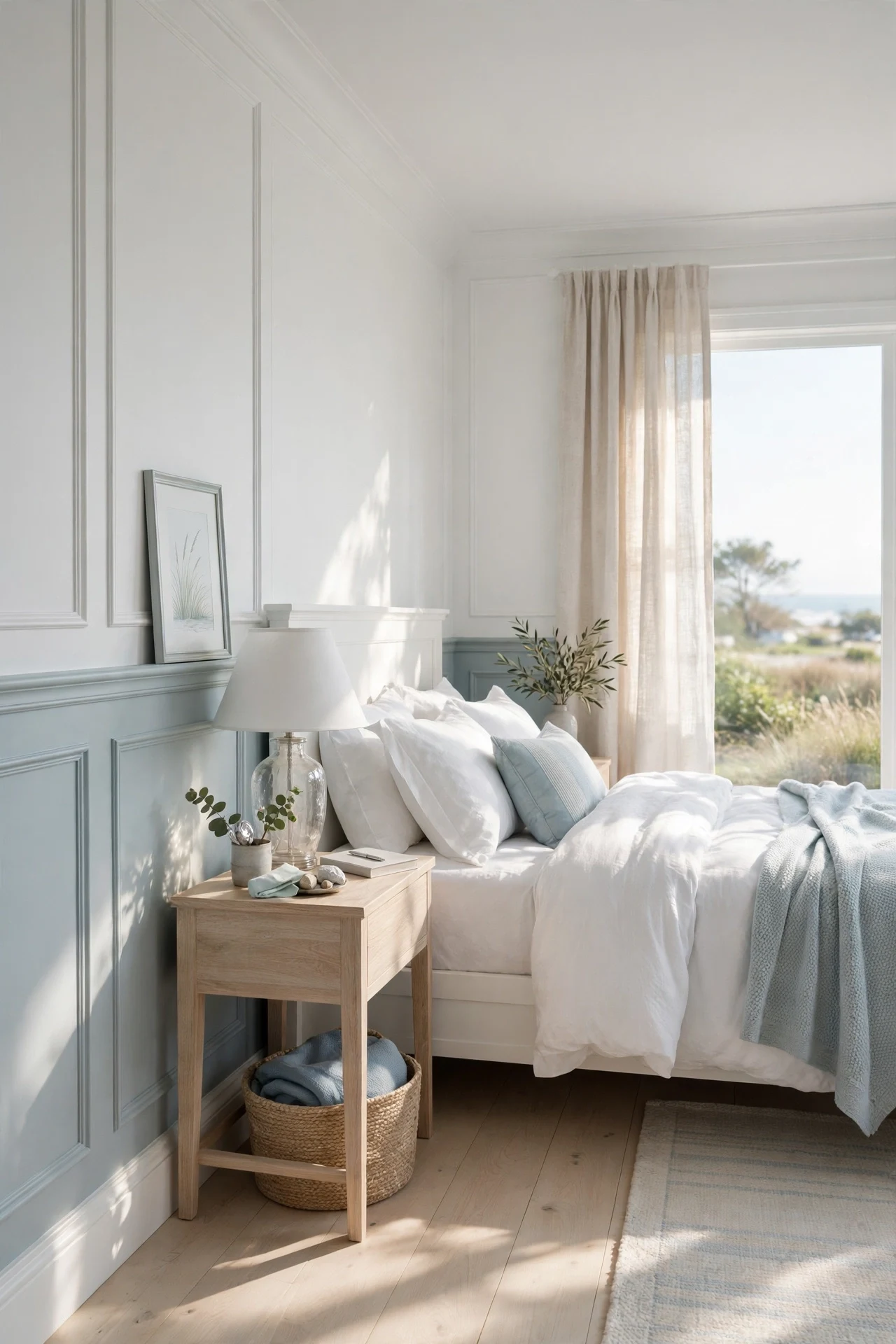
The wall feels like shallow water over white sand — color with the clarity still intact.
Painting only the inset panels pale blue-gray while keeping the framing white creates custom-look joinery from ordinary stock. The technique adds color without commitment: the panels are small fields, so even a bolder choice stays polite, and white rails keep every edge crisp.
Use Farrow & Ball Borrowed Light or Benjamin Moore Beach Glass in eggshell on the inset panels, with rails, stiles, and cap in White Dove satin. Paint panels first with a small foam roller, then cut in the framing with an angled sash brush.
17. Rope-Framed Mirror on a Beadboard Wall

The mirror feels like a porthole that wandered indoors — round, roped, faintly nautical.
A rope frame adds the coarse, hand-worked texture beadboard needs: fine grooves read precise, rope reads human. The reflection doubles the wainscot, bouncing its vertical rhythm across the room so the paneling works twice as hard.
Wrap a 24-inch round mirror with 3/4-inch manila rope using a hot-glue gun, coiling two full rounds and finishing the joint at the bottom. Hang it with its center at fifty-seven inches — gallery height — above a slim console.
💡 Quick Win: Coil rope around a mirror you own — one spool and an afternoon.
18. Chair-Rail Wainscot in a Tiny Powder Room
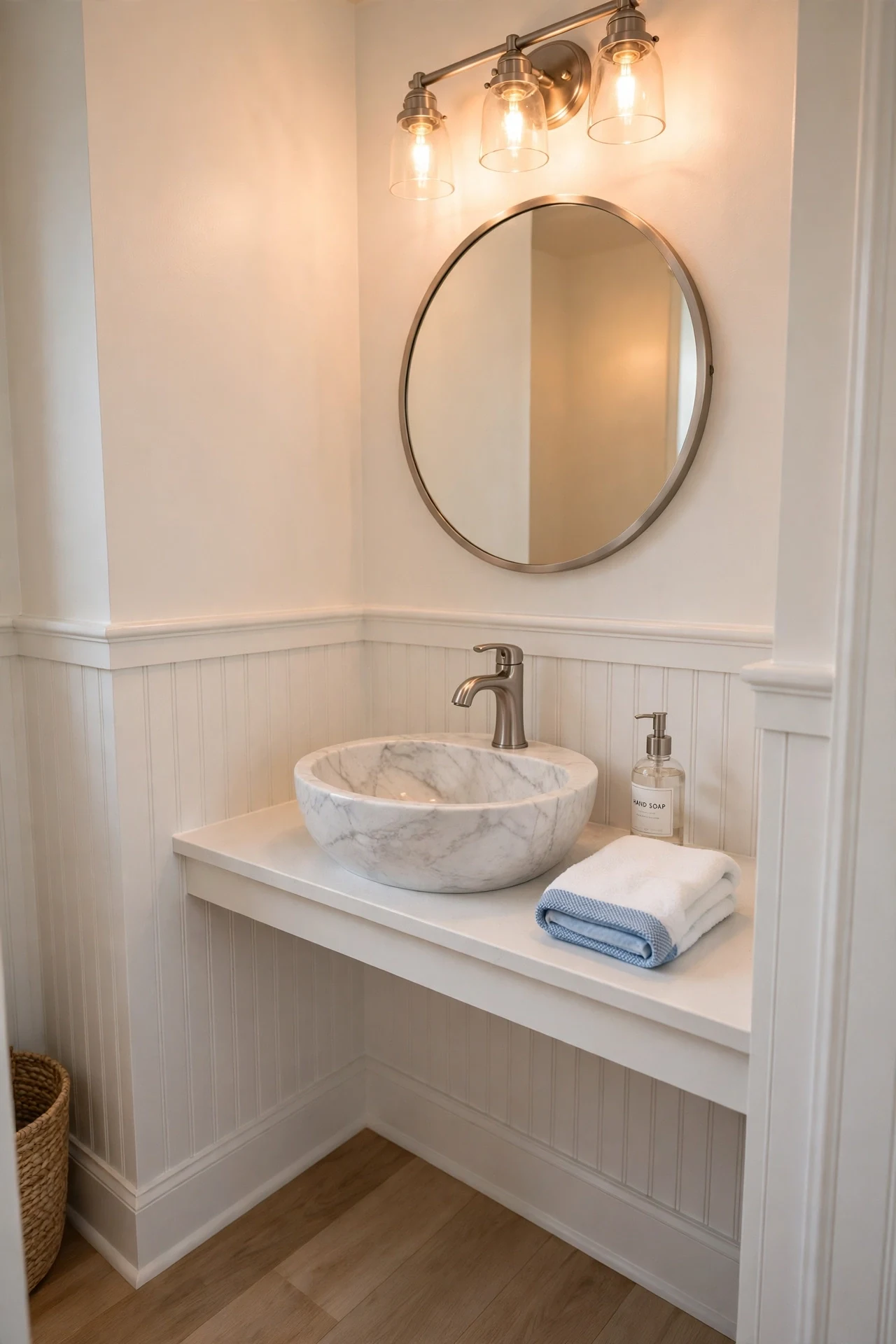
The little room feels tailored and shipshape — every inch considered, nothing wasted.
In a powder room, wainscot is practical armor: the chair-rail band takes the splashes and scuffs that destroy plain drywall behind a sink. Running the beadboard to forty-two inches instead of thirty-six stretches the room vertically, because the taller white band reads as wall rather than trim.
Use moisture-rated PVC beadboard panels — they install like wood but never swell behind the faucet. Paint everything, cap rail included, in a satin white so splashes wipe off, and hang the mirror so its bottom edge clears the rail by four inches.
19. White-on-White Texture Play
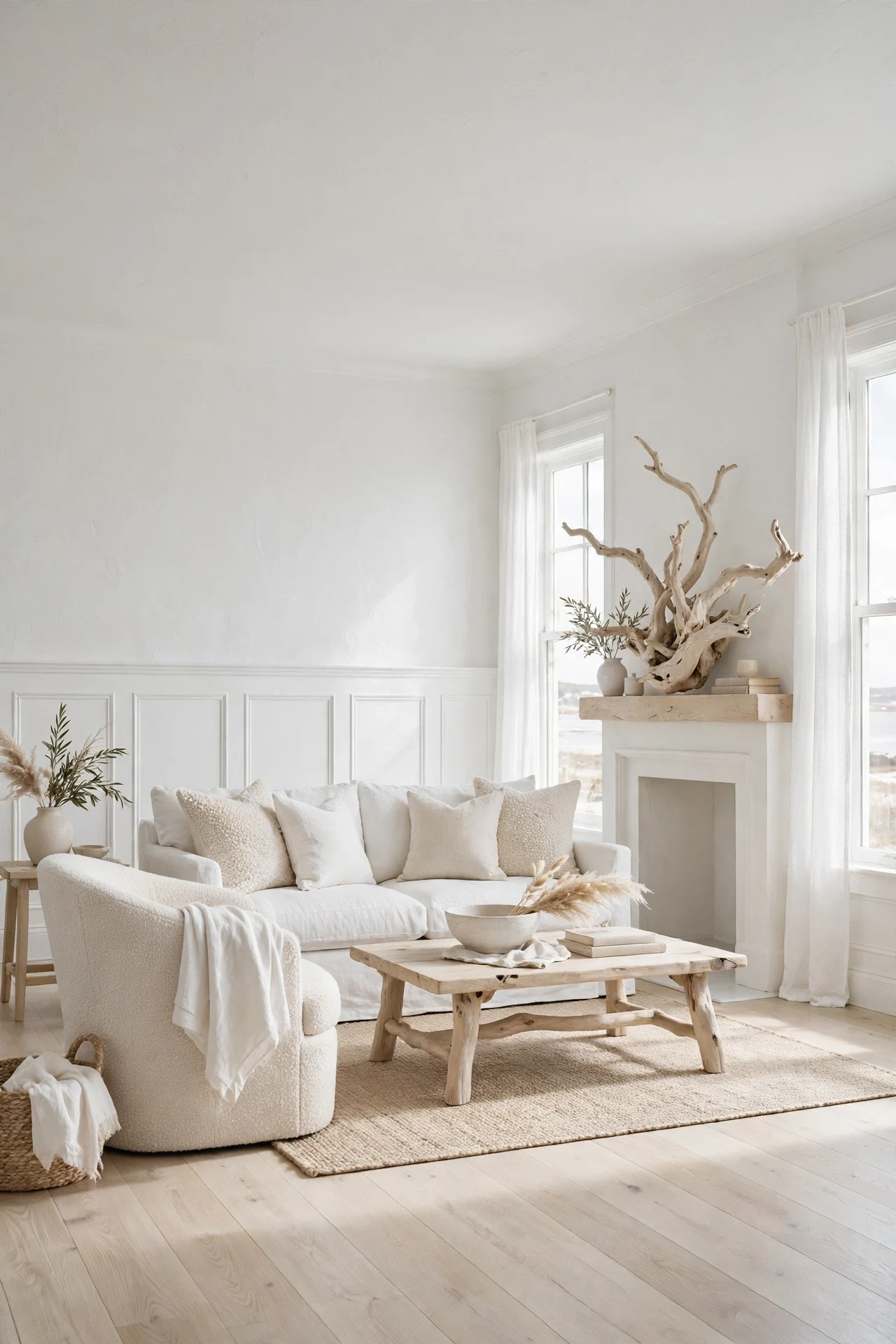
The room feels like morning fog made habitable — soft, silent, edges dissolved.
All-white works only when the whites disagree: matte plaster, satin wainscot, nubby boucle, and bleached oak each reflect light differently, adding depth through sheen instead of color. Without variation, white-on-white collapses into a flat box — texture layering does all the work.
Paint the wainscot in satin and upper walls in flat, both Benjamin Moore White Dove, so the sheen shift draws the division line. Repeat in textiles: matte linen against low-sheen boucle reads as two different whites.
💡 Quick Win: One nubby throw on a smooth sofa adds dimension for under forty dollars.
20. Lantern Pendants Over a Wainscoted Kitchen Island
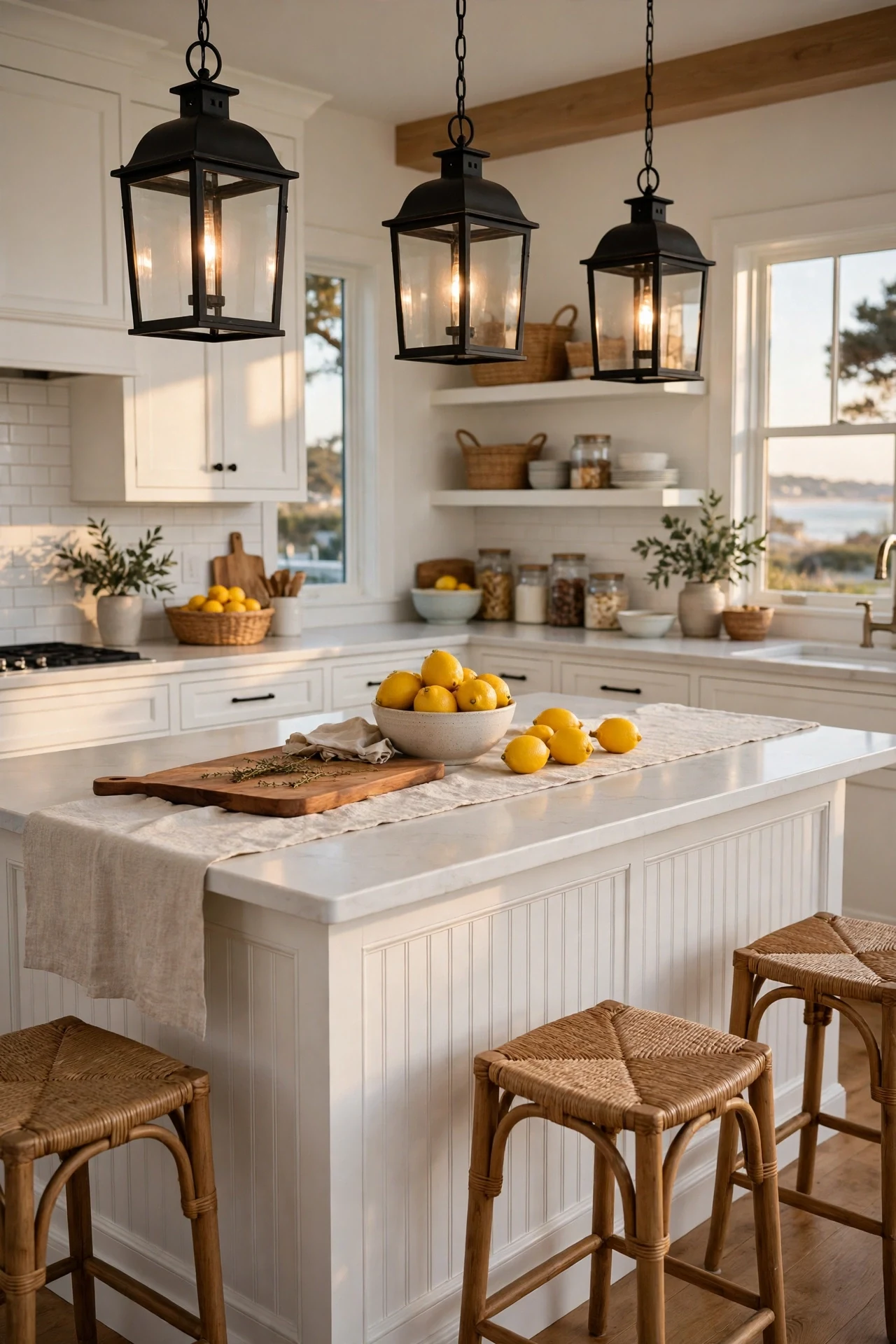
The kitchen hums with the warmth of a harbor at dusk — glowing glass, dark iron, white wood.
Beadboard on the island base turns the kitchen's biggest, plainest surface into a furniture piece, and lantern pendants above repeat its black-white rhythm in metal and glass. Hung at the right height, they pool task light on the counter while glass cages keep sightlines open to the wainscoted walls.
Case the island base with vertical beadboard and hang pendants thirty to thirty-six inches above the counter — lower reads cozy, higher reads airy. Choose seeded glass, which scatters glare into a soft coastal shimmer.
21. Limewashed Cypress Wainscot
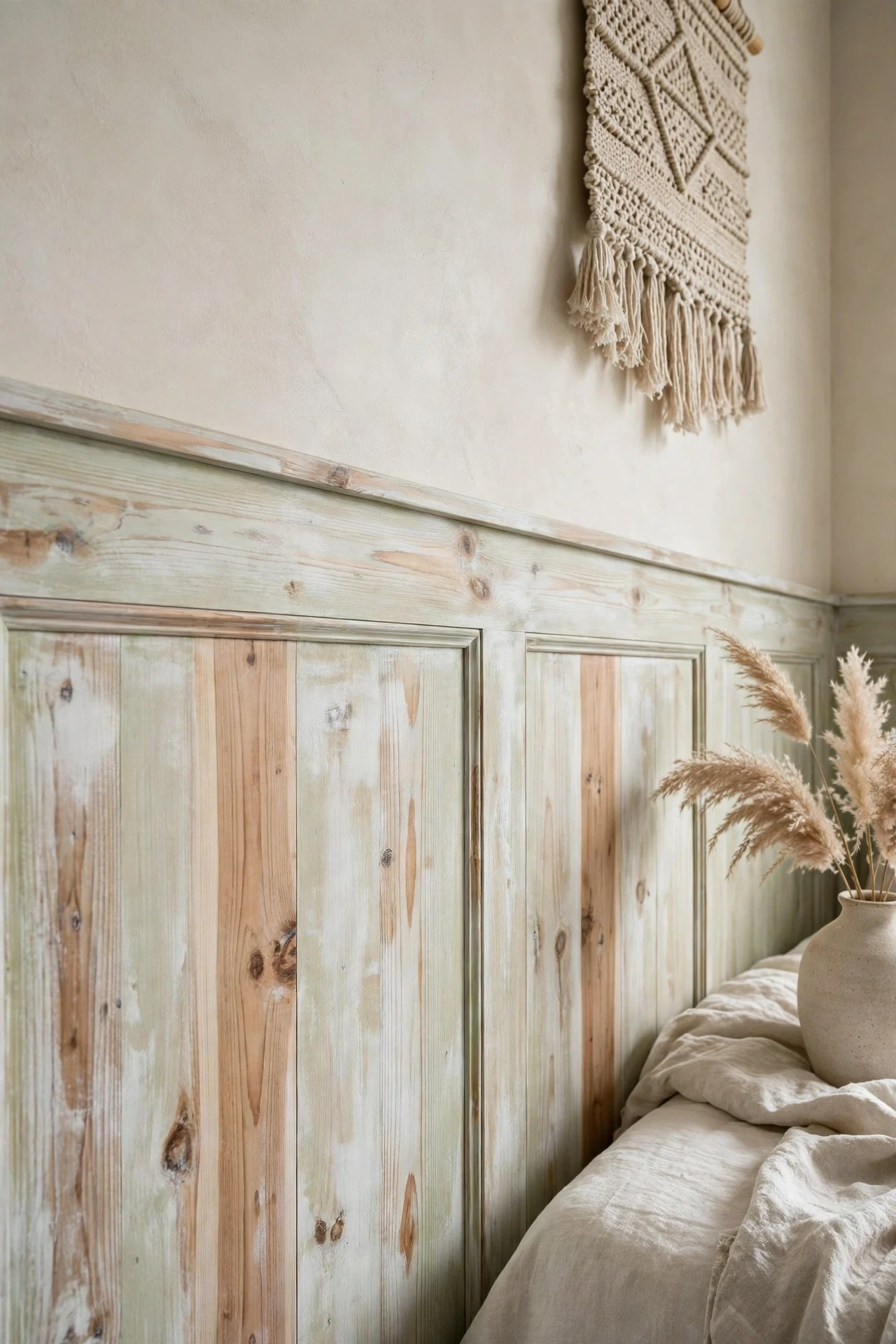
The boards look dredged from another century — cloudy, matte, faintly luminous.
Limewash differs from whitewash in chemistry: crushed limestone reacts with wood tannins into a soft, mottled patina paint cannot imitate. On cypress — naturally resistant to coastal humidity — the result looks centuries old the day it goes up.
Brush on a true limewash such as Portola or Kalklitir in two thin, crisscrossed coats, letting each dry fully so the clouding develops. Mist boards with water before the second coat — damp wood pulls lime into the grain for deeper variation.
💡 Quick Win: Limewash a niche first — small fields show the clouding fastest.
22. Slipcovered Sofa Floating Off a Wainscoted Wall
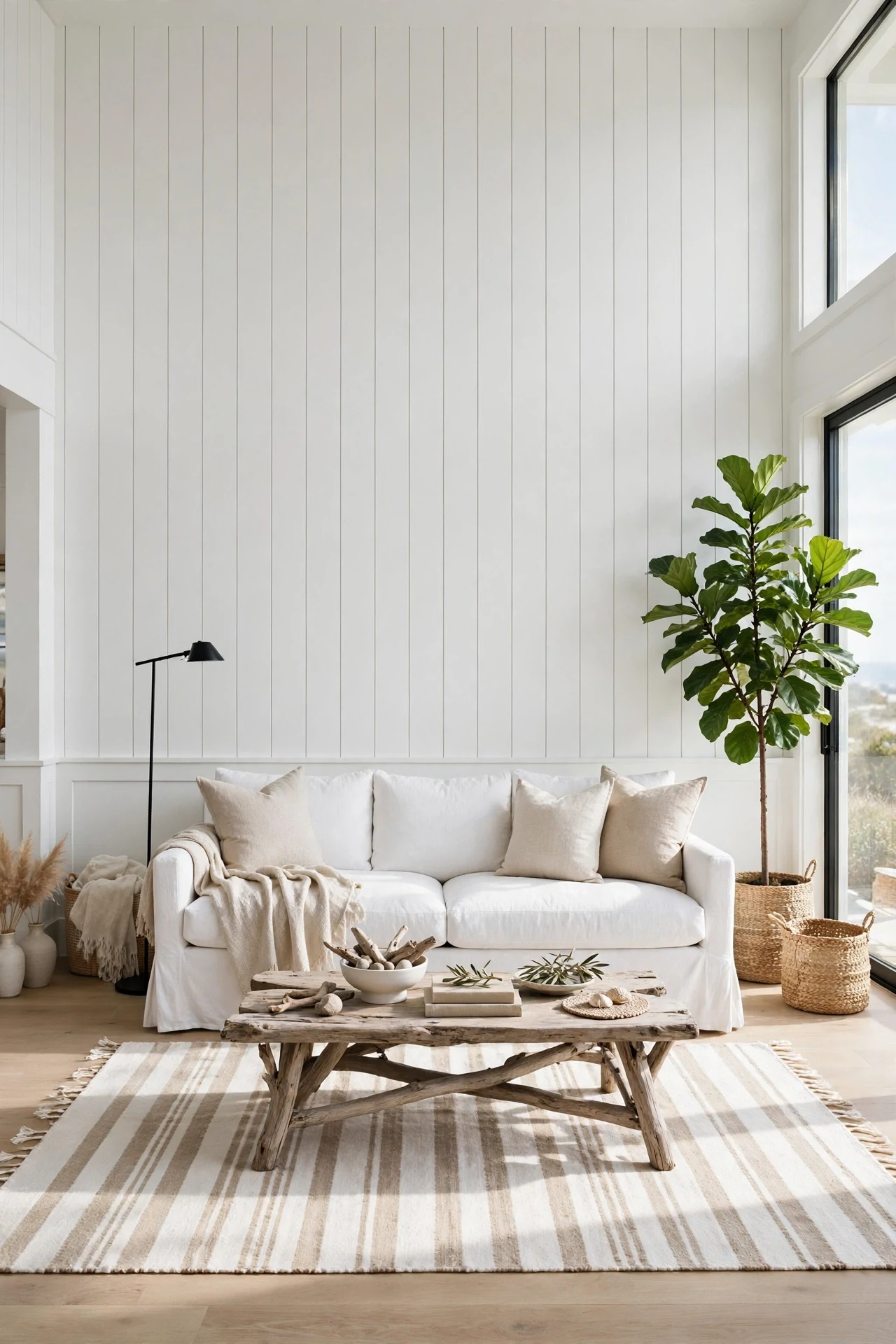
The arrangement feels like a held breath of space — nothing crowded, everything reachable.
Floating the sofa off the wall is a negative-space move: the eighteen-inch gap lets the full shiplap field show, so the wall becomes art instead of a backrest. The slipcover keeps the look washable and relaxed — the coastal contract of beauty that survives sandy feet.
Pull the sofa eighteen inches off the wall, anchored by a rug extending twelve inches beyond each arm. Choose a washable cotton-duck slipcover in natural white, and keep the sofa back under thirty-four inches.
23. Botanical Prints in a Wainscot Gallery Wall

The wall reads like a naturalist's journal — orderly, curious, quietly alive.
A gallery above wainscot gains an alignment line from the chair rail — every frame shares a baseline, so the arrangement looks intentional. Botanical greens echo sea glass and dune grass without introducing a new color.
Hang the grid with the bottom row three inches above the cap rail, keeping a tight two-inch spacing for a collected feel. Use thin black or natural-oak frames with wide cream mats — the mat makes inexpensive prints look gallery-grade.
💡 Quick Win: Drugstore prints in IKEA Ribba frames — a six-print grid under ninety dollars.
24. Wainscoted Reading Nook Under the Stairs
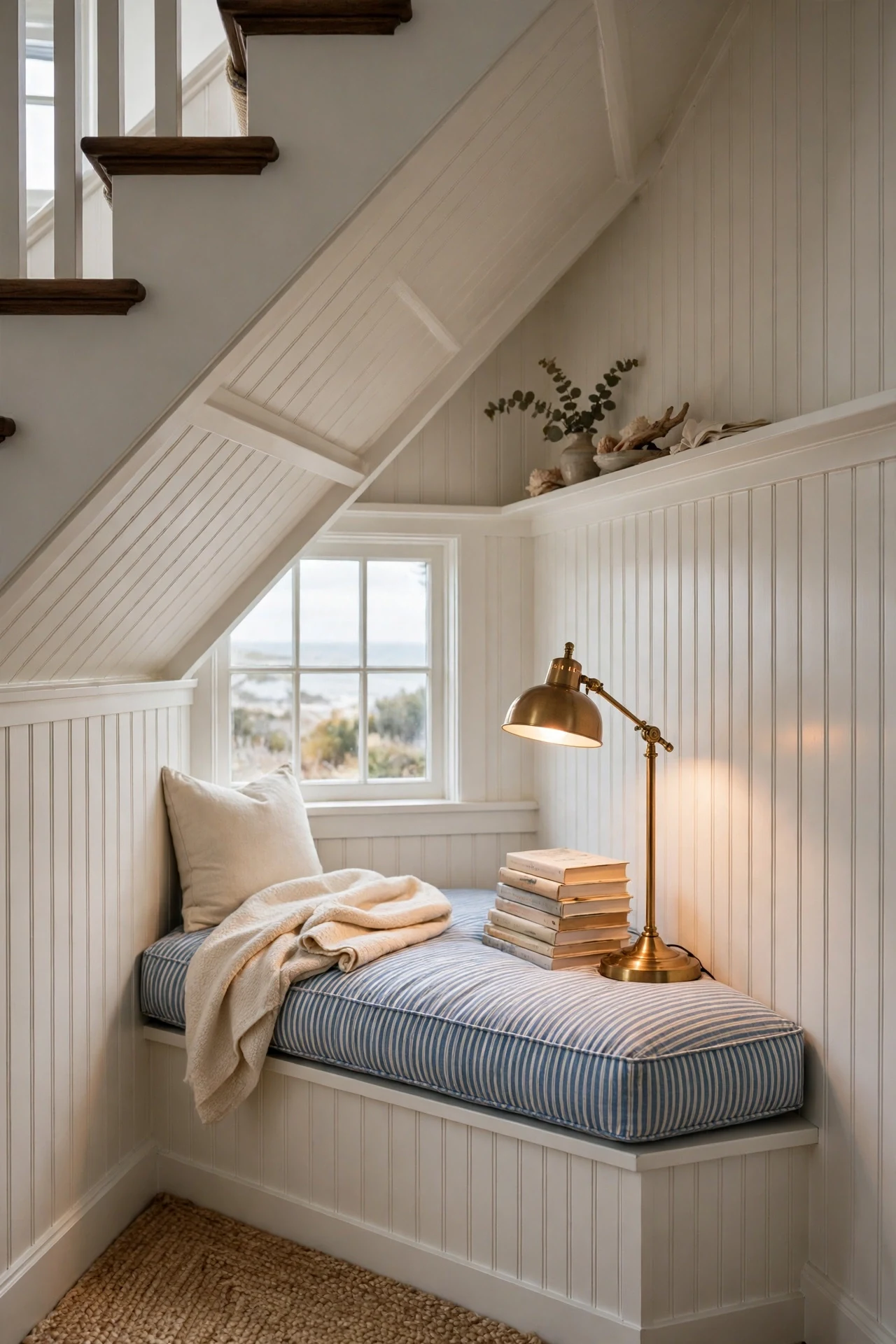
The nook feels like the inside of a boat cabin — snug, wood-lined, entirely yours.
Wrapping beadboard around all three walls turns dead space into a deliberate room, hiding the awkward angles where stringers meet walls. The wainscot's small scale suits the small volume — drywall would feel like leftover space, while paneling feels built.
Run beadboard up the sloped ceiling and finish with cove molding rather than mitering the angle. Build the seat eighteen inches high with a two-inch foam cushion in ticking stripe, and wire a switched brass sconce into the tallest wall.
25. Pale Aqua Wainscot — Favorite Coastal Wainscoting Ideas for Sunrooms
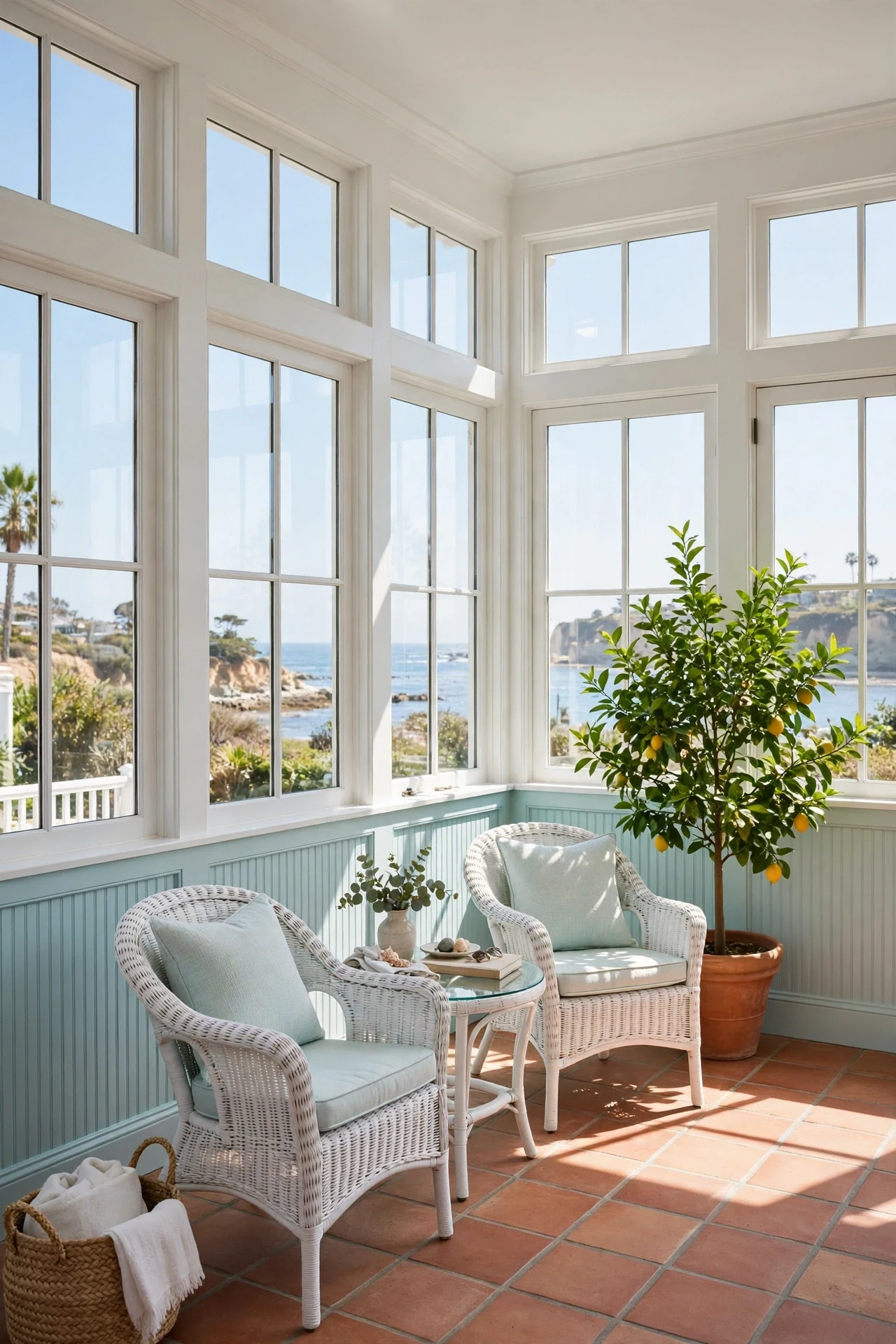
The sunroom shimmers like the inside of a wave — light, water, air in equal measure.
Pale aqua belongs in the brightest room, where strong daylight keeps it reading fresh rather than nursery-sweet. The wainscot band solves the sunroom's glass problem: where walls become windows, aqua panels give the room a solid base for furniture.
Paint the wainscot Benjamin Moore Wythe Blue or Sherwin-Williams Rainwashed in satin, carrying the same aqua onto the window sills. Keep mullions, ceiling, and trim in bright white so the aqua reads as an intentional band.
💡 Quick Win: Paint only the sunroom's wainscot aqua — one gallon usually covers it.
26. Shiplap Ceiling Paired with Wainscoted Walls
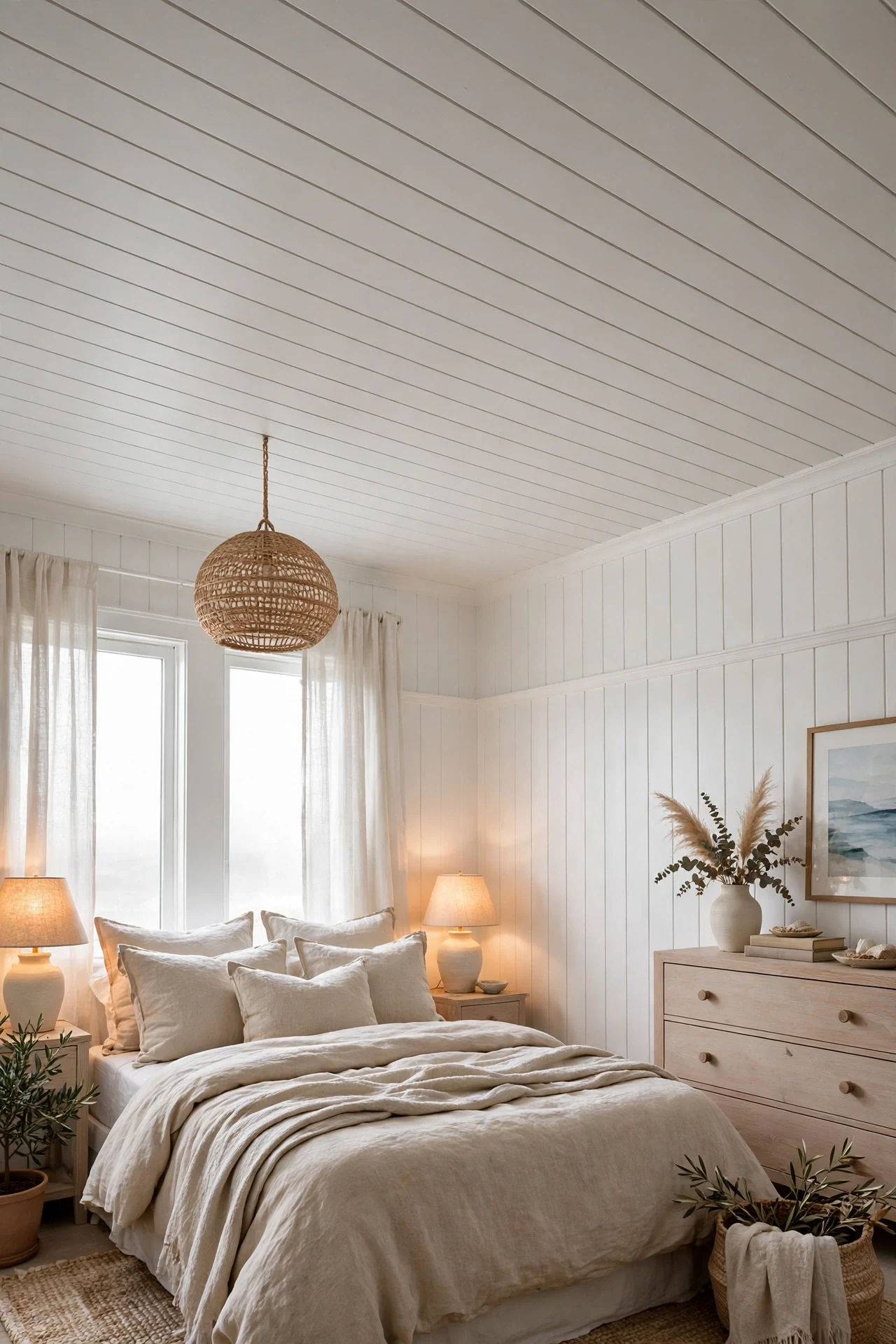
The room feels like the inside of a sail — wrapped, billowing, quietly held.
Ceiling boards perpendicular to wall boards create a woven, basket-like envelope that makes a plain box bedroom feel architecturally considered. The directional change matters: parallel boards would blur into one surface, but the crosshatch adds tailored precision to the room's geometry.
Install ceiling shiplap first, boards running across the narrow dimension to widen the room visually, then case the wall wainscot up to a simple 1×4 crown. Paint ceiling and walls the same white — flat above, satin below — so light plays differently across the two planes.
27. Hurricane Lamps on a Deep Wainscot Ledge
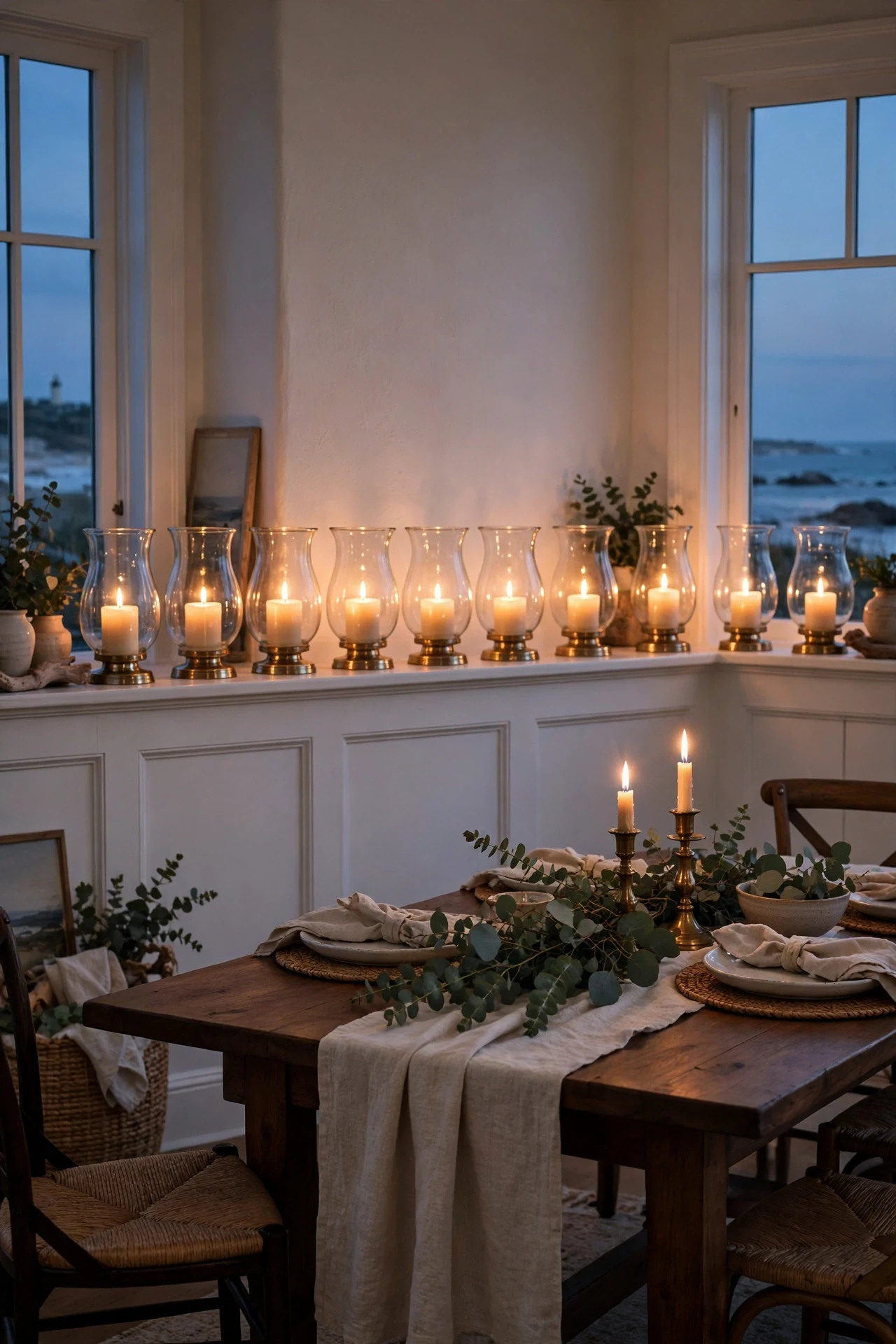
Dinner happens by a row of small lighthouses — each flame doubled in glass.
A deep wainscot ledge is the safest candle display: glass hurricanes sit far from linens, and white paneling reflects every flame into a doubled glow. The flicker animates the grooves, turning a static wall into something that breathes with the evening.
Specify the cap ledge at four inches deep with flameless LED pillars inside real glass hurricanes — authentic refraction, none of the soot. Space hurricanes eighteen inches apart, varying heights by three inches for rhythm.
💡 Quick Win: Three hurricanes with timer LEDs light themselves every evening.
28. Driftwood-Finish Nightstands Against a Wainscoted Bed Wall
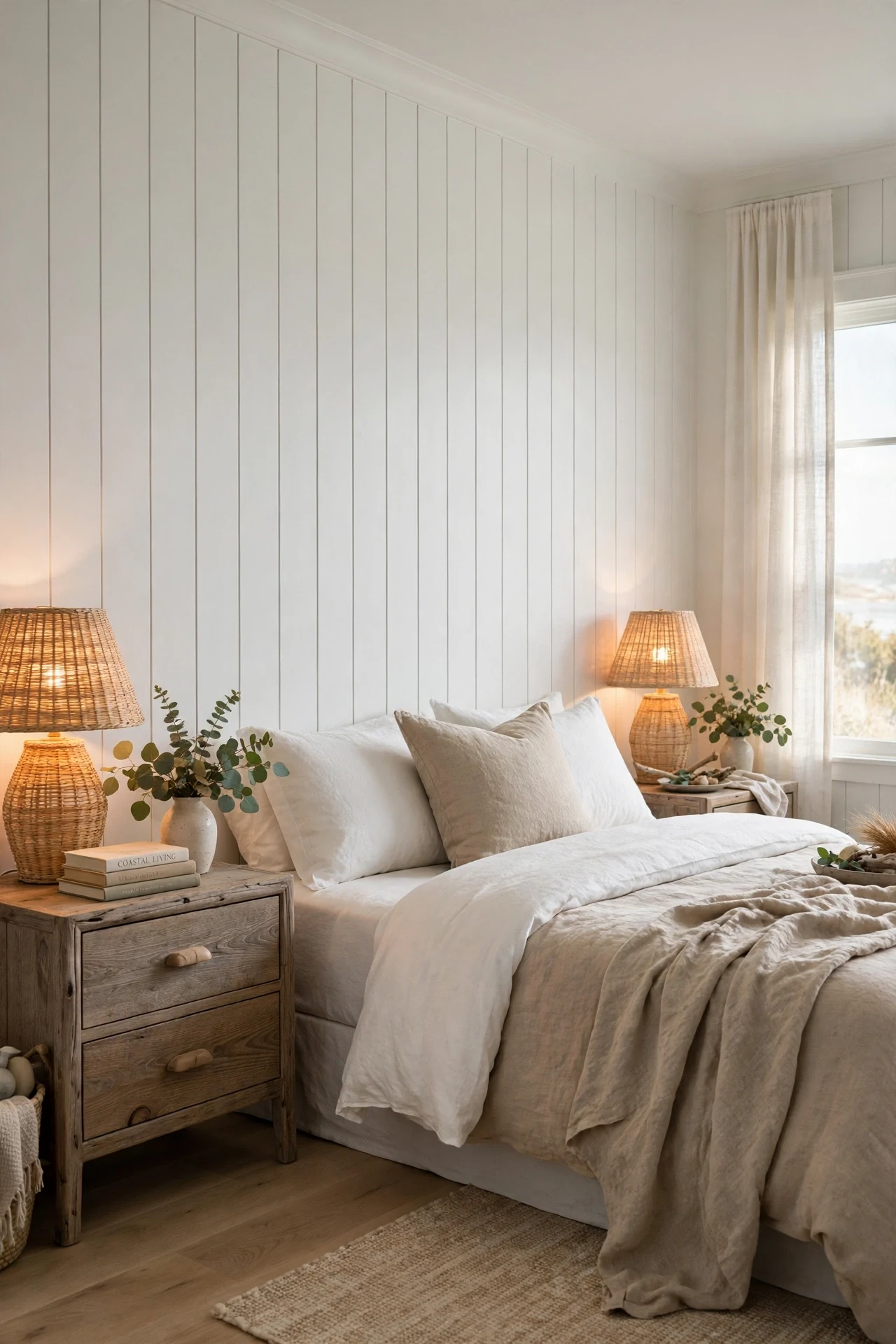
The bed wall feels like a headboard the size of the room — sheltering, simple, complete.
Running wainscot floor-to-ceiling behind the bed replaces the headboard entirely, which is a scale trick: the tall paneled field makes the bed look custom-built into the architecture rather than pushed against a wall. The driftwood nightstands then provide the warm, aged counterpoint that keeps the tall white field from feeling stark.
Install the shiplap wall first, then stain solid-oak nightstands with a driftwood finish. Keep the nightstands at twenty-four inches high — two inches below the mattress top — so lamps land at the right reading height.
29. Woven Basket Gallery on White Beadboard
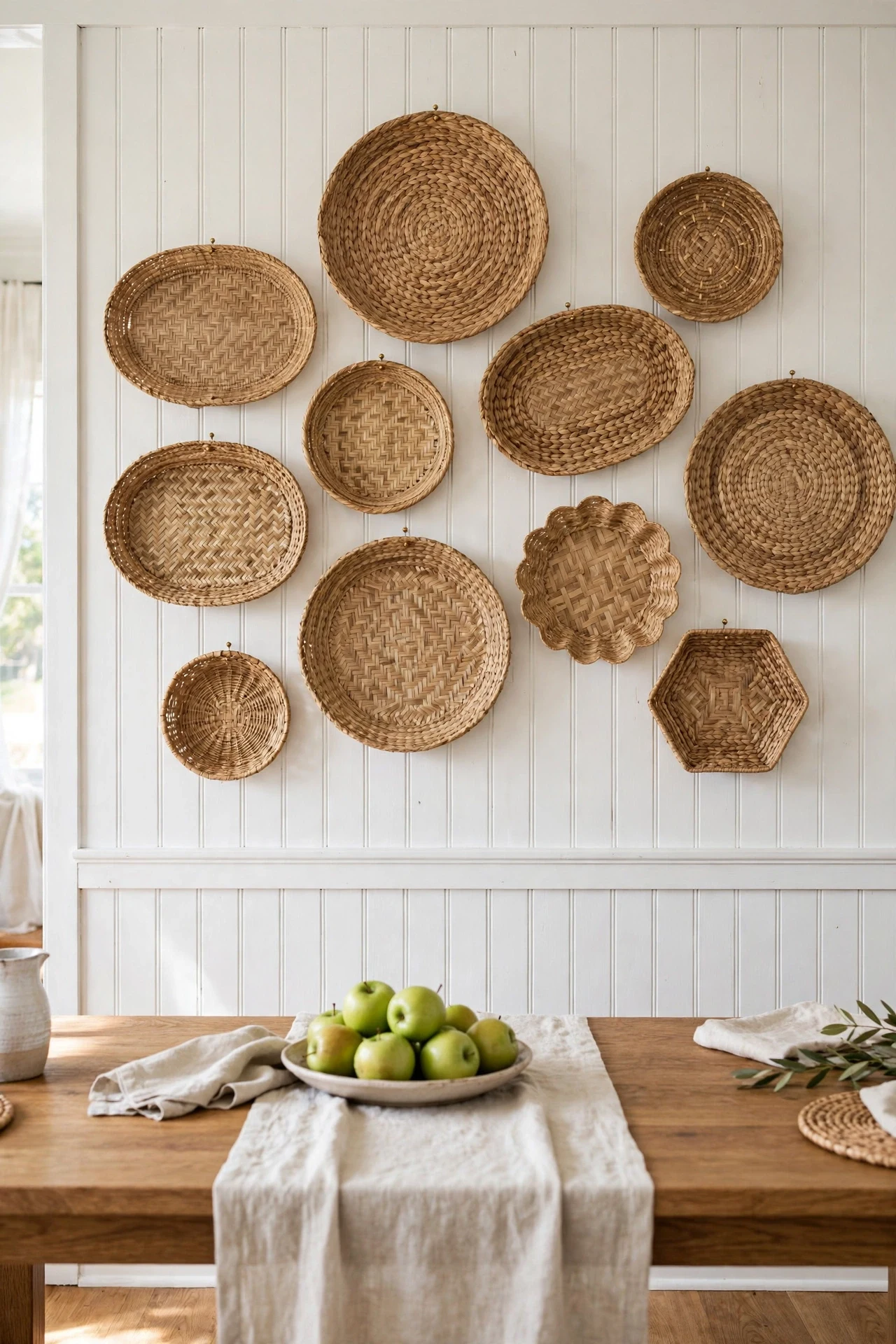
The wall wears its craft proudly — every basket a fingerprint, no two weaves alike.
Flat-back baskets hang flush on beadboard where framed art needs constant leveling, and their round forms break the wainscot's verticality with soft circles. Natural fibers pull warm tones up the wall, balancing all that white at eye level.
Collect flat-back baskets in three sizes and hang on small brass nails driven into the beadboard's stiles — the solid framing, not the thin panel faces. Arrange the largest slightly off-center, orbiting smaller ones around it with two-inch gaps.
💡 Quick Win: Thrifted flat baskets — a nine-basket gallery costs less than one framed print.
30. Wainscoted Breakfast Nook in a Kitchen Corner
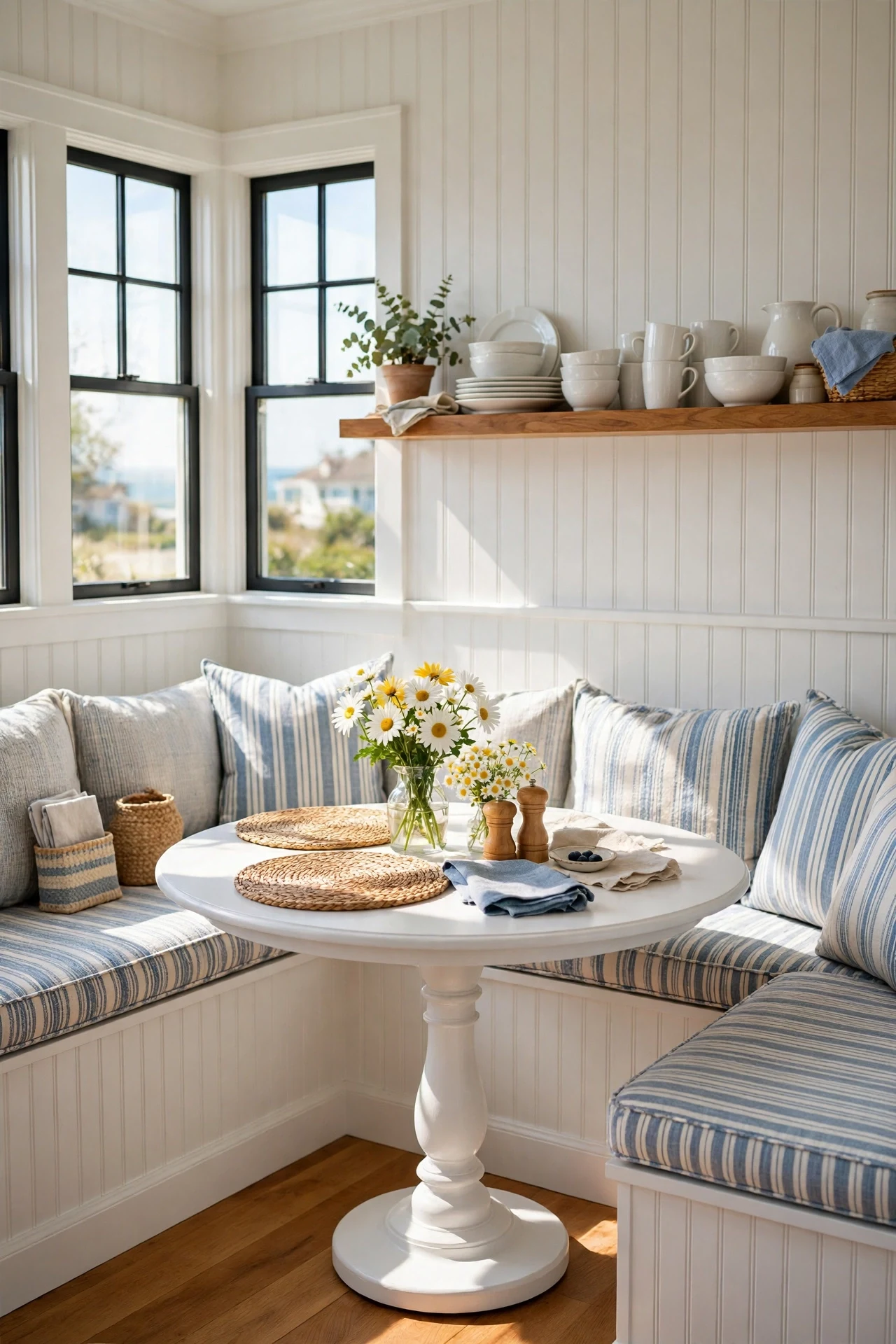
Mornings here start with elbows on the table and sunlight on the beadboard — unhurried by design.
An L-shaped banquette seats four where a table and chairs would barely seat two, because benches need no pull-out clearance. Wrapping the banquette base in matching beadboard makes the nook read as built-in architecture, visually enlarging a small kitchen.
Build the plywood banquette base eighteen inches high and case its face with matching beadboard. Top with a three-inch foam cushion in washable chambray stripe, and overlap the pedestal table edge two inches over the bench for knee room.
31. Veranda Wainscot for Indoor-Outdoor Flow

The veranda dissolves the wall between house and horizon — inside comfort, outside air.
Carrying wainscot onto the veranda is a continuity move: matching paneling makes the eye read one connected space instead of house-plus-addition. Exterior-grade PVC makes it practical — it shrugs off rain, humidity, and salt spray that would destroy wood in a season.
Use cellular PVC beadboard rated for exterior use, installed over rain-screen furring strips so air circulates behind. Paint with exterior acrylic in White Dove and caulk joints with elastomeric sealant for thermal movement.
💡 Quick Win: Wainscot just the knee wall — a four-foot band transforms the veranda cheaply.
32. Whitewashed Cypress in a Steam-Safe Bathroom
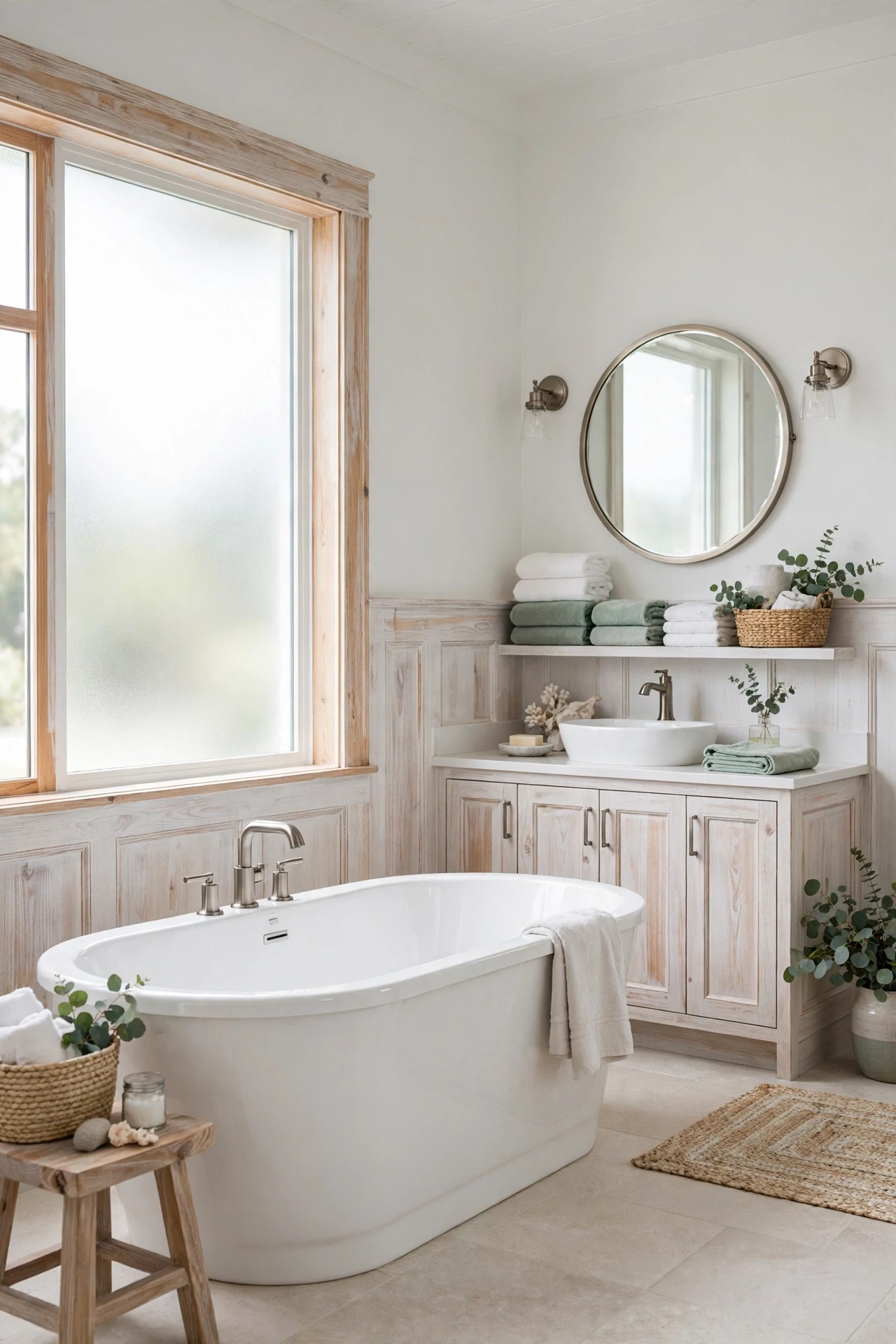
The bath feels like a private cove — steamy, hushed, lined in pale wood.
Cypress suits wet rooms because its natural oils resist rot without chemical treatment, and a whitewash keeps it light enough for a small bath. Below the chair rail, wainscot takes the daily splash zone; above, subway tile handles steam — each material matched to its moisture level.
Seal clear cypress beadboard on all six sides with marine-grade spar varnish before installation — moisture attacks from behind. Run the wainscot to forty-two inches and transition to tile with a slim marble pencil rail.
How to Start Your Coastal Wainscoting Transformation
Start with paint. Benjamin Moore White Dove OC-17 in satin is the tonal foundation of nearly every coastal wainscot here — brush it over existing trim and one paneled wall, and everything you add afterwards feels intentional. White Dove's warm undertone keeps white wainscot from reading blue or sterile in coastal daylight.
The most common mistake is the wrong groove scale — wide 3-inch beads in a powder room read chunky, while tight 1.5-inch beads disappear in a grand living room. Match bead width to room volume: 1.5-inch grooves for rooms under 120 square feet, wider V-groove boards for open plans.
Three items under fifty dollars: a quart of Sherwin-Williams Sea Salt SW 6204 for one accent wainscot wall, a coiled manila rope to frame a mirror you own, and three flameless LED pillar candles for a chair-rail ledge.
One accent wall takes a weekend and two to four hundred dollars in pre-primed MDF panels and paint. A full room in real wood runs two to four weekends and fifteen hundred to four thousand dollars. Paint on a dry weekend — humidity slows satin cure times — and save the veranda or bathroom for last.
Frequently Asked Questions About Coastal Wainscoting Ideas
What is the difference between coastal wainscoting and farmhouse wainscoting?
Coastal wainscoting is lighter, airier, and maritime in reference — think whitewashed pine, vertical shiplap, seafoam and sand tones, and rattan or linen pairings. Farmhouse wainscoting leans rustic and work-worn: rough-sawn boards, black hardware, plaid textiles, and a heavier, grounded feel. The practical difference shows in the finish: coastal paneling is usually painted or whitewashed in pale tones to bounce light, while farmhouse often celebrates raw or dark-stained wood. Both use beadboard and board-and-batten profiles, but the color palette and styling decide which story the wall tells.
What paint colors work best for coastal wainscoting?
Start with a warm white such as Benjamin Moore White Dove OC-17 or Sherwin-Williams Alabaster SW 7008 — warm undertones keep coastal whites from reading cold or blue. For color, the classics are Sherwin-Williams Sea Salt SW 6204, Benjamin Moore Wythe Blue, and Farrow & Ball Skylight, all of which sit between green and blue like shallow water. Warm sand tones such as Manchester Tan ground the palette, and one soft navy — Hale Navy or Stiffkey Blue — adds depth as an accent. Always sample on the actual wainscot boards, because grooves catch shadow and paint reads a half-shade darker once installed.
Is coastal wainscoting expensive to install?
It scales to nearly any budget. Pre-primed MDF beadboard panels run about one to two dollars per square foot, so a single DIY accent wall typically costs two to four hundred dollars including paint and trim. Real wood — pine, cypress, or fir — pushes a full room to fifteen hundred to four thousand dollars, and hiring a carpenter roughly doubles material costs. The budget lever most people miss is scope: wainscoting one wall, a nook, or a hallway delivers most of the style for a fraction of a whole-room job.
Can I mix coastal wainscoting with other design styles?
Yes, and it blends especially well with styles that share its love of natural texture. Scandinavian rooms accept coastal wainscot easily — both favor pale woods, white walls, and uncluttered surfaces. Traditional interiors work too, since wainscot is a classic millwork form; just keep the styling tailored rather than beachy. The combinations to handle carefully are industrial and ultra-modern minimalism, where the cottage texture can feel out of place — in those rooms, keep the wainscot flat-paneled and color-matched to the walls so it reads as architecture, not decoration.
What lighting works best with coastal wainscoting?
Raking light is the secret — fixtures that wash across the boards at an angle so every groove casts a soft shadow. Brass sconces mounted on the chair rail, picture lights over a hallway gallery, and lantern pendants with seeded glass all do this well. In daylight, sheer linen panels turn windows into giant softboxes that make white wainscot glow rather than glare. Avoid recessed downlights aimed straight at paneled walls; the flat top-down light erases the very texture you installed the wainscot to create.
Ready to Create Your Dream Coastal Wainscoting Space?
These 32 coastal wainscoting ideas span color, materials, lighting, furniture, accessories, and layout — from a single painted chair rail to a full veranda wrapped in exterior PVC. You do not need to do it all at once; the best coastal rooms were layered over seasons, and starting with one wall is exactly how the best ones began. This weekend, pull one natural texture into your home — a jute runner, a rope-framed mirror, a quart of seafoam paint — and watch how the room's whole temperature changes. When it is done, the space will feel the way the shoreline does: unhurried, sun-washed, and quietly certain of itself. Pin the ideas that made your shoulders drop, and come back to this list when the next project calls.