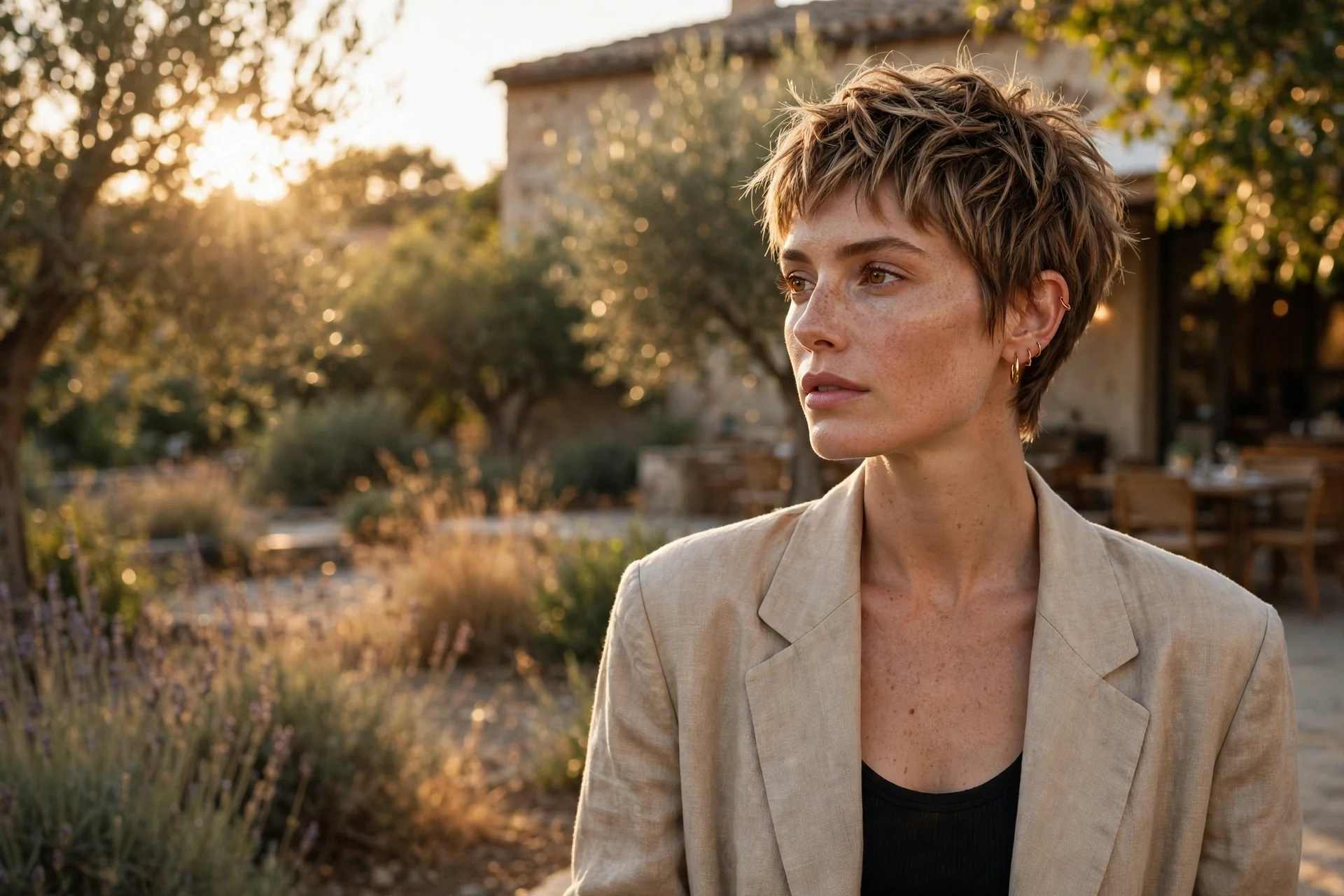
A feminine textured pixie cut is a short style where deliberate surface irregularity — created through point cutting, razor slicing, disconnection, or the natural expression of wave and curl — is the defining aesthetic rather than smooth, flat precision. This article gives you exactly 28 variations: from choppy piece-y crops and lived-in shag pixies to defined curl textures and sea-salt-finish styles, with image prompts, technique notes, product picks, and tips for every one.
Texture in a pixie cut is the element that makes a short crop feel alive rather than architectural — it introduces movement, visual depth, and an organic quality that the perfectly smooth, sleek pixie simply doesn't have. Feminine textured pixie cuts are the opposite of a low-effort compromise; they require skilled cutting to achieve and reward that skill with a result that looks simultaneously casual and completely considered. Here are 28 ideas worth saving — and showing your stylist.
Why Feminine Textured Pixie Cuts Work So Well
Texture in short haircuts became a deliberate technical practice in the 1970s as razor cutting introduced alternatives to the blunt scissors precision of the Sassoon era. Point cutting, channel cutting, and razor slicing each produce different surface characteristics — irregular tips, feathered ends, or stripped lengths — and the combination of these techniques at pixie length creates the visual depth that the "textured pixie" category encompasses. What distinguishes a textured pixie from a standard short crop is intentionality: the texture is built into the cut rather than being a byproduct of growth, with each technical decision contributing to a specific textural outcome.
The three primary techniques for textured pixie cuts are: point cutting (scissors angled upward into the ends at 45 degrees, creating irregular tips), razor cutting (a straight razor sliced along the hair shaft, producing feathered, wispy ends), and slide cutting (scissors slid along the hair shaft at an angle, tapering the mid-length and ends). Each produces a different texture character — point cutting creates defined, separated pieces; razor cutting creates airy, movement-forward ends; slide cutting creates tapered, blended texture that flows rather than separates. Most textured pixie cuts combine at least two of these. For finishing, a matte clay, sea salt spray, or texture paste are the standard products — shine-forward products like pomade or serum counteract the texture by sealing the irregular surface flat.
Textured pixie cuts are the dominant direction in short hair design right now, having overtaken the perfectly sleek, sculpted pixies of the 2010s. The current cultural preference for "lived-in" aesthetics — visible in the popularity of shag cuts, curtain bangs, and effortless styling across all hair lengths — has driven a significant shift toward textured short cuts that look stylish without looking styled. Social media platforms reward these cuts because they photograph variably: from different angles and in different light, the texture produces different visual readings.
Textured pixie cuts work across all hair textures but require texture-appropriate techniques. On straight hair, the texture must be cut in — point cutting, razor slicing, and products create it where the hair wouldn't naturally provide it. On wavy hair, the cut works with the existing wave to amplify its natural texture. On curly and coily hair, the curl's own surface character is the texture — the cut's job is to shape and proportion it rather than manufacture it. Fine hair benefits from razor and point cutting because the feathered ends create apparent density. Thick hair benefits from slide cutting and internal thinning to manage bulk while preserving surface texture.
| Element | Cut-In Texture | Natural Texture |
|---|---|---|
| Philosophy | Manufacture texture on straight/fine hair | Amplify and shape existing wave/curl |
| Technique | Point cut, razor, slide cut, matte clay | Graduated layers, mousse or sea salt |
| Best for | Straight, fine, medium hair | Wavy, curly, coily hair |
28 Feminine Textured Pixie Cuts
1. Piece-y Matte Crop
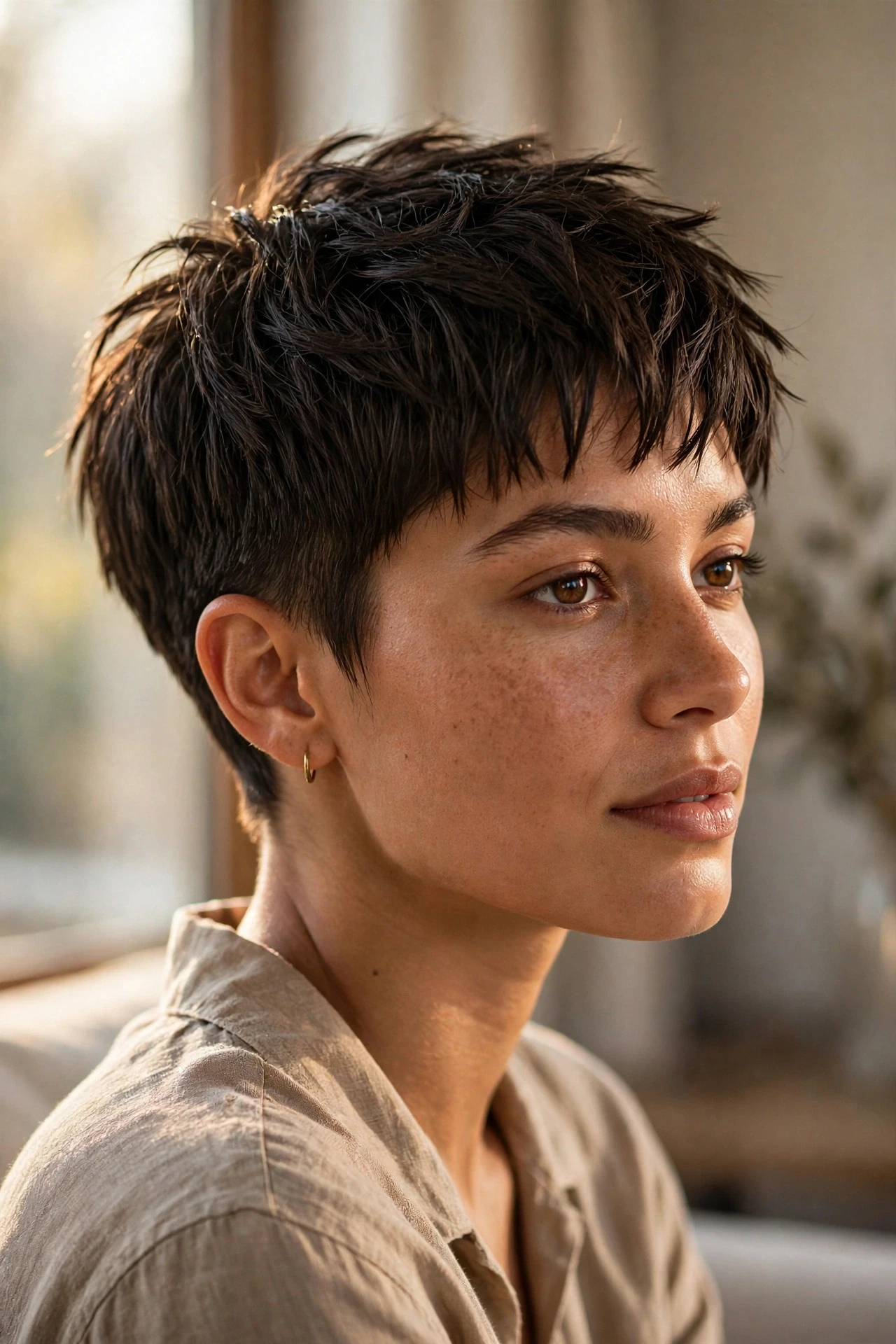
Vibe: Modern — piece-y texture is the most deliberately casual of all the textured pixie finishes, and on the right cut it reads as a considered choice.
A piece-y matte crop uses point-cutting throughout to create irregular, individually visible strand tips that separate naturally when finished with a matte clay. The technical principle is removing the blunt edge from the cut so each group of hairs ends at a different length — the irregular tips catch light from different angles and create the visible separation. Matte clay is the essential finishing product: applied to dry fingers and worked through the crown in a pinching-and-separating motion rather than combed or brushed through.
Ask for "a piece-y crop with point-cut ends throughout — I want visible separation, matte finish." Apply a pea-sized matte clay to dry fingertips, pinch small sections of the crown and separate, working from front to back.
💡 Quick Win: Day-2 piece-y texture is actually better than day-1 — a light mist of water to the roots, a quick fingertip scrunch to re-activate the clay residue, and 60 seconds of low-heat diffusing or finger-drying resets the texture more naturally than a fresh application.
Shop The Look
| Product | Type |
|---|---|
| Matte styling clay medium-strong hold | Styling |
| Texturising dry spray for re-activation | Styling |
| Sulphate-free daily shampoo | Haircare |
| Point-cut thinning scissors | Tool |
| Diffuser for texture setting | Tool |
2. Sea Salt Texture Pixie
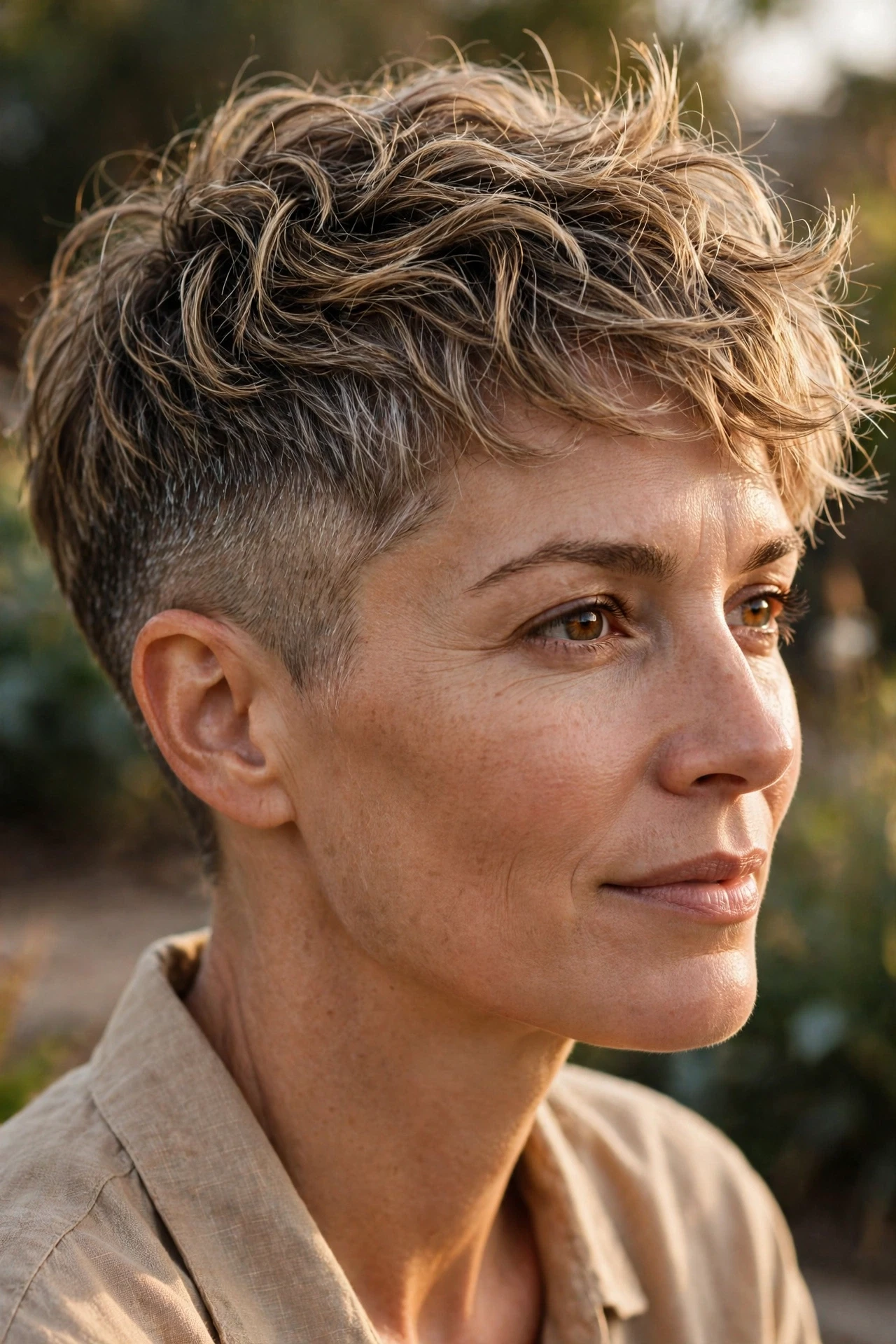
Vibe: Natural — sea salt texture on a pixie is the version that looks like the style found you rather than the other way around.
Sea salt spray on a pixie cut works by depositing sodium chloride and often magnesium sulfate onto the hair shaft, creating a roughened surface texture that mimics the effect of ocean water. Applied to damp hair before drying, it produces a tousled, natural movement that is particularly effective on straight-to-wavy hair where natural texture needs encouragement. The cut must have sufficient graduation and point-cut ends for the sea salt to have irregularities to amplify — a blunt-cut smooth crop will produce a frizzy result rather than a textured one.
Ask for "a pixie that works with sea salt spray — graduated layers and point-cut ends, I want it to air dry well with texture." Apply sea salt spray to damp hair, scrunch once, and air dry or rough-dry with fingers on medium heat.
Shop The Look
| Product | Type |
|---|---|
| Sea salt texturising spray | Styling |
| Lightweight curl-enhancing serum | Styling |
| Anti-frizz finishing mist | Styling |
| Moisturising daily conditioner | Haircare |
| Microfibre towel for gentle drying | Accessory |
3. Razor-Cut Textured Pixie
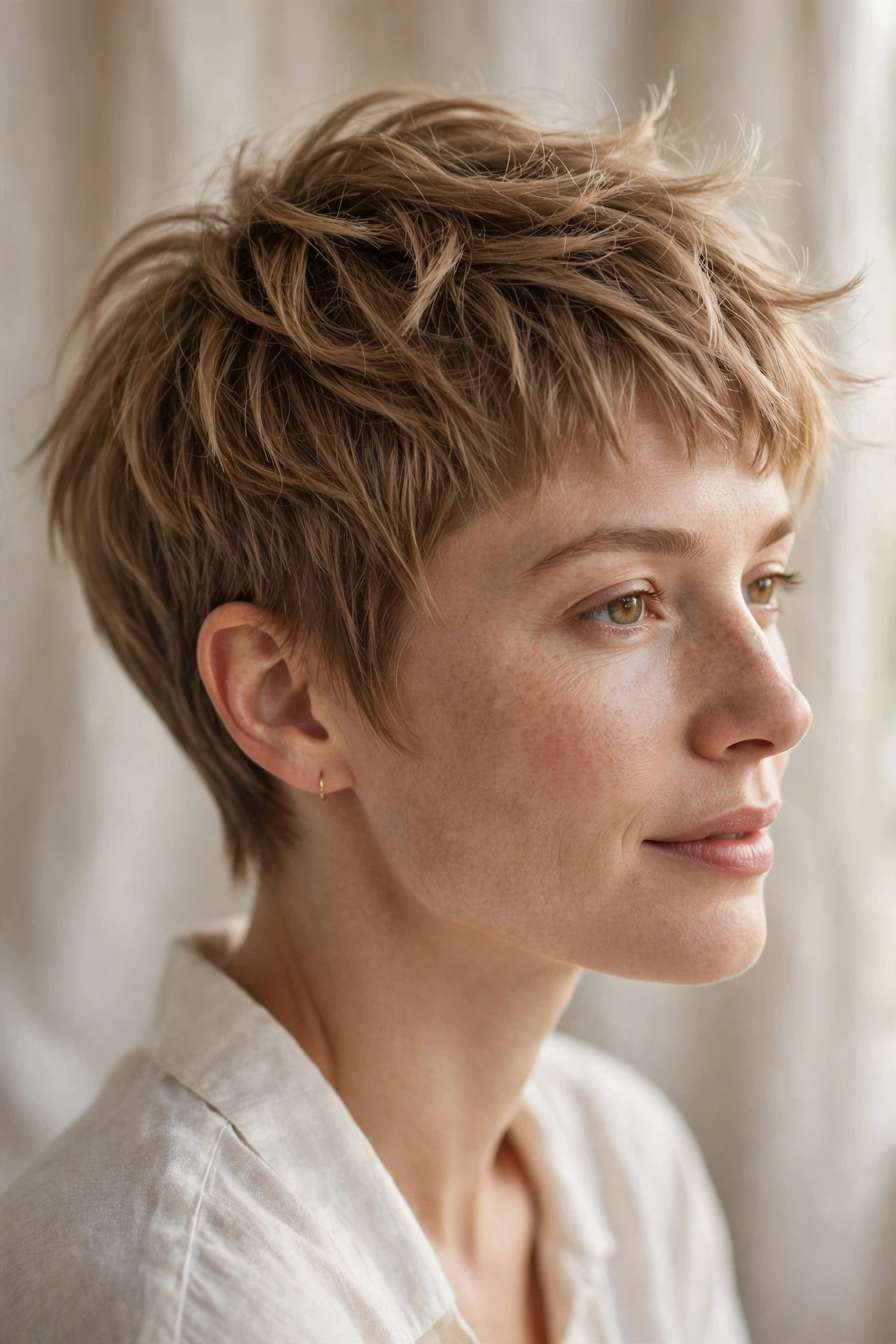
Vibe: Airy — razor-cut ends on fine hair produce a lightness that scissors can't replicate.
Razor-cutting on a pixie creates feathered, tapered tips at the ends of each hair section — the razor slices through at a near-parallel angle, removing the blunt edge and creating multiple fine tips that catch light separately. On fine hair specifically, this technique creates the appearance of significantly more hair because the multiple tips multiply the visual density at the perimeter of the cut. The razor technique requires damp (not soaking wet) hair and a sharp professional straight razor.
Ask for "a razor-cut pixie — feathered ends throughout, I want the tips to be wispy, not blunt." Apply a lightweight thermal serum to damp hair before any heat styling to protect the razor-cut tips.
Shop The Look
| Product | Type |
|---|---|
| Lightweight thermal serum | Styling |
| Small round brush for razor-end definition | Tool |
| Volumising mousse fine hair | Styling |
| Sulphate-free moisturising shampoo | Haircare |
| Featherweight finishing mist | Styling |
4. Shaggy Textured Pixie
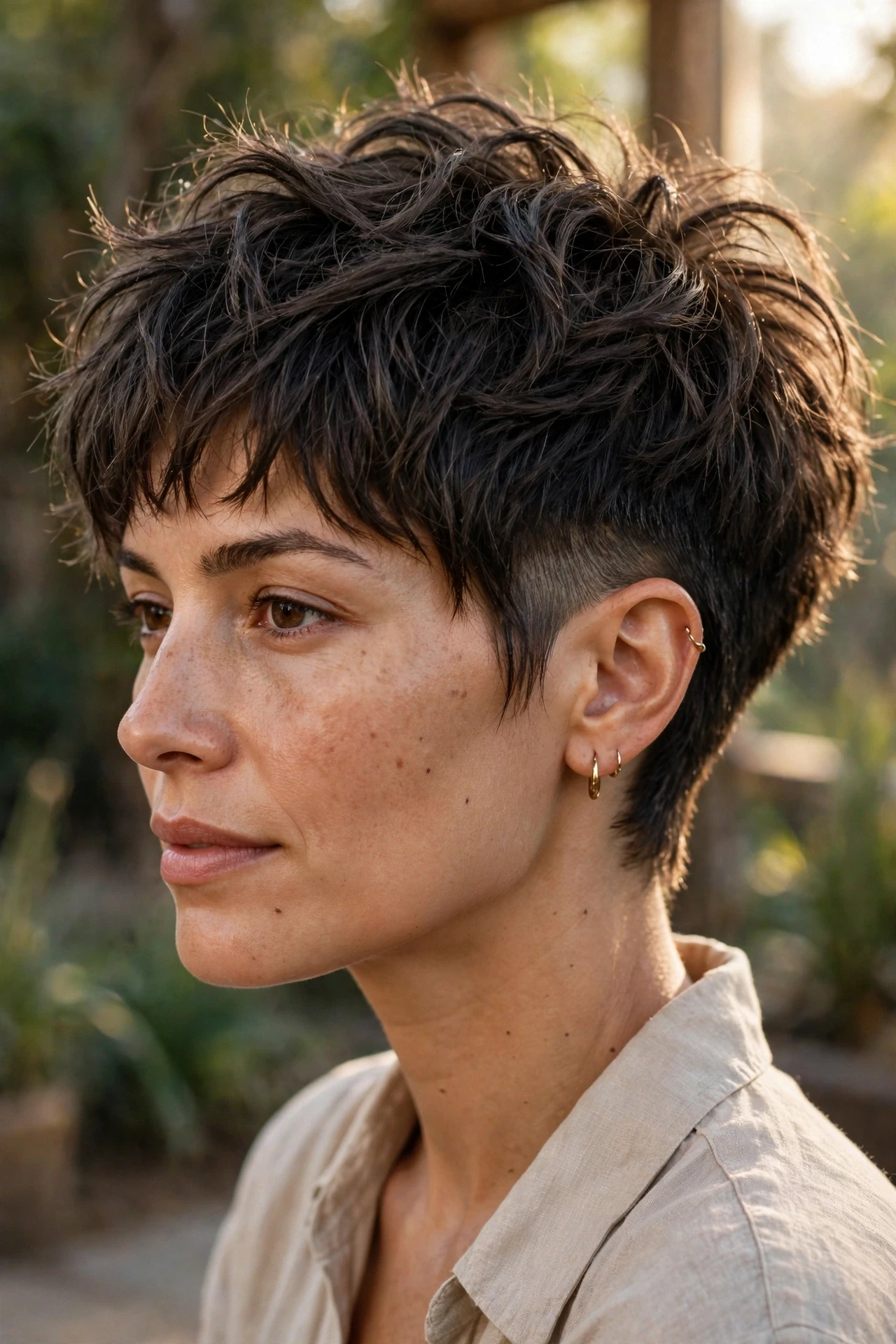
Vibe: Lived-in — the shaggy textured pixie is the embodiment of the current "I woke up like this, but intentionally" aesthetic.
A shaggy textured pixie uses a combination of layering, point cutting, and razor slicing throughout the crown to create visible choppy layers with significant depth. The shag's characteristic quality is visual layering — the eye can read multiple distinct layers of texture rather than a single-surface cut. Close fade or taper sides create the structural contrast against the expressive, layered crown. Sea salt spray applied to the damp crown and rough-dried with fingers is the full styling routine.
Ask for "a shaggy textured pixie — layered and choppy on top, I want visible depth in the texture." Apply sea salt spray to the damp crown section, scrunch in irregular directions, rough-dry with fingers on medium heat.
Shop The Look
| Product | Type |
|---|---|
| Sea salt spray for shag texture | Styling |
| Matte paste for piece definition | Styling |
| Point-cut scissors for choppy ends | Tool |
| Sulphate-free shampoo | Haircare |
| Diffuser for rough-dry texture | Tool |
5. Textured Pixie for Wavy Hair
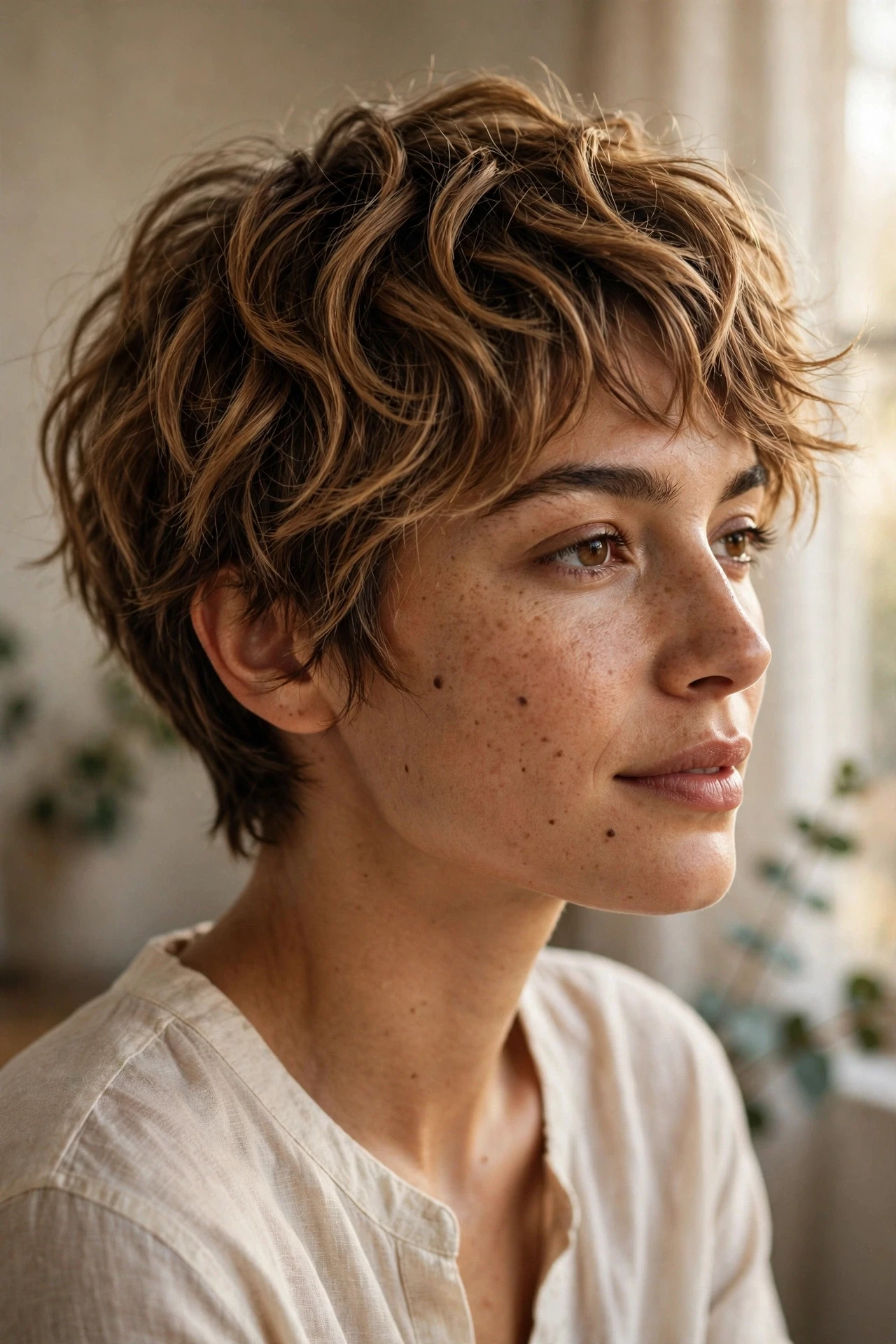
Vibe: Effortless — wavy hair at pixie length with the right layered cut produces texture entirely on its own.
A textured pixie for wavy hair works by using a graduated layer cut to allow each wave section to move independently rather than being weighted down as a unit. Point-cut ends throughout remove the blunt edge, and the wave's natural surface character does the rest. On 2C/3A waves, this combination air-dries into a textured, naturally defined style with no product needed beyond a sea salt spray.
Ask for "a layered pixie with point-cut ends for my wavy hair — I want the wave to be the texture." Apply sea salt spray to damp hair, scrunch once, and leave completely undisturbed to air dry.
💡 Quick Win: For wavy textured pixies, the best styling trick is no trick at all: apply sea salt spray, tilt the head forward (crown pointing toward the floor), scrunch upward once, and straighten back up — this sets the wave in an upward direction rather than flat against the scalp.
Shop The Look
| Product | Type |
|---|---|
| Sea salt spray for wave texture | Styling |
| Leave-in conditioner for wave definition | Haircare |
| Diffuser for wave-set drying | Tool |
| Anti-frizz finishing mist | Styling |
| Sulphate-free wave-enhancing shampoo | Haircare |
6. Textured Crop for Thick Hair
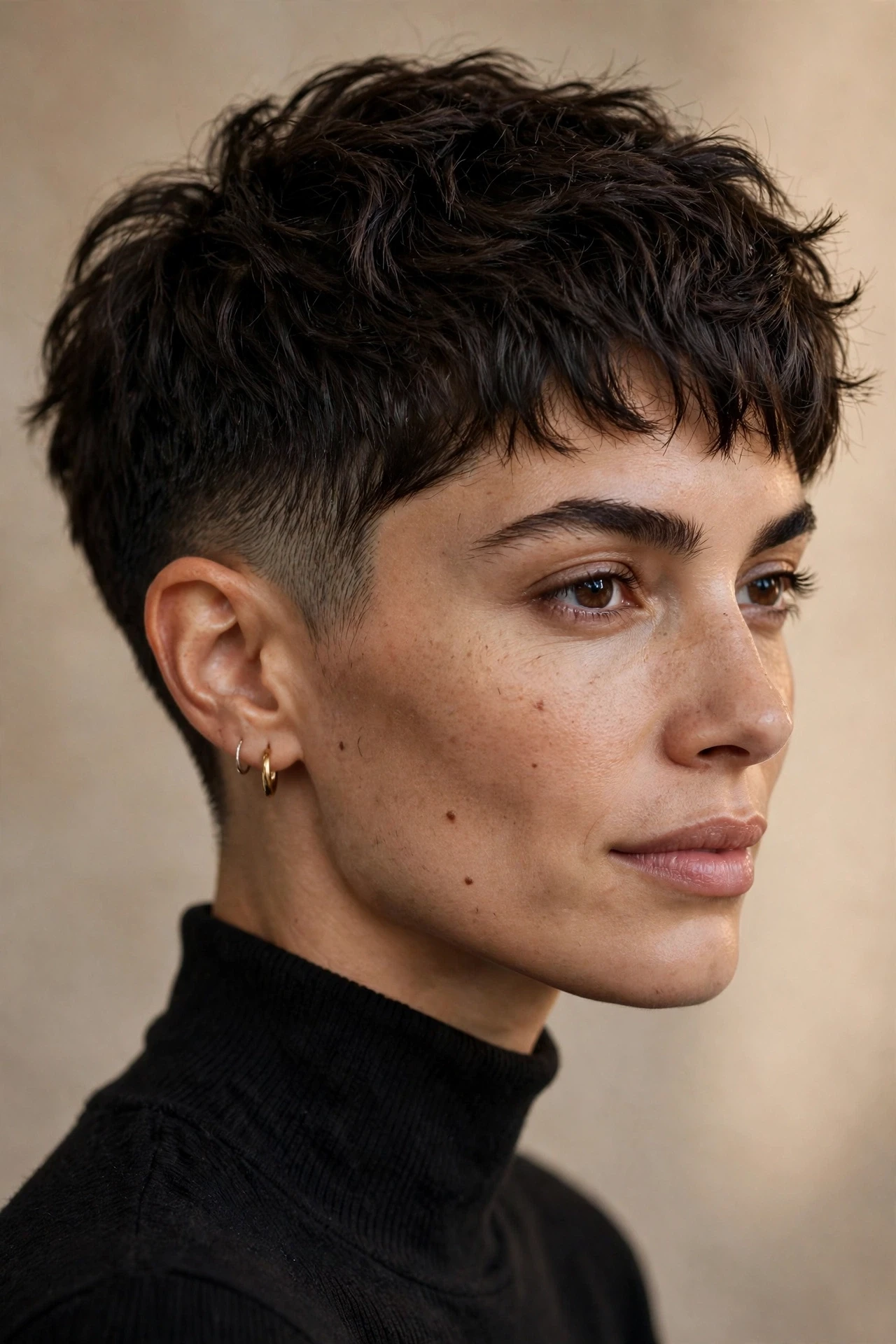
Vibe: Polished — thick hair textured correctly reads as deliberately crafted rather than simply short.
A textured crop for thick hair requires internal thinning before any surface texture work — thinning scissors used from the underside of sections reduce bulk by 30–40% without changing the surface length. Slide cutting (scissors angled along the hair shaft) then creates a tapered mid-length texture rather than the blunt density that thick hair naturally produces. The result is a cut with visible texture and movement rather than a solid mass.
Ask for "a textured crop for thick hair — thin it internally first, then slide-cut texture through the surface." Apply a matte clay to dry hair — thick hair needs less product per section than fine hair to achieve the same textured result, so start with a pea-sized amount and add only if needed.
Shop The Look
| Product | Type |
|---|---|
| Matte clay for thick hair texture | Styling |
| Professional thinning scissors | Tool |
| Texturising paste for definition | Styling |
| Clarifying shampoo for thick hair | Haircare |
| Wide-tooth comb for product distribution | Tool |
7. Soft Textured Pixie for Fine Hair
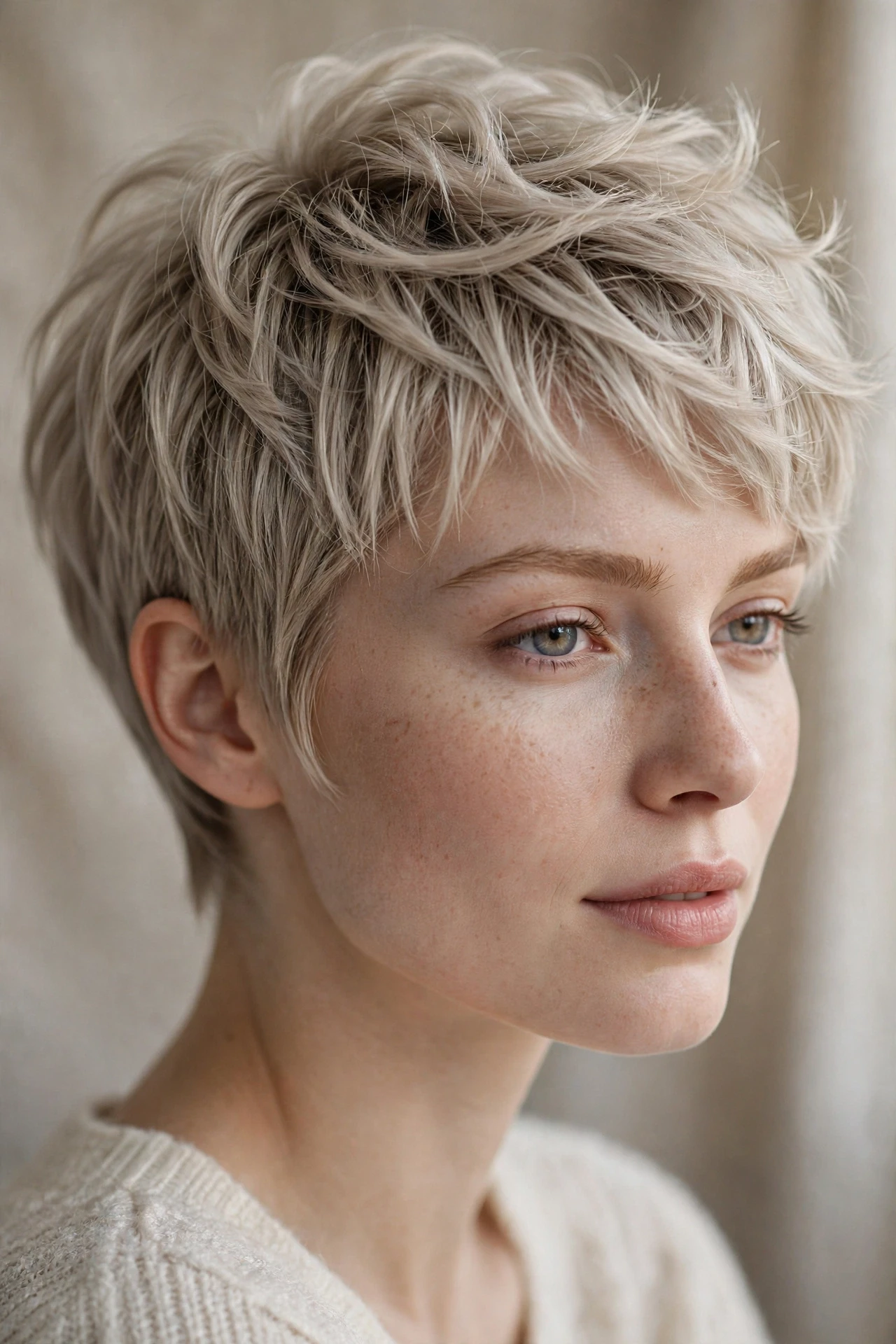
Vibe: Feminine — fine hair textured with a razor ends up looking more abundant at pixie length than it ever has at any longer style.
Fine hair at pixie length benefits specifically from razor-cut ends: each razor-feathered tip is thinner than a blunt-cut end, but the multiple tips together create more visual surface area at the perimeter than a single blunt edge. Combined with internal graduation (underlayers shorter than the surface), the result is a cut that appears significantly denser than the hair's actual count. A volumising mousse before blow-drying at the roots multiplies the effect.
Ask for "a razor-cut textured pixie for fine hair — I want it to look as full as possible." Apply volumising mousse to the roots only before blow-drying, lifting from underneath with a small round brush.
Shop The Look
| Product | Type |
|---|---|
| Volumising mousse for fine hair roots | Styling |
| Small round brush for fine hair lift | Tool |
| Thickening shampoo fine hair | Haircare |
| Lightweight finishing spray | Styling |
| Razor comb for at-home end texture | Tool |
8. Textured Pixie with Curtain Fringe
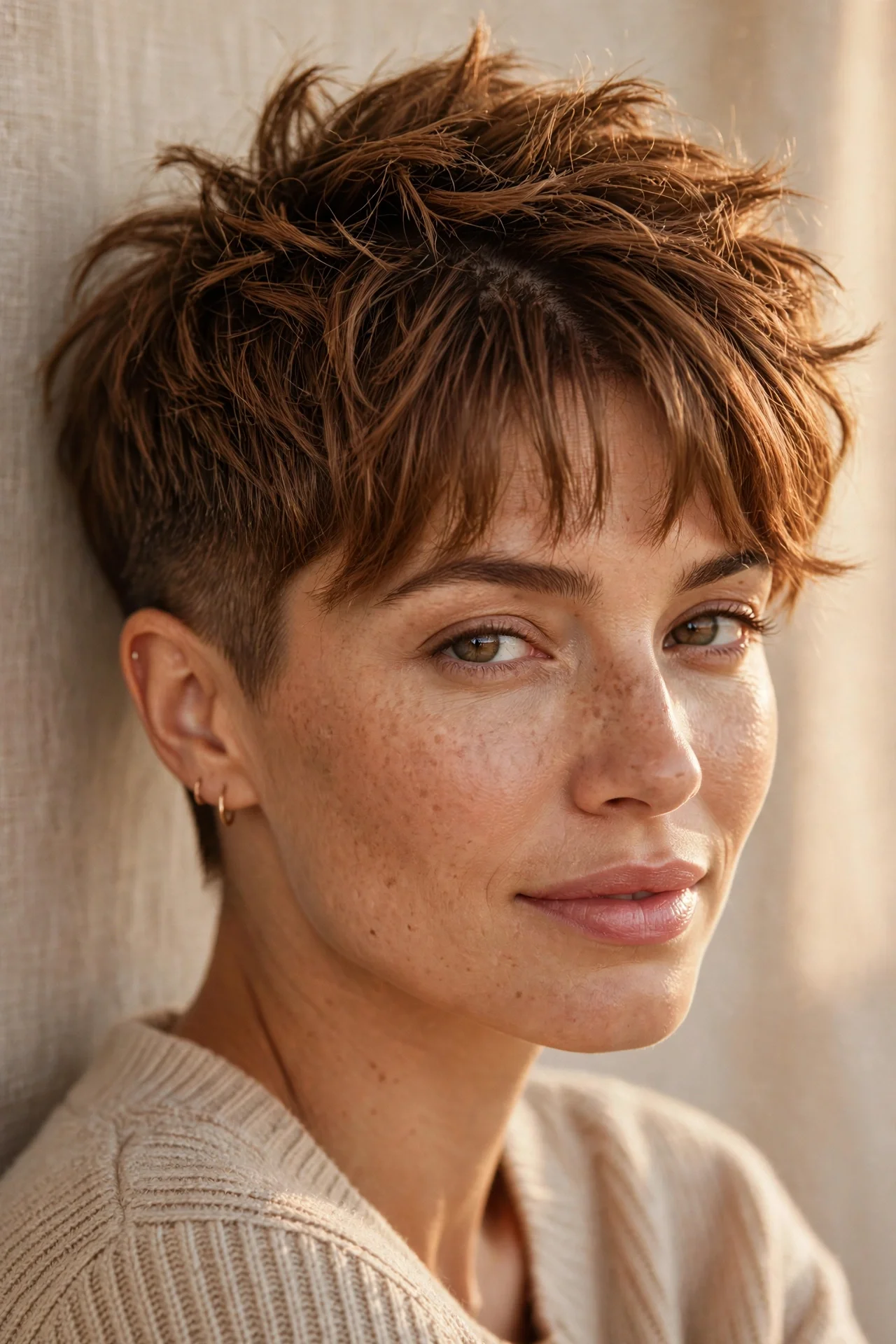
Vibe: Feminine — curtain bangs on a textured pixie bring the cut's most-requested fringe variation into the textured category.
Curtain bangs on a textured pixie combine the soft, face-framing quality of a curtain fringe with the movement-forward energy of a textured crown. The fringe is cut and styled separately — blown dry with a small round brush for the inward curve — while the textured crown behind it is finished with a sea salt spray or matte paste. The two finishing approaches (smoothed fringe, textured crown) create an intentional contrast between the front and top of the cut.
Ask for "a textured pixie with curtain bangs — point-cut texture throughout the crown, curtain fringe styled separately." Blow-dry the curtain fringe first with the inward curve, then rough-dry the textured crown with fingers and sea salt spray.
Shop The Look
| Product | Type |
|---|---|
| Sea salt spray for textured crown | Styling |
| Small round brush for curtain fringe | Tool |
| Light serum for fringe shape | Styling |
| Flexible-hold fringe spray | Styling |
| Matte paste for crown definition | Styling |
9. Textured Pixie with Bold Colour
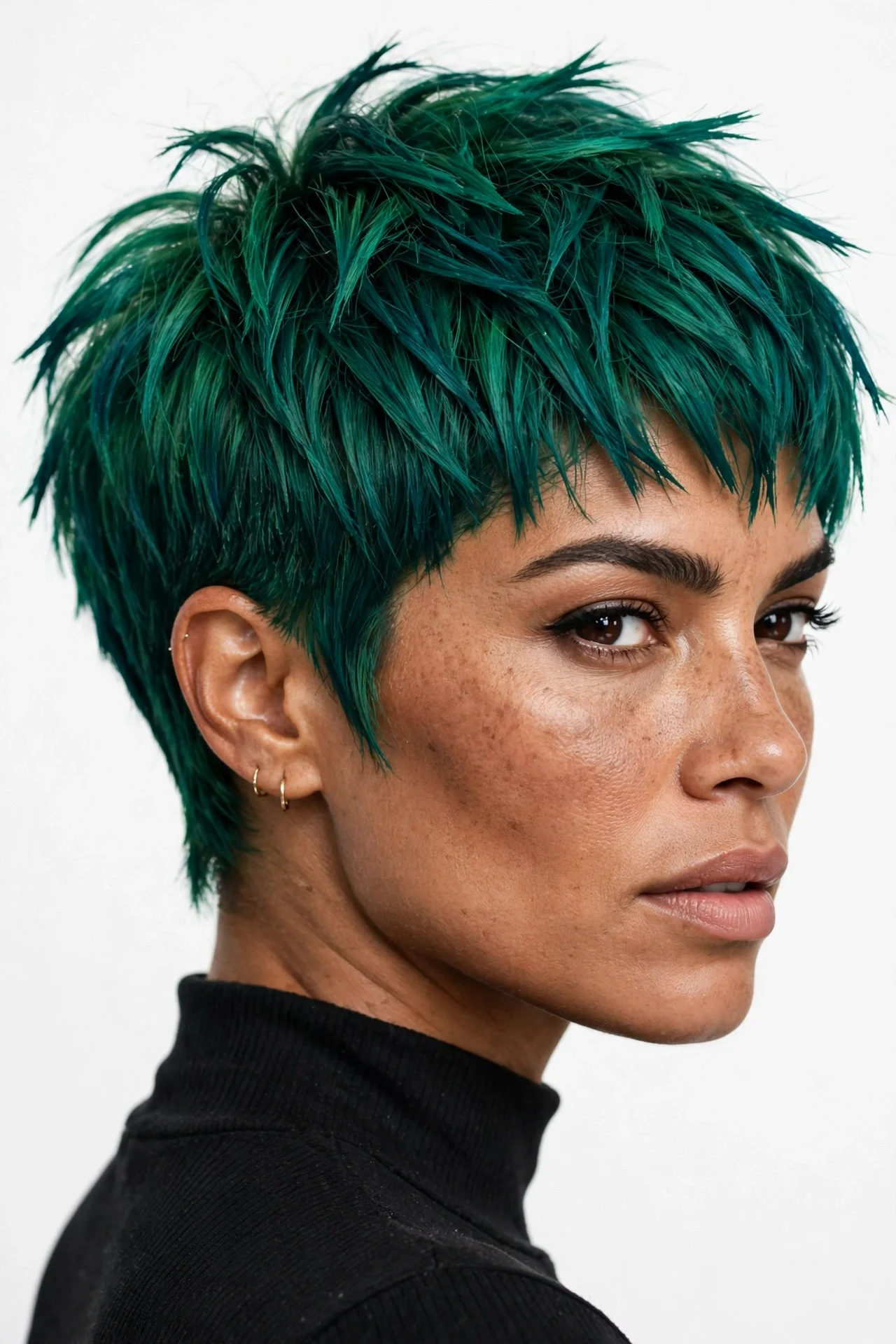
Vibe: Expressive — vivid colour and textured ends on a pixie create a two-dimensional statement: the colour draws the eye, and the texture makes the colour move.
Vivid colour on a textured pixie gains an additional dimension that colour on a smooth pixie doesn't have: texture creates variation in how the colour reflects light, producing a multi-tonal quality from a single-process colour. Each point-cut tip reads as slightly different from the next because the angle of light to the tip changes with each strand's direction. The matte clay finish keeps the vivid colour visible per individual piece rather than the colour merging into a single mass.
Ask your colourist for "a vivid [emerald/teal/electric blue] all-over on my textured pixie." Apply a matching colour-depositing conditioner weekly to the textured sections only.
Shop The Look
| Product | Type |
|---|---|
| Vivid colour-depositing conditioner | Haircare |
| Sulphate-free vivid colour shampoo | Haircare |
| UV colour-sealing spray | Styling |
| Matte clay for textured colour display | Styling |
| Bond-strengthening treatment | Haircare |
10. Textured Pixie for Curly Hair
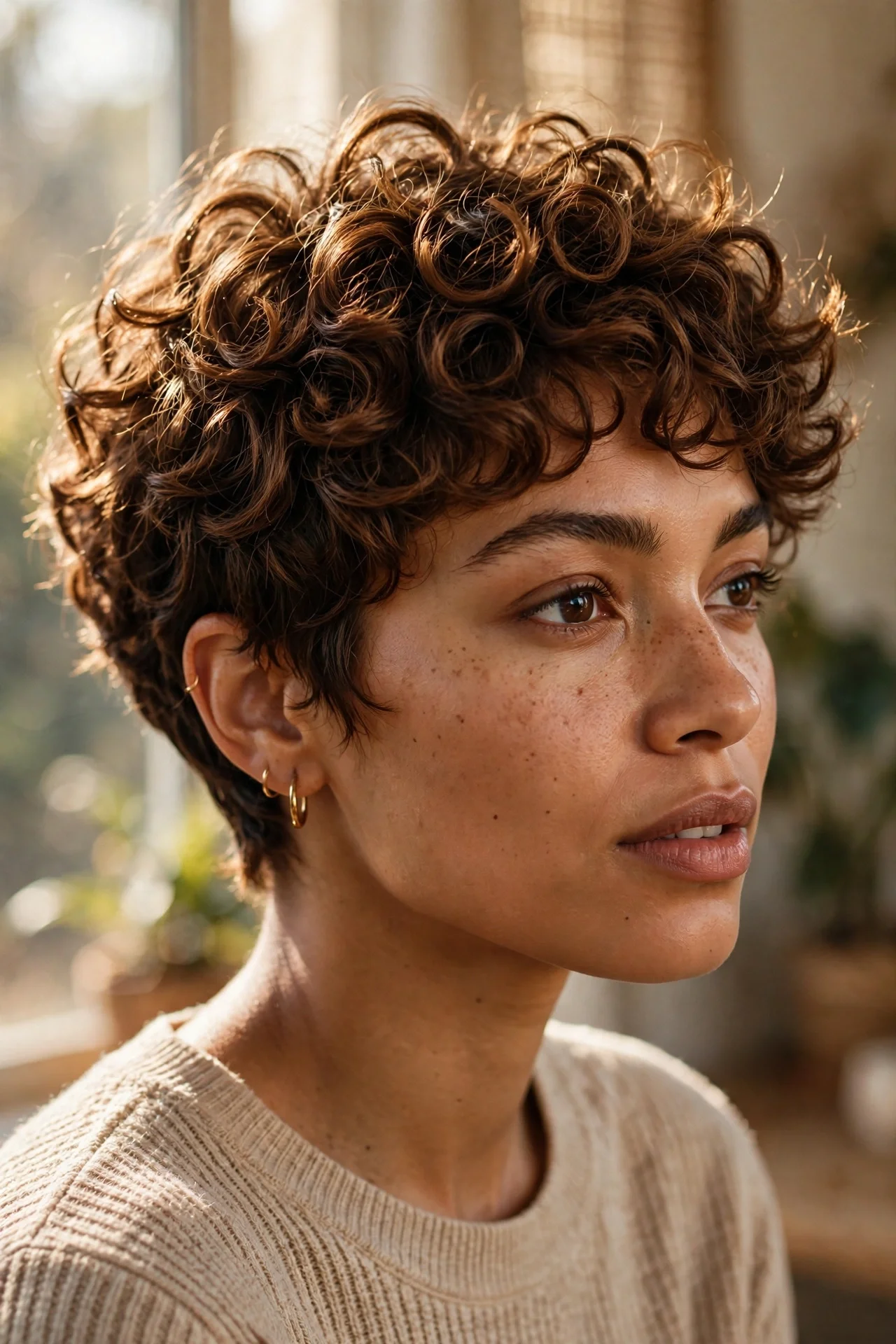
Vibe: Authentic — curly hair at pixie length is its own texture, and the cut's job is simply to frame it correctly.
A textured pixie for curly hair uses the curl's own surface character as the texture — the cut's role is shaping and proportioning rather than manufacturing texture. A DevaCut (dry, curl-by-curl) or dry cutting approach ensures the stylist cuts the curl to its final dry position, creating a shape that works with the spring and volume of each section. Curl cream applied to soaking-wet sections defines the natural texture without adding artificial character.
Ask for "a curly pixie cut dry — I want the texture to be my natural curl, just shaped and proportioned." Apply a curl cream to soaking-wet sections in the DevaCut method and air dry completely.
Shop The Look
| Product | Type |
|---|---|
| Medium-hold curl cream | Styling |
| Diffuser for curl pixie drying | Tool |
| Leave-in conditioner curl base | Haircare |
| Curl refresher mist between washes | Styling |
| Microfibre scrunch towel | Accessory |
11. Textured Pixie with Silver Colour
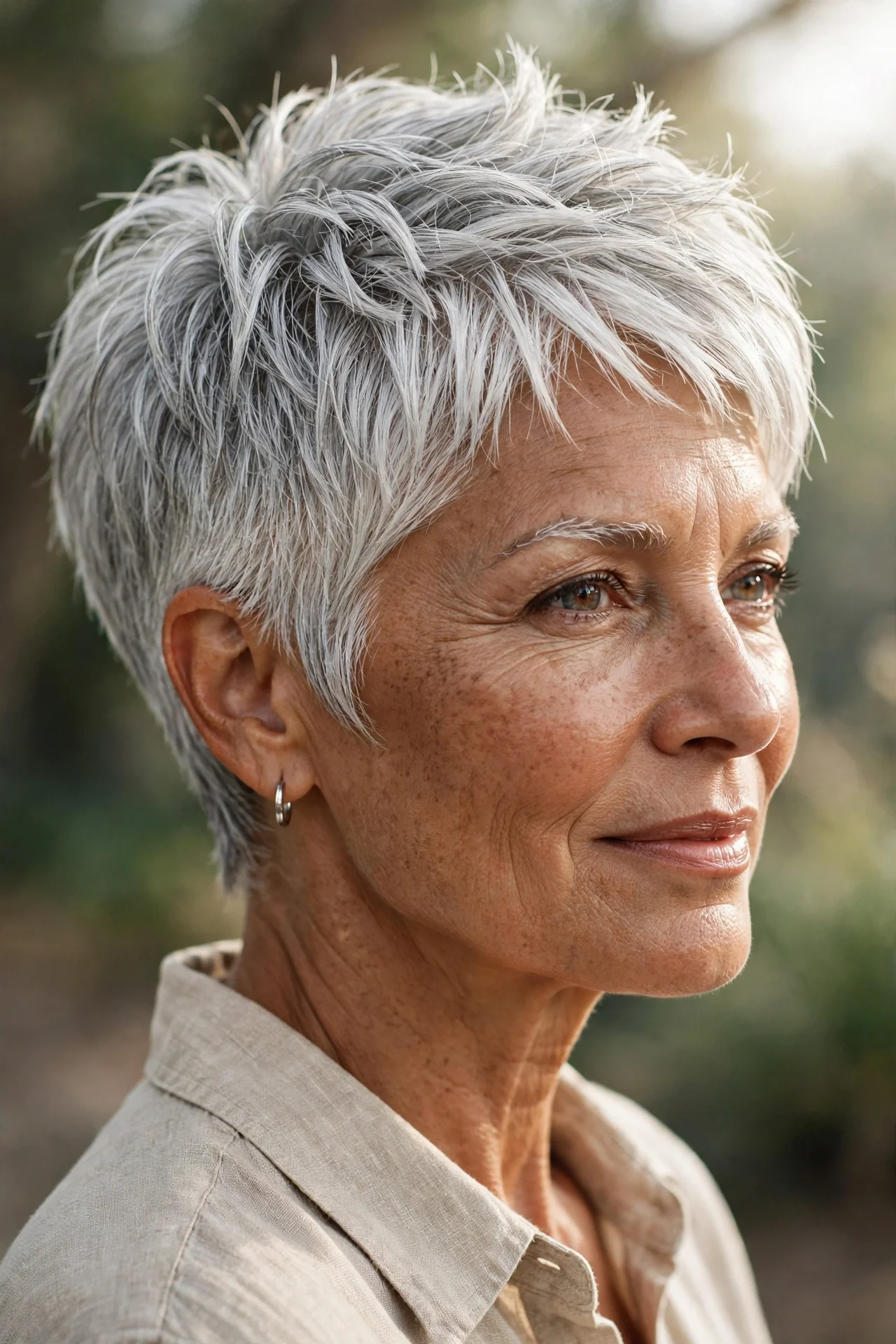
Vibe: Luminous — textured silver hair at pixie length reveals the range of tones within the silver — from bright white to warm grey — as individual pieces catch light at different angles.
A textured silver pixie uses point-cutting to create individual, separated tips that reveal silver hair's natural multi-tonal range. Natural silver is rarely a single tone — it contains white, pale grey, and darker graphite threads — and the point-cut separation makes each tone visible as an individual strand. A matte clay with moisturising ingredients (shea butter or natural oil) provides separation without emphasising the natural dryness of grey hair.
Ask for "a textured pixie with point-cut ends — natural silver, I want the texture to show the tonal range." Apply a moisturising matte clay lightly through the crown, separating with fingertips.
💡 Quick Win: Silver hair's natural coarser texture means that less matte clay goes further than on fine hair — start with a half-pea-sized amount, work into both palms until invisible, then work through the crown. Over-applying matte clay on silver makes the texture look dull rather than dimensional.
Shop The Look
| Product | Type |
|---|---|
| Moisturising matte clay silver hair | Styling |
| Purple toning shampoo silver | Haircare |
| Hydrating conditioner grey hair | Haircare |
| Shine-enhancing finishing mist | Styling |
| Wide-tooth comb for product distribution | Tool |
12. Textured Pixie with Side Sweep

Vibe: Modern — a textured side sweep on a pixie has a more relaxed, current quality than a smooth pomaded sweep.
A textured side-swept pixie uses the same asymmetric cut as a smooth sweep (longer on one side, tapered on the other) but finishes with a matte clay rather than pomade, preserving the texture of the point-cut ends rather than sealing them flat. The sweep maintains directional movement while the texture creates irregular surface variation within that direction — the two qualities work together without competing.
Ask for "a side-swept pixie with textured, point-cut ends — I want the sweep but with a matte texture rather than sleek." Apply a matte clay to the crown in the direction of the sweep, using fingers rather than a comb to preserve the texture.
Shop The Look
| Product | Type |
|---|---|
| Matte clay for textured sweep | Styling |
| Texturising paste for separation | Styling |
| Anti-humidity finishing mist | Styling |
| Point-cut scissors for end texture | Tool |
| Sea salt pre-spray before clay | Styling |
13. Textured Natural Afro Pixie
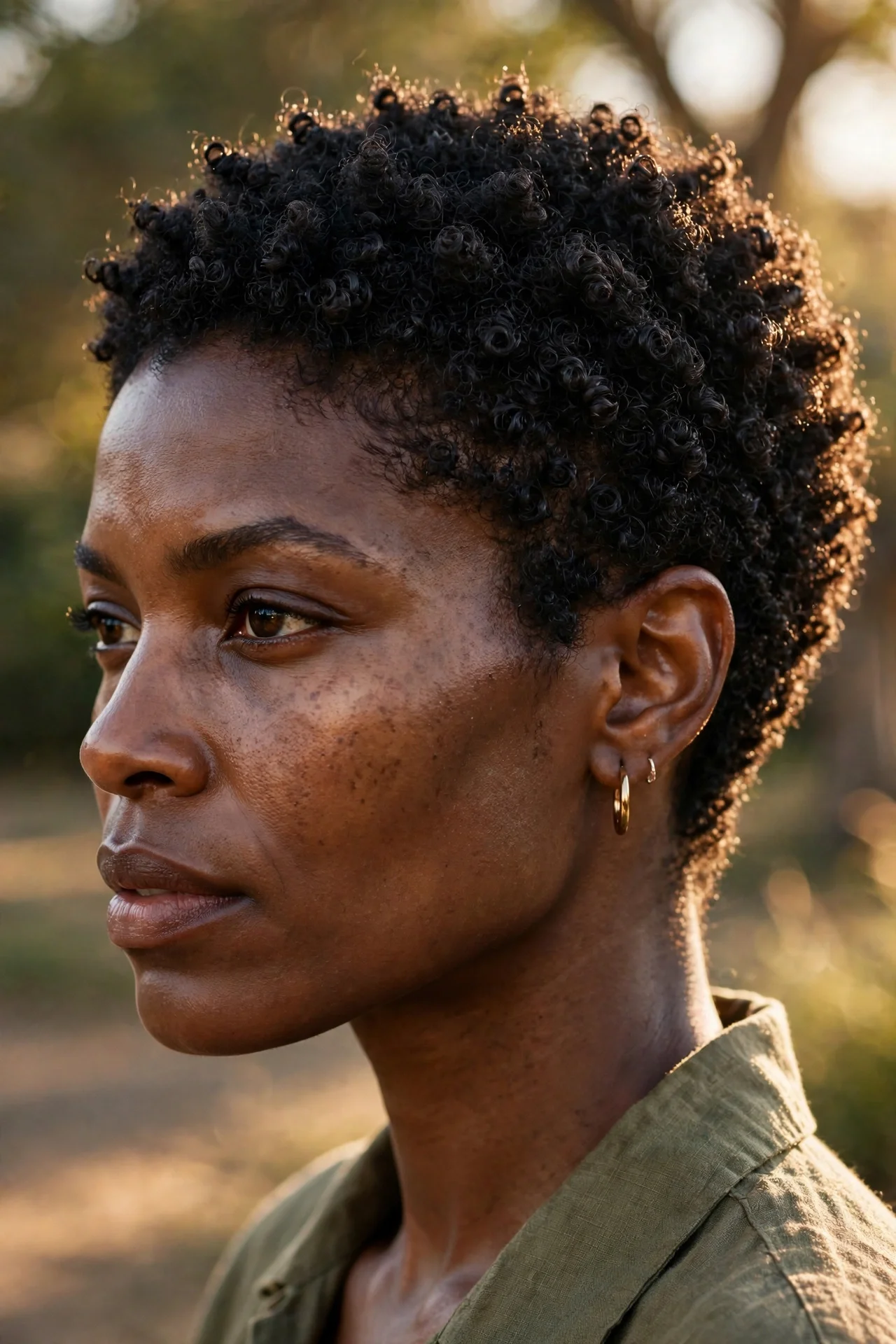
Vibe: Powerful — 4A/4B coils at pixie crop length are their own texture statement, requiring nothing added except moisture to look complete.
A textured natural afro pixie crop for 4A/4B hair uses a scissors-only even cut at 2–2.5 inches, letting the tight coil pattern create its own surface texture. The cut's job is purely proportional — an even shape so each coil presents its full pattern without one section overpowering another. The LOC method (leave-in conditioner, then oil, then curl cream) applied on soaking-wet sections maximises moisture retention and coil definition.
Ask for "an even afro crop at 2–2.5 inches — scissors only, let my natural coil be the texture." Apply LOC in sequence to soaking-wet sections and air dry completely.
Shop The Look
| Product | Type |
|---|---|
| Rich leave-in conditioner 4A/4B | Haircare |
| Sealing natural hair oil | Haircare |
| Curl cream for coil definition | Styling |
| Co-wash moisturising cleanser | Haircare |
| Satin sleep bonnet | Accessory |
14. Textured Pixie with Diagonal Fringe
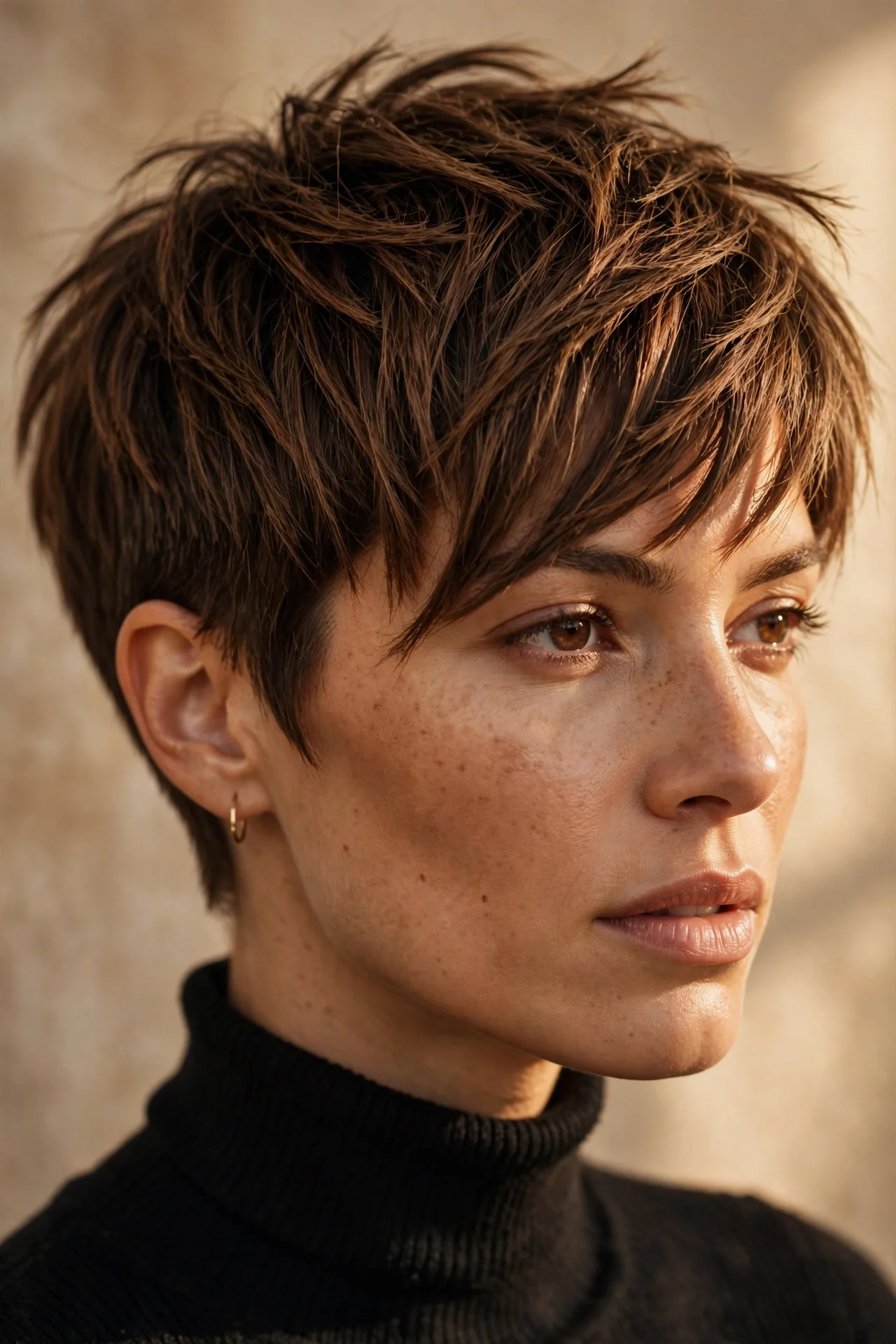
Vibe: Dynamic — a textured diagonal fringe has more visual energy than a smooth sweep because the irregular tips create movement within the direction.
A textured diagonal fringe on a pixie uses the same diagonal angle as a smooth fringe but point-cuts the fringe section for texture. The fringe tips — irregular from the point-cutting — create a soft, feathered edge at the diagonal rather than a clean line. The fringe is finished with a matte paste applied in the sweep direction using fingers, creating a textured forward direction rather than a precise flat sweep.
Ask for "a diagonal fringe with point-cut textured ends — I want the sweep to have texture, not be sleek." Apply a small amount of matte paste in the direction of the sweep, using fingertips rather than a comb.
Shop The Look
| Product | Type |
|---|---|
| Matte paste for textured fringe | Styling |
| Sea salt spray for pre-texture | Styling |
| Anti-humidity finishing spray | Styling |
| Point-cut scissors for fringe ends | Tool |
| Wide-tooth fringe comb for product | Tool |
15. Lived-In Textured Pixie

Vibe: Warm — the lived-in textured pixie is the version that requires genuinely nothing after washing, and reads as genuinely intentional.
The lived-in textured pixie is designed to air-dry into a naturally textured shape — the stylist cuts graduated layers and point-cut ends that create a predictable textured result from every wash. On wavy or slightly textured straight hair, this cut produces a reliably natural-looking result with only a sea salt spray and a rough-finger-dry. The "lived-in" quality is engineered into the cut, not achieved by neglect.
Ask for "a textured pixie that air-dries well — graduated layers and point-cut ends, I want it to look textured with minimal effort." Apply a sea salt spray to damp hair, tousle once, and leave completely undisturbed.
Shop The Look
| Product | Type |
|---|---|
| Sea salt spray for natural texture | Styling |
| Featherweight anti-frizz serum | Styling |
| Gentle daily sulphate-free shampoo | Haircare |
| Moisturising conditioner | Haircare |
| Satin pillowcase for texture preservation | Accessory |
16. Bold Textured Pixie with Copper Colour
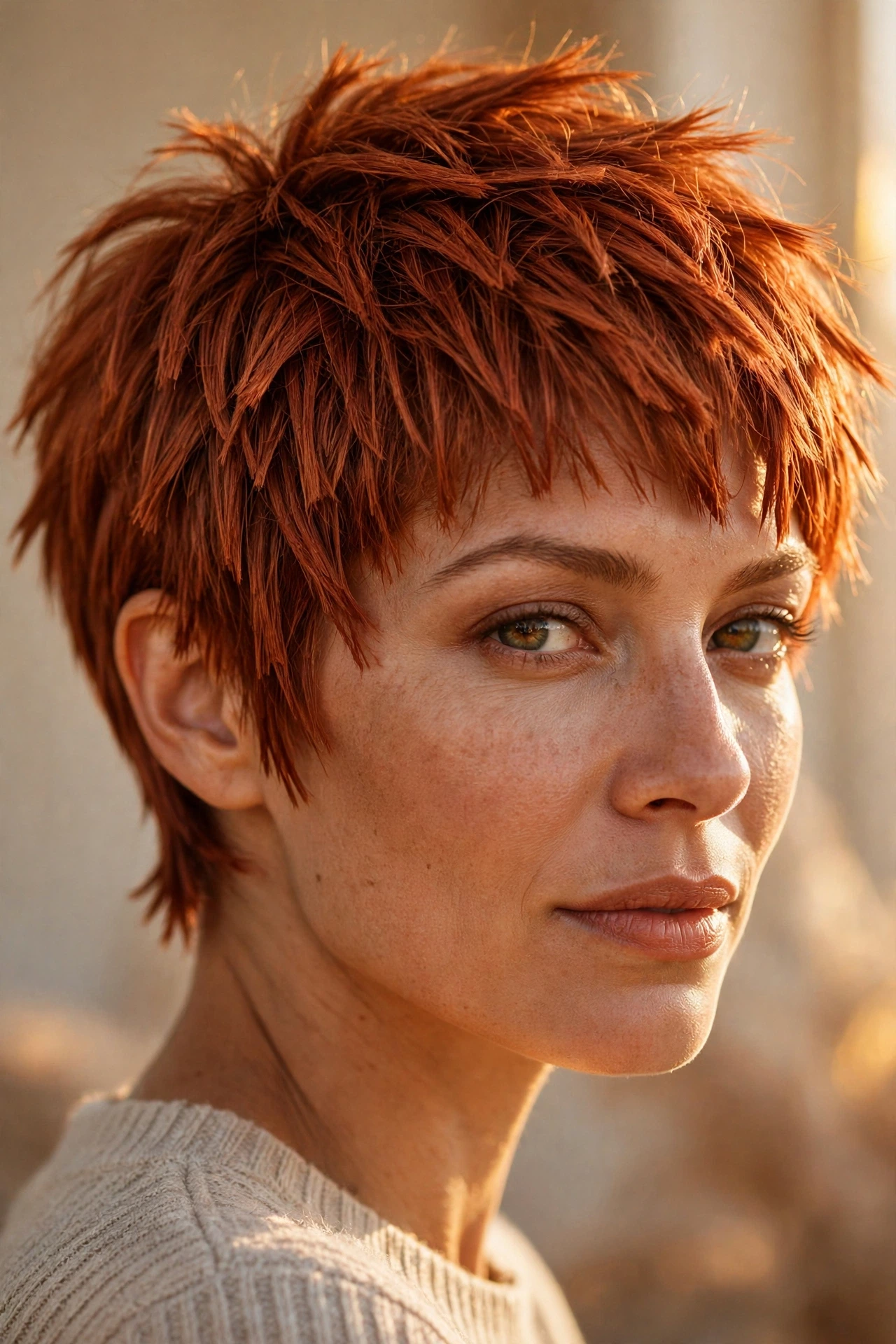
Vibe: Vivid — copper on a textured pixie gives the colour individual strand presence rather than a single uniform surface.
Copper or auburn on a textured pixie gains from the texture — each point-cut tip reflects the copper tone slightly differently depending on its angle, creating a multi-dimensional warmth that a smooth single-surface copper doesn't achieve. The matte clay finish is essential: pomade on a copper textured pixie would flatten and darken the colour's visible range.
Ask your colourist for "a vivid copper all-over on my textured pixie." Use a copper colour-depositing conditioner weekly and avoid sulphate shampoos.
Shop The Look
| Product | Type |
|---|---|
| Copper colour-depositing conditioner | Haircare |
| Sulphate-free colour shampoo | Haircare |
| Matte clay for copper texture | Styling |
| Colour-sealing UV spray | Styling |
| Weekly deep conditioning mask | Haircare |
17. Textured Pixie for Round Faces

Vibe: Balanced — textured height at the crown on a round face creates vertical visual length through directional texture rather than sleek precision.
For round face shapes, a textured pixie works best when the texture is directed upward at the crown — the irregular tips of point-cut ends create height and visual lift when blow-dried and styled upward. A root-lift mousse before blow-drying, followed by a matte clay applied while lifting the crown section upward, creates textured height. Close sides (1–2 guard taper) prevent side volume that would widen the face horizontally.
Ask for "a textured pixie with upward texture at the crown for a round face — close sides." Apply root-lift mousse to crown roots, blow-dry lifting upward, then apply matte clay in an upward lifting motion.
Shop The Look
| Product | Type |
|---|---|
| Root-lift spray for crown texture | Styling |
| Matte clay for upward direction | Styling |
| Round brush for crown texture | Tool |
| Volumising thickening shampoo | Haircare |
| Flexible-hold spray for crown hold | Styling |
18. Balayage Textured Pixie
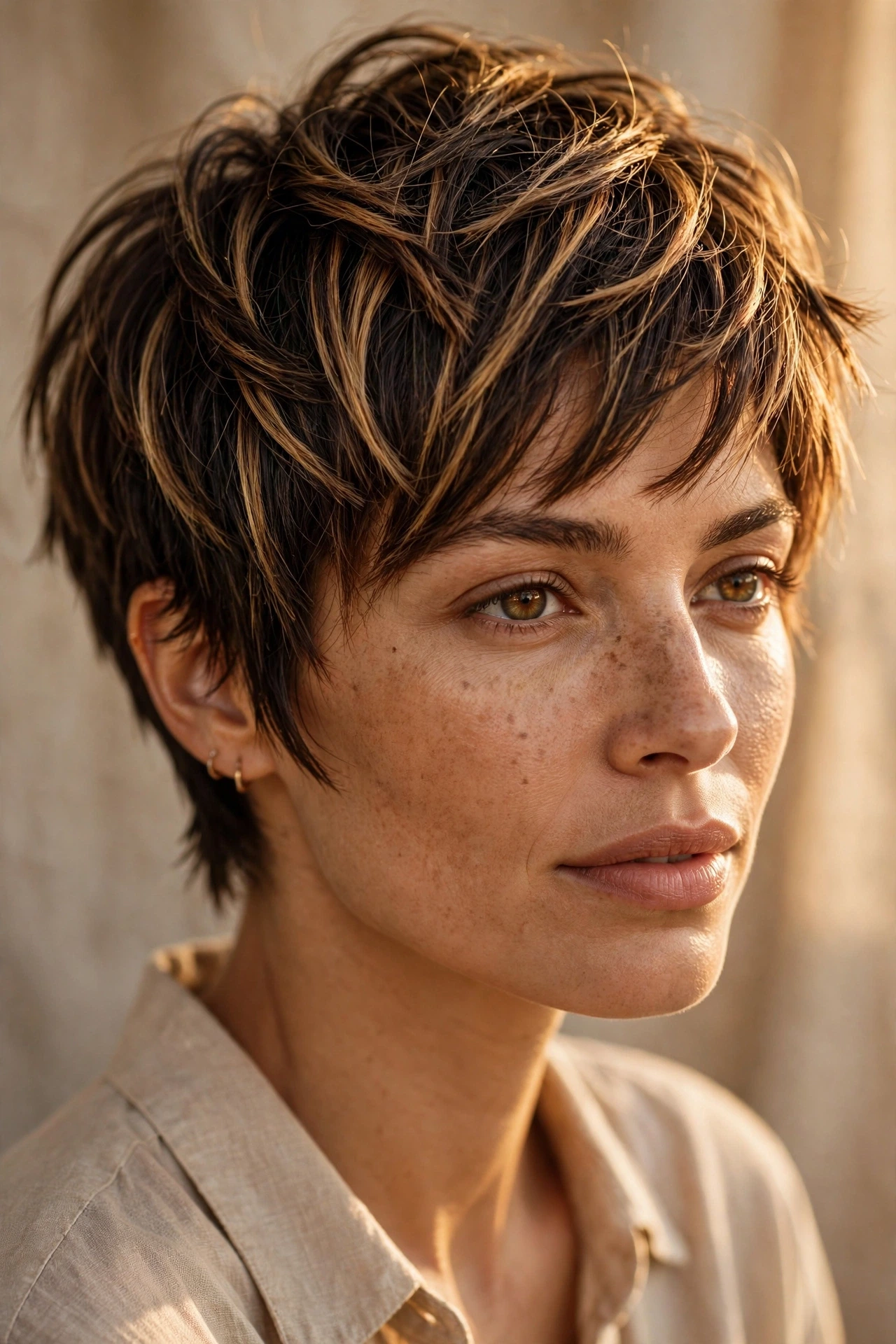
Vibe: Warm — balayage per textured piece reveals the colour's dimensional range one strand at a time.
Balayage on a textured pixie gains specific value from the texture — when the point-cut ends separate individual strands, the lighter highlighted pieces and the darker base pieces become individually visible, creating a colour depth that a smooth surface compresses into a single tonal impression. The matte clay finish is essential: a pomade on a balayage textured pixie would merge the individual highlighted pieces into a smooth mass.
Ask your colourist for "balayage through the top of my textured pixie — I want the individual highlighted pieces to be visible when I use matte clay." Apply a colour-protecting serum before blow-drying and a matte clay after.
Shop The Look
| Product | Type |
|---|---|
| Colour-protecting heat serum | Styling |
| Sulphate-free balayage shampoo | Haircare |
| Warm-toning conditioner | Haircare |
| Matte clay for piece display | Styling |
| Weekly conditioning mask | Haircare |
19. Textured Pixie with Micro Bang
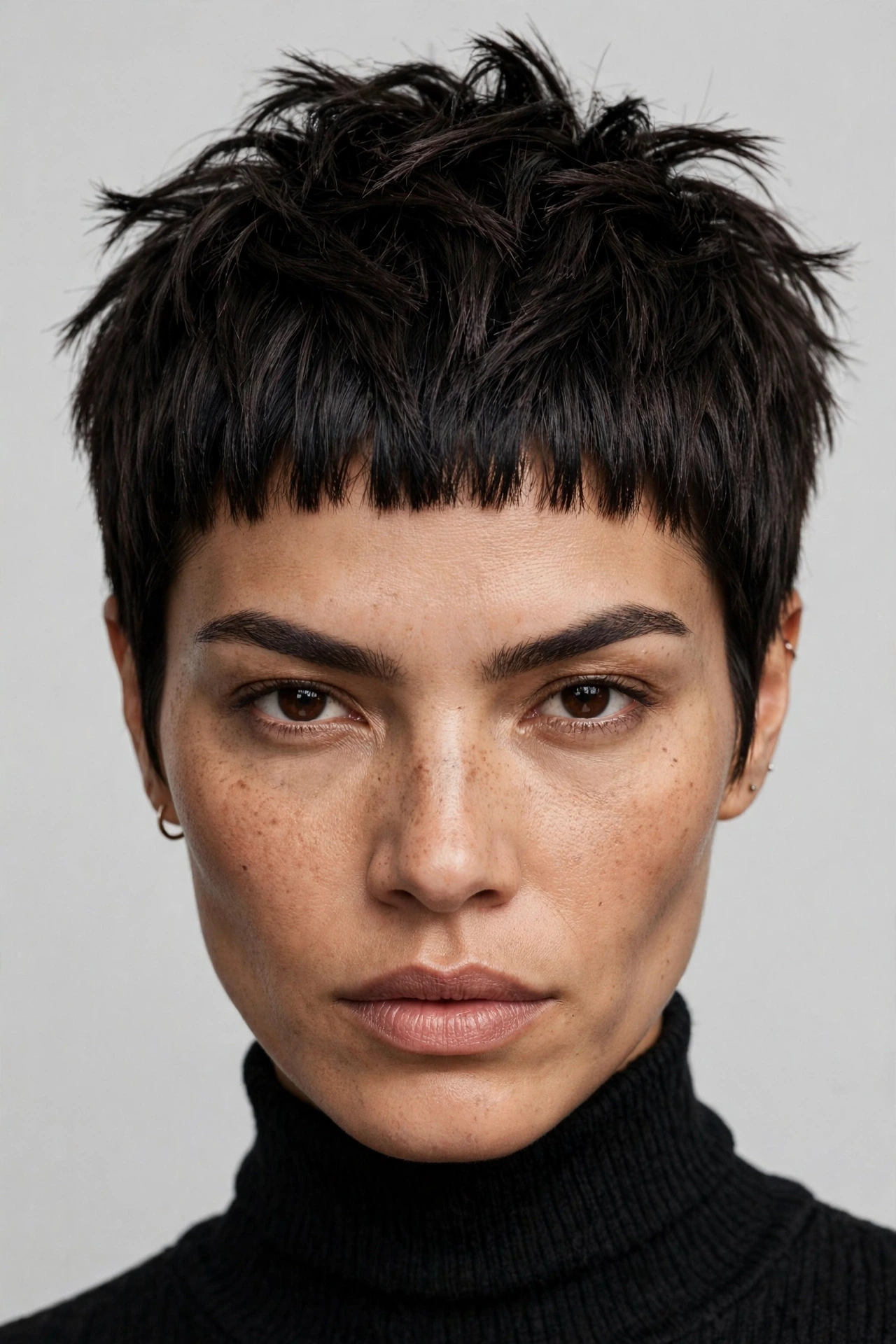
Vibe: Bold — a micro bang combined with a textured crown creates a graphic front frame against an expressive textured back — two different visual languages in one cut.
A micro bang on a textured pixie creates a deliberate contrast between the fringe's geometric precision (1–1.5 cm flat) and the textured crown's organic irregularity (3 inches of point-cut movement). The two elements use completely different finishing approaches: the micro fringe is smoothed flat with a tiny amount of edge gel, and the textured crown is finished with a matte clay in a tousling motion.
Ask for "a textured pixie with a micro bang — very short flat fringe, textured crown behind." Apply edge gel to the micro fringe with a fingertip, then matte clay to the crown separately.
Shop The Look
| Product | Type |
|---|---|
| Edge gel for micro fringe control | Styling |
| Matte clay for textured crown | Styling |
| Precision scissors for fringe touch-up | Tool |
| Fine-tooth micro fringe comb | Tool |
| Anti-frizz serum for crown | Styling |
20. Textured Pixie for Heart Faces
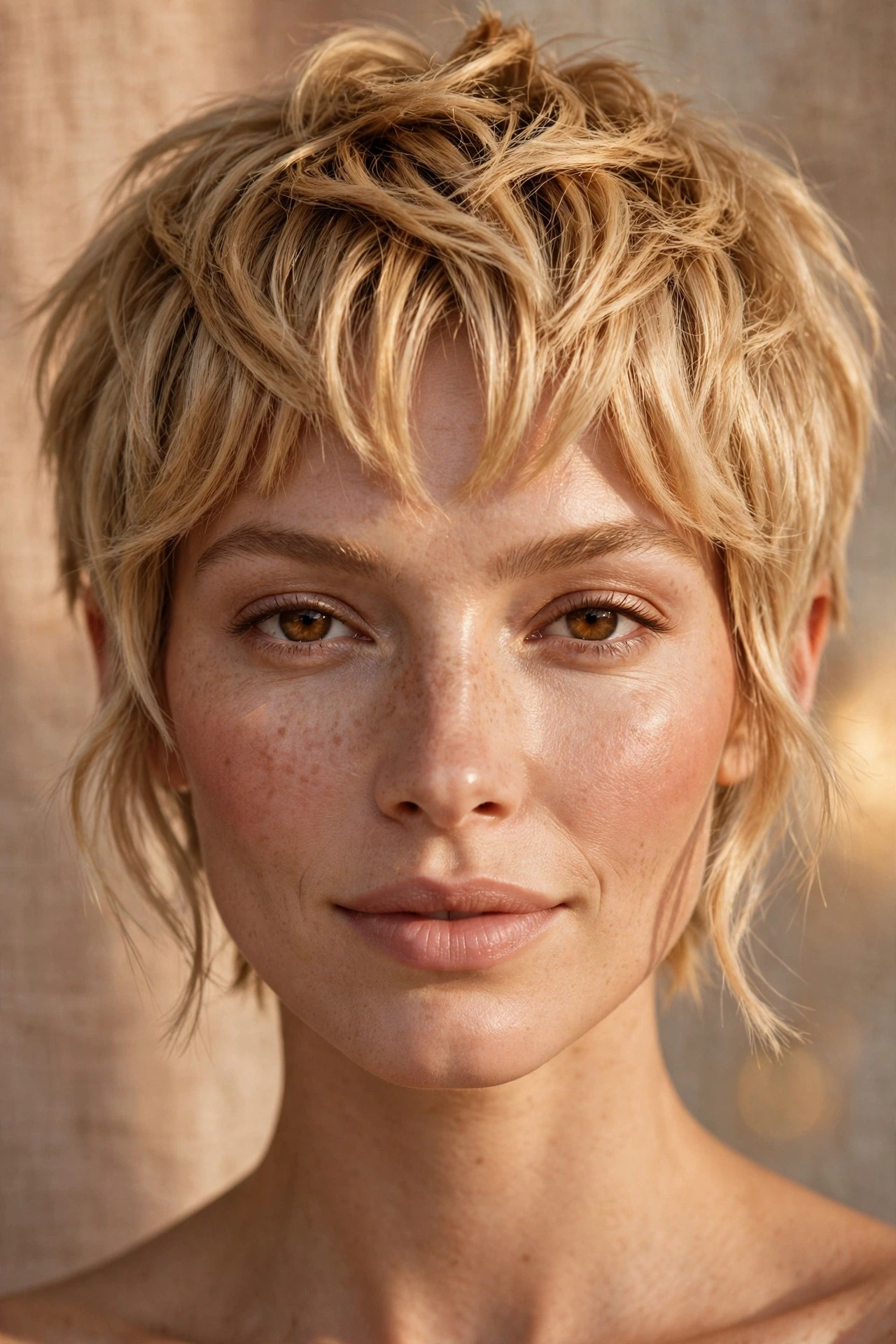
Vibe: Balanced — textured face-framing pieces on a heart-shaped face add visual width at the jaw through texture and movement rather than precise sleek framing.
For heart-shaped faces, a textured pixie with face-framing pieces and a textured curtain fringe addresses the face's proportional needs through movement rather than precision. Textured face-framing pieces at cheekbone level create visual width through their irregular movement; a textured curtain fringe softens the forehead width through its organic rather than architectural quality. Together they create a frame that works with the face's natural character rather than imposing a geometric structure on it.
Ask for "a textured pixie with textured face-framing pieces and curtain fringe for a heart face — everything point-cut." Finish with sea salt spray and matte paste, letting both the fringe and framing pieces fall naturally without forcing them into position.
Shop The Look
| Product | Type |
|---|---|
| Sea salt spray for natural texture | Styling |
| Matte paste for piece definition | Styling |
| Light-hold serum for fringe | Styling |
| Featherweight finishing mist | Styling |
| Point-cut scissors | Tool |
21. Low-Maintenance Textured Pixie
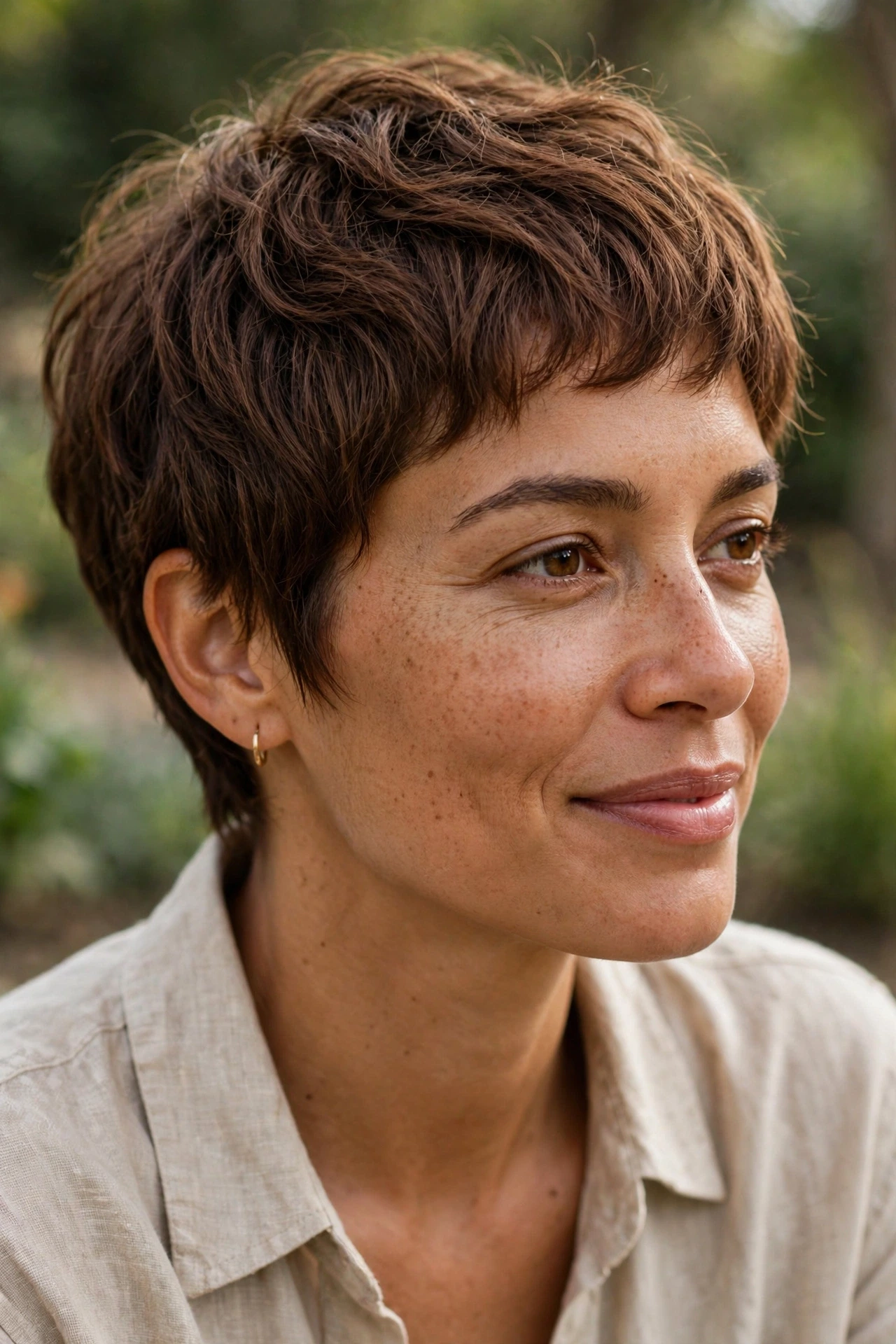
Vibe: Easy — the lowest-maintenance version of a textured pixie is one cut well enough to not need daily attention.
A low-maintenance textured pixie relies on the cut rather than the product for its textured quality — the stylist uses point-cutting throughout and cuts the shape specifically around the hair's natural growth pattern, so the result air-dries into a textured shape predictably every wash. No hard lines, no fades that need frequent professional touch-ups, no directional styling required.
Ask for "a textured pixie that air-dries well with no styling — I want the texture to come from the cut." Apply a single drop of anti-frizz serum to damp hair and leave to air dry.
💡 Quick Win: A low-maintenance textured pixie needs trimming every 8 weeks rather than the standard 6 — the soft, irregular edges of a point-cut style absorb small amounts of growth more gracefully than a blunt-cut precision pixie, extending the window between professional visits significantly.
Shop The Look
| Product | Type |
|---|---|
| Featherweight anti-frizz air-dry serum | Styling |
| Gentle daily sulphate-free shampoo | Haircare |
| Moisturising daily conditioner | Haircare |
| Microfibre press towel | Accessory |
| Satin pillowcase for texture preservation | Accessory |
22. Textured Pixie with Natural Grey
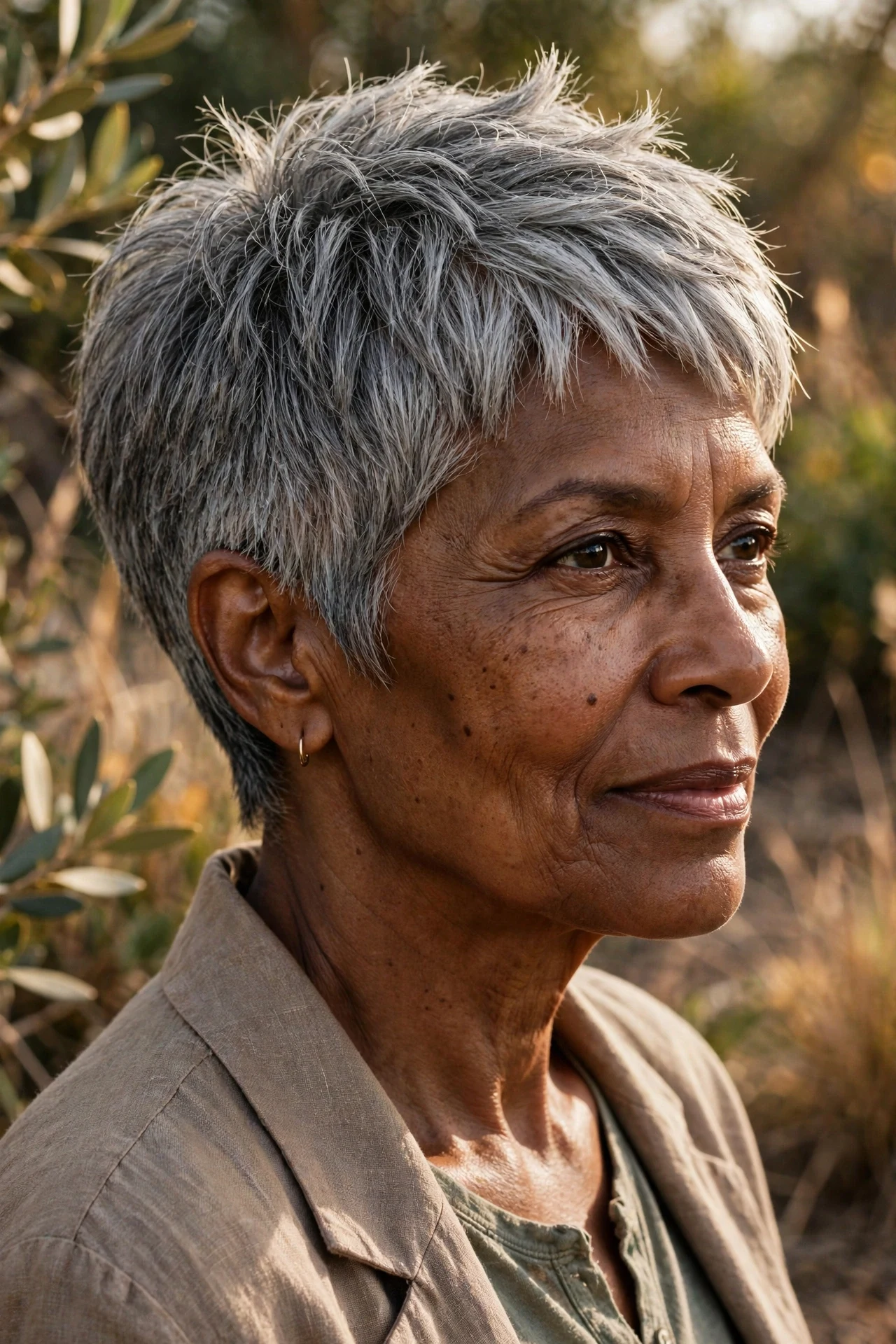
Vibe: Confident — textured natural grey at pixie length is natural hair worn with absolute authority.
Textured natural grey shows the tonal range within grey hair — bright white, warm silver, and cooler graphite — as individual separated pieces rather than a flat uniform tone. Point-cutting through natural grey reveals these individual tones through separation, giving the grey pixie a dimensional quality that smooth grey styling cannot achieve. A moisturising matte clay is the essential finish.
Ask for "a textured pixie with point-cut ends — natural grey, I want the texture to show the different tones." Use a moisturising matte clay (with shea butter or argan oil) to avoid emphasising natural grey hair's tendency toward dryness.
Shop The Look
| Product | Type |
|---|---|
| Moisturising matte clay natural oils | Styling |
| Silver-brightening sulphate-free shampoo | Haircare |
| Hydrating deep conditioner grey hair | Haircare |
| Shine mist for grey finish | Styling |
| Wide-tooth comb for product distribution | Tool |
23. Textured Pixie for Square Faces
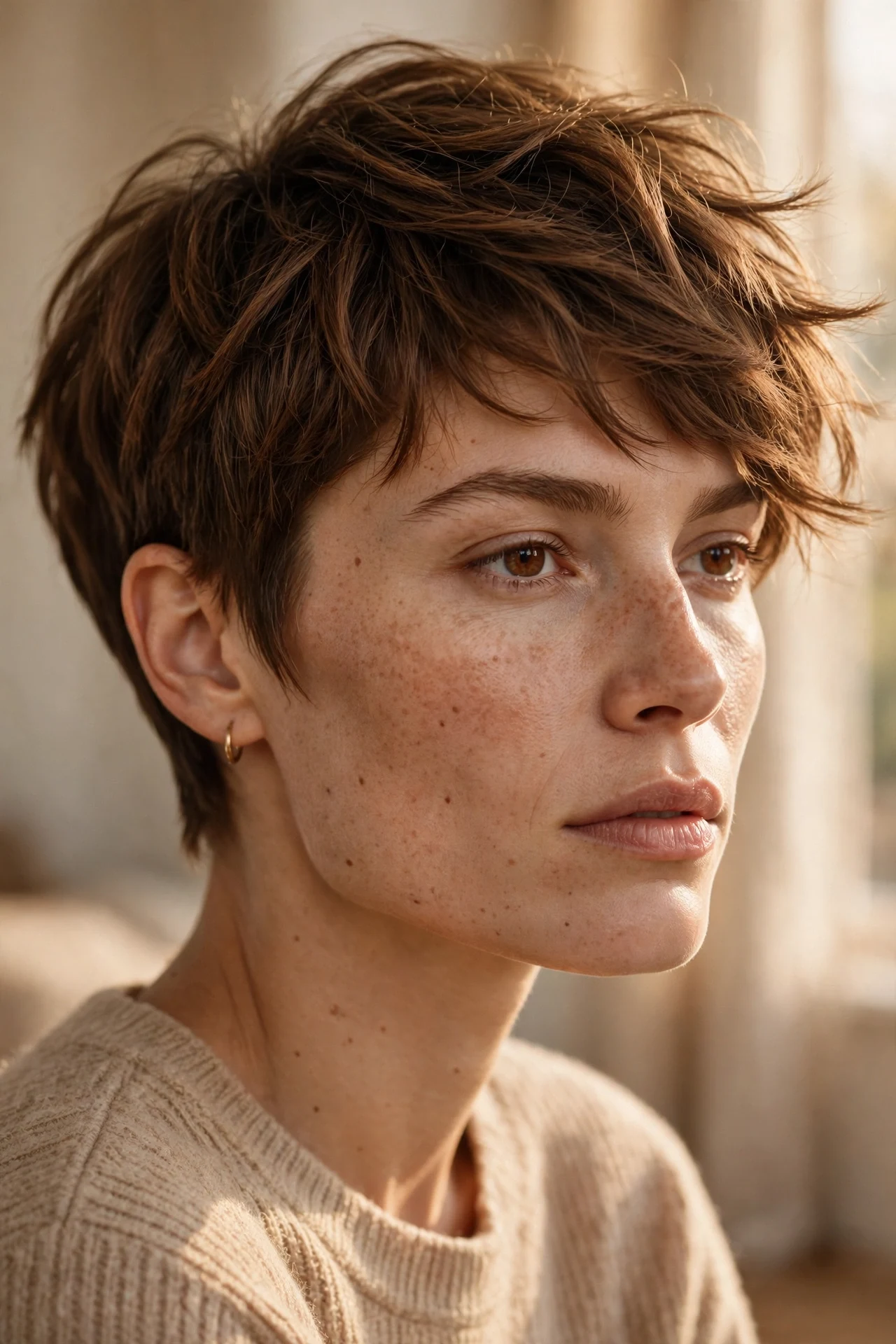
Vibe: Soft — irregular textured ends on a square face avoid the hard horizontal lines that echo the jaw's geometry.
For square face shapes, textured pixie cuts are specifically flattering because the irregular, soft ends of a point-cut or razor-cut style create organic movement that contrasts with the jaw's geometric quality. The texture's unpredictability softens the cut's overall perimeter, preventing any single hard line from reading as an echo of the jaw. A slight asymmetric direction in the top section reinforces this by breaking the symmetry that emphasises a strong jaw.
Ask for "a textured pixie for a square face — soft irregular ends, slight asymmetric direction, no blunt lines." Apply sea salt spray and finish with matte paste for soft, organic texture.
Shop The Look
| Product | Type |
|---|---|
| Sea salt spray for organic texture | Styling |
| Light matte paste for soft definition | Styling |
| Point-cut scissors for soft ends | Tool |
| Anti-frizz soft-hold spray | Styling |
| Soft boar-bristle finishing brush | Tool |
24. Textured Pixie with Platinum Colour
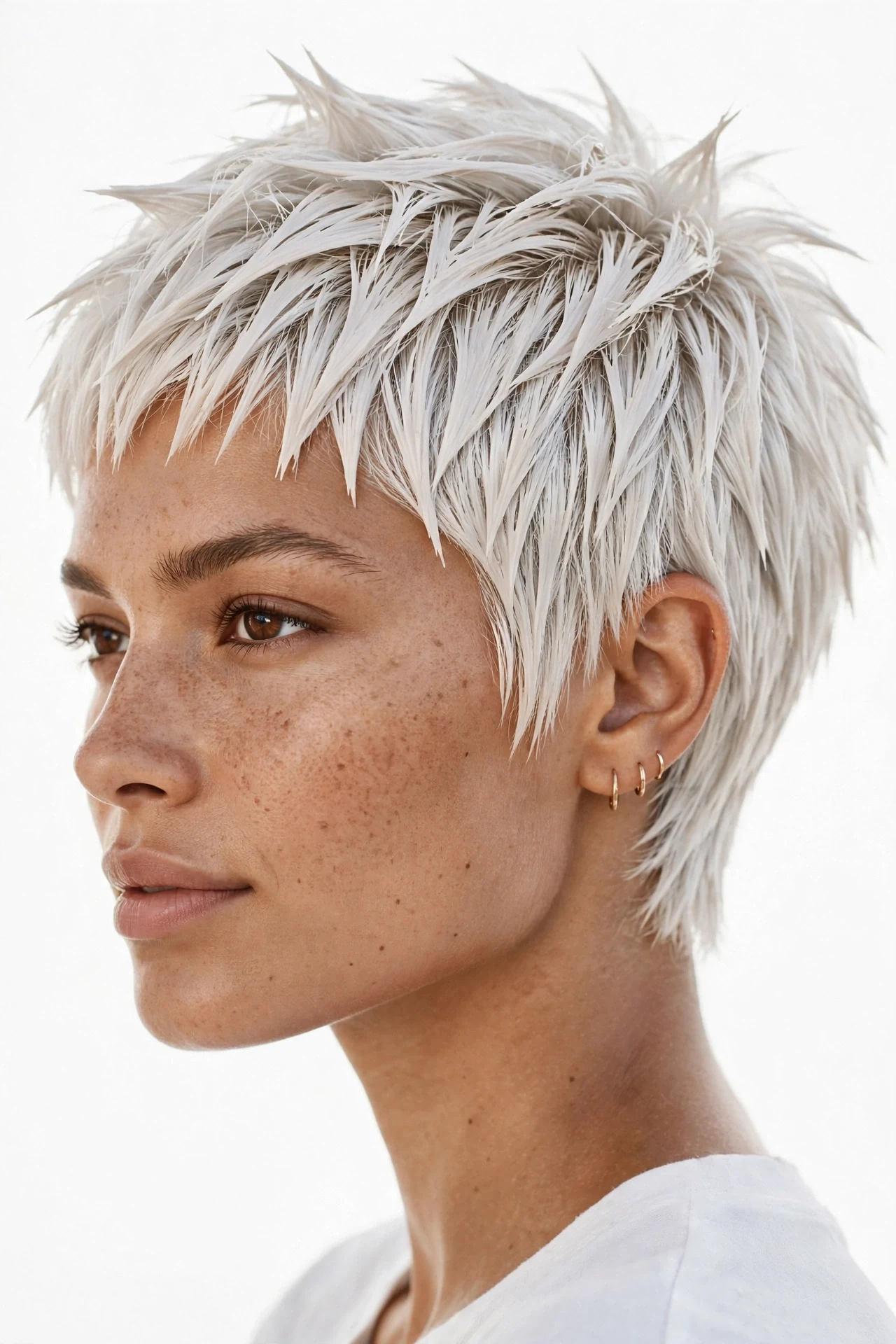
Vibe: Luminous — platinum and texture together create a light-catching surface where each individual strand reflects differently.
Platinum on a textured pixie produces a particularly striking result because the white-blonde catches light from every angle — and the texture means it catches light differently from each point-cut tip. A matte clay finish is the counterintuitive but correct choice for platinum textured pixies: pomade would create a high-shine mass that merges the individual tips, while matte clay keeps each platinum strand individually visible.
Ask your colourist for "platinum with cool toner on my textured pixie." Use purple toning shampoo twice weekly and a matte clay for texture.
Shop The Look
| Product | Type |
|---|---|
| Purple toning shampoo platinum | Haircare |
| Bond-strengthening treatment | Haircare |
| Matte clay for platinum texture | Styling |
| UV-protecting hair mist | Styling |
| Moisturising mask bleached hair | Haircare |
25. Textured Pixie for Oblong Faces
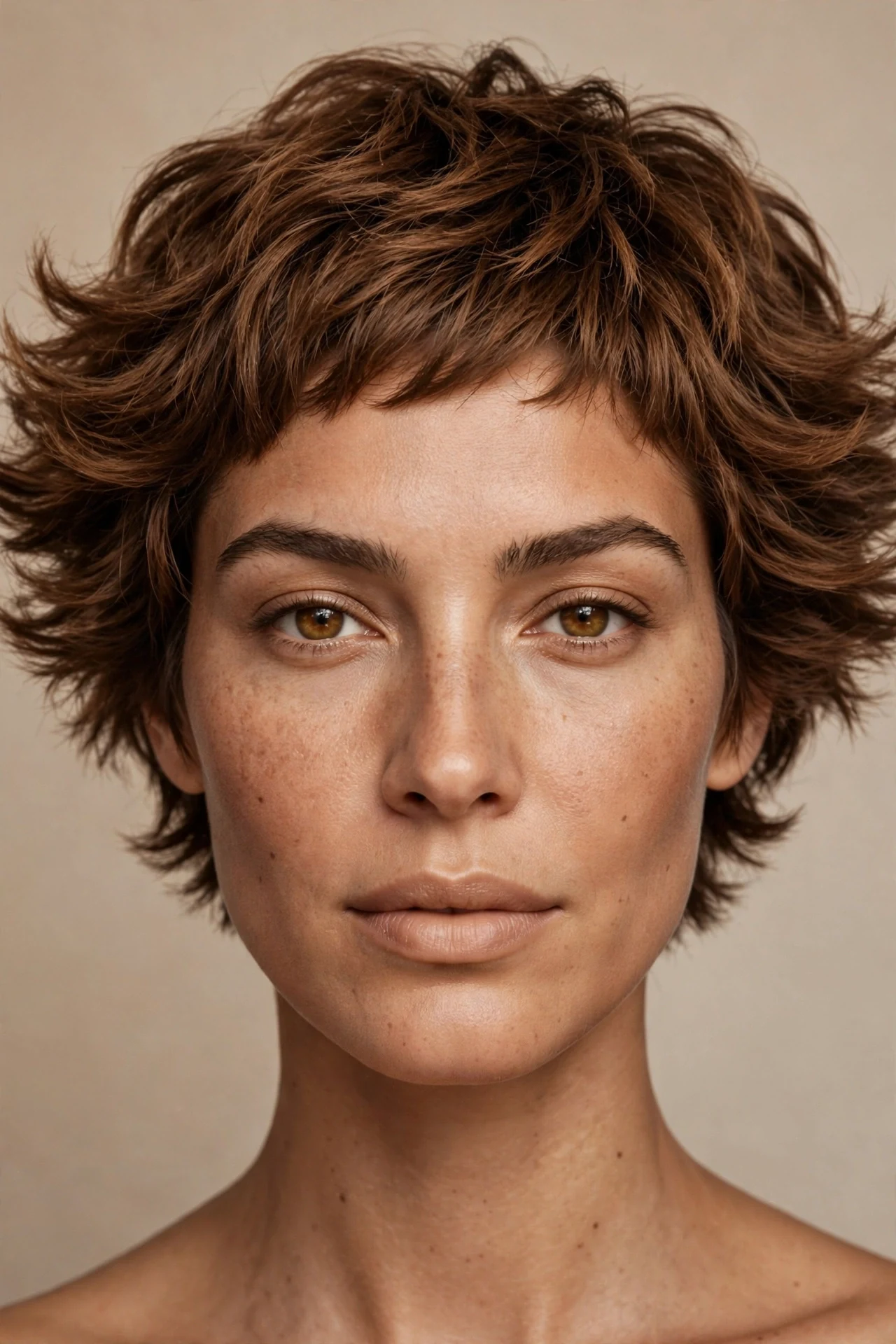
Vibe: Balanced — textured side volume on an oblong face creates horizontal width through organic movement rather than precise styling.
For oblong face shapes, a textured pixie distributes texture and volume at the sides and temples (cheek level) rather than the crown, creating horizontal visual width. The point-cut ends at the temples create natural outward movement that adds horizontal dimension organically. The crown is kept shorter to avoid adding further vertical length to an already-long face structure.
Ask for "a textured pixie with more volume and texture at the temples and sides, shorter crown — oblong face." Apply a volumising mousse to the temple sections before blow-drying horizontally outward, then finish with matte paste.
Shop The Look
| Product | Type |
|---|---|
| Volumising mousse for temple texture | Styling |
| Horizontal blow-dry round brush | Tool |
| Matte paste for side definition | Styling |
| Anti-frizz spray for side finish | Styling |
| Thickening conditioner | Haircare |
26. Textured Pixie with Grown-Out Look
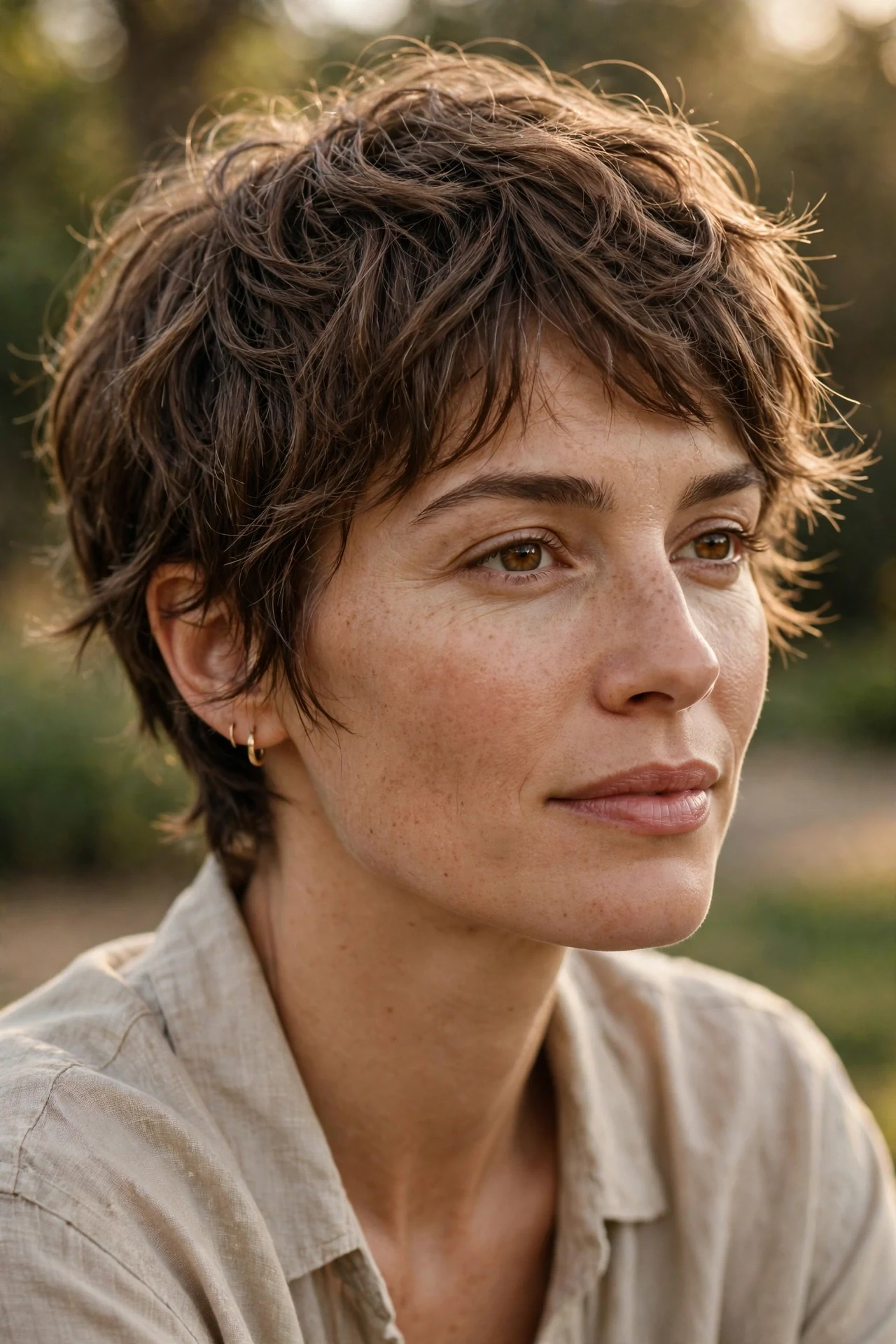
Vibe: Relaxed — a grown-out textured pixie is a style in its own right, not a waiting room between cuts.
A textured grown-out pixie at 3.5–4 inches uses soft point-cut layers that grow out gracefully — the texture absorbs the growth rather than resisting it. At this length, the hair has enough weight to move naturally and enough structure from the layers to read as intentional. A dusting trim every 8–10 weeks removes dry ends while allowing overall length progress.
Ask for "just a dusting — remove dry ends and keep the texture, I'm growing it out." Apply sea salt spray and a light matte paste for lived-in texture that makes the grown-out length read as a deliberate style.
Shop The Look
| Product | Type |
|---|---|
| Sea salt spray for grown-out texture | Styling |
| Light matte paste for definition | Styling |
| Split-end treatment serum | Haircare |
| Sulphate-free gentle shampoo | Haircare |
| Moisturising conditioner | Haircare |
27. Textured Pixie with Tonal Highlights
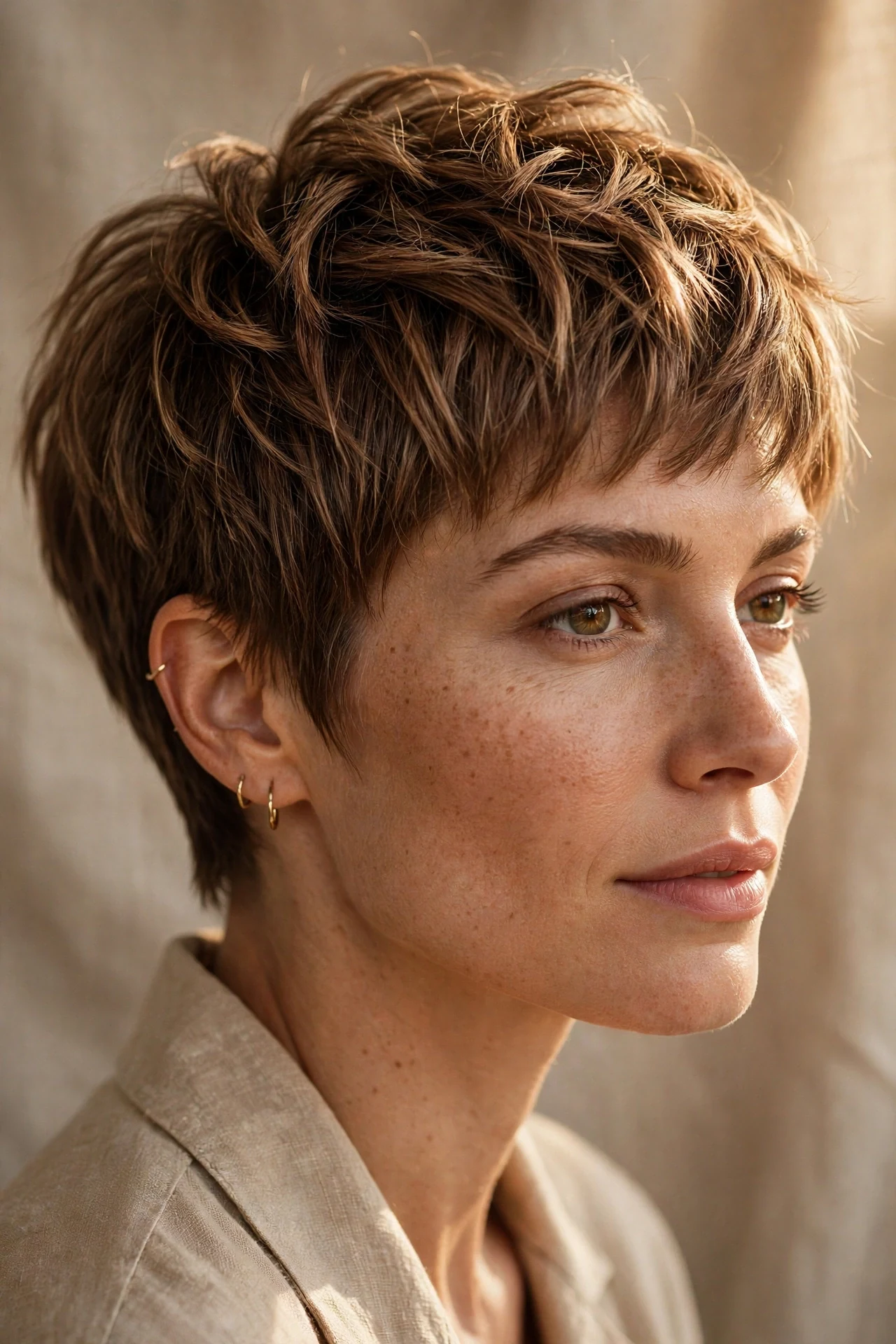
Vibe: Subtle — tonal highlights in a textured pixie add dimensional depth that reads as natural rather than coloured.
Tonal highlights on a textured pixie use a semi-permanent or demi-permanent colour to place subtly lighter pieces that read as natural sun-lightened variation. On a textured cut, these tonal pieces become individually visible through the point-cut separation — the lighter pieces catch light against the darker base pieces, creating dimension that flat smooth styling would merge into a single tone.
Ask your colourist for "a few tonal highlights in a shade or two lighter than my base — something subtle that looks natural through my textured cut." Use a colour-protecting serum before any blow-drying of the highlighted sections.
Shop The Look
| Product | Type |
|---|---|
| Colour-protecting serum for highlights | Styling |
| Sulphate-free colour shampoo | Haircare |
| Warm-toning depositing conditioner | Haircare |
| Matte clay for texture and colour display | Styling |
| Weekly repair mask highlighted hair | Haircare |
28. Statement Textured Pixie with Maximum Volume
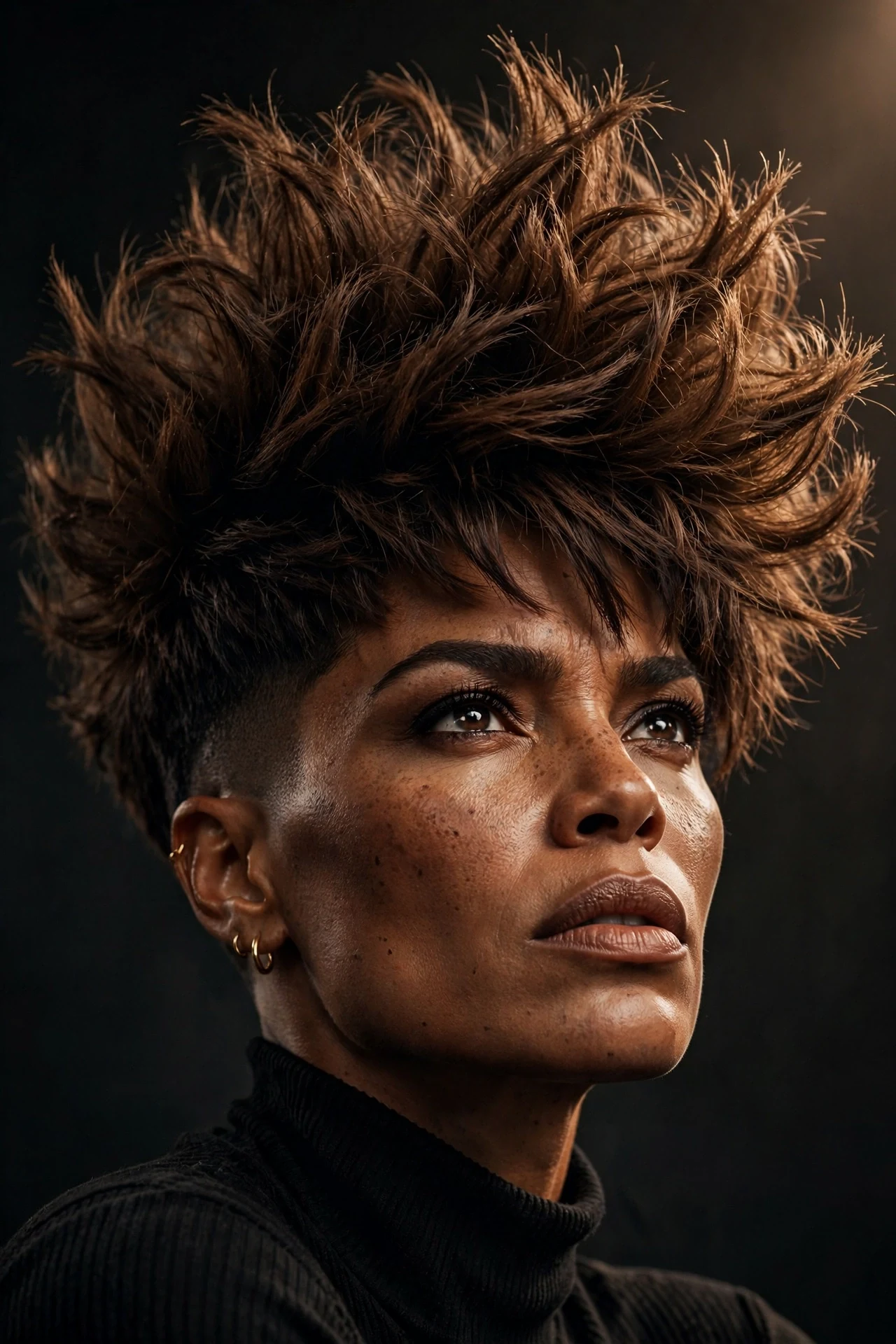
Vibe: Powerful — maximum textured volume on a close-sided pixie is a cut that announces itself and then invites you to look closer.
A statement textured pixie with maximum volume uses the longest crown length on this list (4 inches), heavily layered and point-cut throughout, over skin-faded sides. The volume is created by a root-lift mousse before blow-drying the crown upward with a large round brush, followed by a matte clay worked through in a tousling motion to separate the layered sections into visible textured pieces. The skin-fade creates maximum contrast with the volumised textured crown.
Ask for "maximum textured volume — 4 inches on top, heavily layered and point-cut, skin-fade sides." Apply root-lift mousse to crown roots, blow-dry lifting upward with a large round brush, then apply matte clay through crown in an upward tousling motion.
💡 Quick Win: After applying matte clay to the maximally volumised crown, lean your head forward (crown pointing down), shake gently, and return upright — gravity redistributes the clay through the volume naturally and the crown settles at its maximum height, approximately 20% higher than when styled upright.
Shop The Look
| Product | Type |
|---|---|
| Root-lift volumising mousse for crown | Styling |
| Strong-hold matte clay for texture | Styling |
| Large round brush for crown volume | Tool |
| Skin-fade clipper set | Tool |
| Buildable-hold finishing spray | Styling |
How to Ask Your Stylist for Feminine Textured Pixie Cuts
The single most important first move is to specify the finish you want before the stylist picks up scissors: matte or shine, separated or smooth, touchable or polished. This distinction determines which cutting techniques and which products your stylist will use, and getting it right before the first cut prevents a correction appointment. The clearest phrase is: "I want a matte, textured finish with visible separation — not smooth or sleek." This tells your stylist immediately that point-cutting, razor work, or slide-cutting is appropriate for your ends, and that pomade is not the finishing product.
The most common mistake with textured pixie cuts is using the wrong finishing product. Pomade, serum, and shine spray on a textured cut flatten the irregular ends, closing the surface texture and merging the individual tips into a smooth mass. The entire visual logic of a textured pixie — separated pieces, visual depth, movement — disappears under a high-shine product. The fix is switching to a matte clay, matte paste, or sea salt spray: products that add hold or texture without sealing the surface. If your textured pixie currently looks smooth and flat, the cut is probably correct and the product is the problem.
For under $20, three products with immediate textured-finish impact: a matte clay with medium-strong hold (approximately 14–18) for separated piece-y finishes on straight or wavy hair; a sea salt texturising spray (approximately 10–14) for natural, lived-in movement on any texture; and a texturising dry spray (approximately 10–15) for day-2 texture re-activation without washing.
A textured pixie cut with no hard geometric lines or shaved elements needs professional trimming every 7–9 weeks — the soft, irregular edges of a point-cut style grow out more gracefully than a blunt precision pixie, extending the maintenance window. Textured pixies with faded or shaved side elements need those elements touched up every 2–3 weeks. Daily styling for most textured pixie variations takes 3–7 minutes: apply one product to damp or dry hair, use fingers or diffuser, and leave.
Frequently Asked Questions About Feminine Textured Pixie Cuts
What makes a pixie cut "textured" as opposed to standard?
A textured pixie cut is distinguished by the deliberate introduction of surface irregularity — through point cutting (upward-angled scissors cuts at the ends), razor slicing (feathered tips), or slide cutting (tapered mid-lengths) — that creates movement, visual depth, and organic variation at the cut's perimeter. A standard pixie cut uses consistent guard lengths or clean scissors cuts that produce a uniform surface. The finish products reinforce this: textured pixies use matte clay, sea salt spray, or paste; standard pixies use pomade, serum, or shine spray. If a short cut has visible, separated, irregular ends and a matte finish, it's textured.
What hair texture works best for a textured pixie cut?
All hair textures suit a textured pixie cut, but the approach differs significantly by texture. Straight hair requires the texture to be cut in — point cutting, razor work, and matte products are essential because straight hair doesn't provide natural texture. Wavy hair (2C/3A) is the most naturally suited texture for a textured pixie because the wave adds organic movement that the cut simply needs to proportion correctly. Curly and coily hair is its own texture — the cut shapes it rather than manufacturing it. Fine hair benefits particularly from razor-cut textured pixies because the feathered ends create apparent density. Thick hair needs internal thinning before surface texture work to manage bulk.
How much does a textured pixie cut cost?
A textured pixie cut at a quality specialist salon costs 60–110 in the US and £50–£85 in the UK. Textured cuts sometimes take slightly longer than standard pixie cuts because the point-cutting and razor work require more individual attention per section — some salons price the appointment 10–15% higher for this. Any colour added — vivid all-over, balayage, or platinum — brings the combined appointment to 120–230+. Textured pixies without shaved elements need professional trimming every 7–9 weeks, making them marginally less expensive to maintain than precision pixies requiring more frequent 5–6 week touch-ups.
How do you style a textured pixie cut at home?
The three most effective home-styling approaches for textured pixies: (1) Apply a matte clay to dry fingertips, work through the crown in a pinching-and-separating motion — 3 minutes, done; (2) Apply a sea salt spray to damp hair, scrunch once, and air dry completely without touching — 0 active styling minutes; (3) Apply a volumising mousse to damp roots only, blow-dry lifting from underneath with fingers on medium heat — 5 minutes for volume and texture together. The universal rule: never use a comb or brush after applying matte products to a textured pixie — combing merges the separated pieces and removes the texture entirely.
How long does a textured pixie cut last before needing a trim?
A textured pixie cut with soft, point-cut edges lasts 7–9 weeks before the shape begins to lose its proportional quality — the irregular ends absorb the first 2–3 weeks of growth gracefully, making the grow-in phase less noticeable than on precision blunt-cut pixies. Textured pixies with fade or shaved elements need those specific areas touched up every 2–3 weeks, but the top section can continue to 7–9 weeks. The lived-in, natural character of textured finishes also makes the growing-in period more stylish than a sleek pixie's equivalent phase — at 8 weeks, a textured pixie reads as deliberately relaxed rather than overdue.
Ready to Try Feminine Textured Pixie Cuts?
These 28 ideas cover the full range of what texture on a pixie can be — from the precise, separated energy of a piece-y matte crop and the organic freedom of a sea salt wave pixie, to the expressiveness of defined curls and the power of maximum volumised texture, with colour variations, face-shape adaptations, and genuinely low-maintenance options throughout. Finding the right texture approach for your specific hair is usually a one-appointment discovery — describe the finish you want (matte and separated, organic and tousled, or voluminous and lifted) and bring a reference image, and your stylist will choose the appropriate cutting technique. Start today by saving the one or two ideas that made you want to reach for your phone and book an appointment — that instinct is the most accurate guide. Pin your favourites and return to this list when you're ready for the next textured variation.