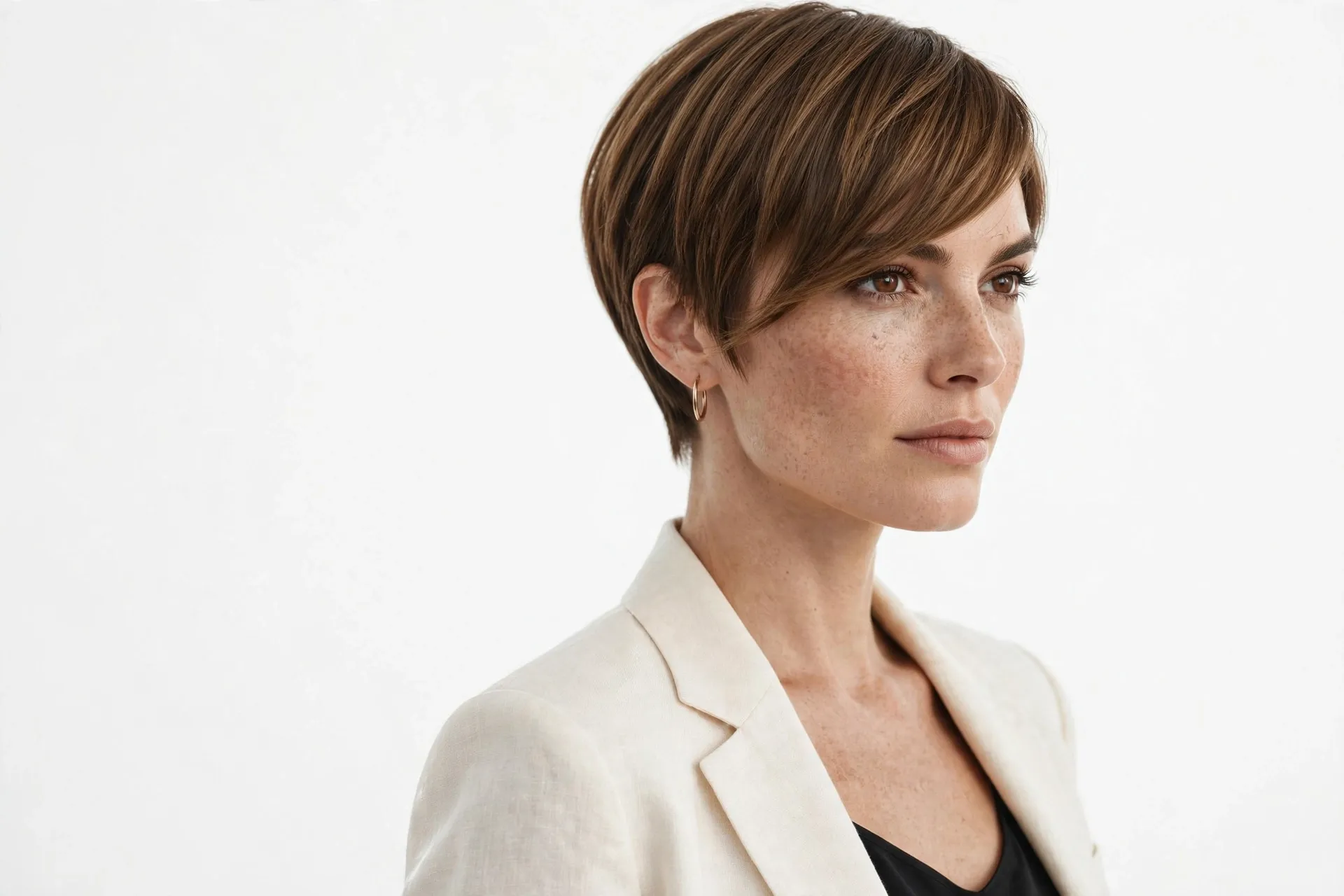
A feminine pixie cut with bangs is a precision short style that uses a fringe — blunt, wispy, diagonal, curtain, or micro — as the cut's primary design element, placing intentional length and shape at the forehead to frame the face and define the entire look. This article gives you exactly 29 variations: from classic blunt fringes and soft curtain bangs to bold micro bangs and textured piece-y styles, with image prompts, technique notes, product picks, and tips for every one.
The fringe on a pixie cut changes everything about how it reads — it turns a short crop into a deliberate composition, placing the forehead as a design surface and the eyes as the focal point. Feminine pixie cuts with bangs are among the most expressive and face-specific short styles available right now, because the fringe can be tuned precisely to the face shape, hair texture, and personality of the person wearing it. Here are 29 ideas worth saving — and showing your stylist.
Why Feminine Pixie Cuts with Bangs Work So Well
Pixie cuts with bangs have a continuous history in fashion from the early 1960s — Sassoon's geometric precision cuts introduced the blunt fringe as a structural design element, and subsequent decades added wispy, asymmetric, curtain, and micro variations. What distinguishes a pixie with bangs from a standard pixie is the deliberate relationship between the forehead and the fringe: the fringe is not a leftover section but an intentional frame, cut specifically to interact with the face shape and placed at a precise length that creates the intended effect. A blunt fringe draws the eye to the eyes; a diagonal fringe creates movement; a micro fringe exposes the forehead as a design surface; a curtain fringe softens and frames simultaneously.
The core techniques for bangs on a pixie cut are: dry cutting for blunt and precise fringes (wet cutting creates shrinkage surprises on delivery); razor cutting for wispy or textured fringe ends; point cutting for soft diagonal or curtain fringes; and precision clipper work at the hairline below any fringe that sits above a close-cut side or taper. For product, a fine-tooth comb with a tiny amount of light-hold serum or pomade is the standard blunt fringe finishing approach; a lightweight mousse on damp fringe sections before diffusing produces the best curl-fringe result; a flat iron on the lowest heat setting tames any fly-away fringe sections in 30 seconds.
Feminine pixie cuts with bangs are one of the most searched short hair variations right now — particularly curtain bangs on pixies, driven by the broader curtain bang trend that has dominated social media for several years and is now being applied at short lengths. The micro bang has returned from its 1990s and early 2000s origins as an editorial and high-fashion choice; the blunt fringe on a pixie remains a perennial classic that re-enters trend cycles every 3–4 years. Currently, the texturised, piece-y fringe — neither fully blunt nor fully wispy — is the most requested variation at forward-thinking salons.
Bangs on a pixie work across all hair textures but behave differently on each: blunt fringes are easiest to maintain on straight hair; curtain and wispy fringes work on straight and wavy textures; curly fringes require shrinkage allowance (cut longer than intended final length) and a DevaCut approach; thick hair fringes need internal thinning to lie flat. Face shape guidance: blunt fringes suit oval and heart shapes best; diagonal fringes work across all face shapes; curtain fringes are the most universally flattering; micro bangs suit strong, defined features most effectively.
| Element | Blunt/Precise Approach | Soft/Textured Approach |
|---|---|---|
| Philosophy | Geometric frame, strong statement | Movement and softness, face-following |
| Technique | Dry cut horizontal scissors | Point cut or razor, damp hair |
| Best for | Straight hair, oval/heart faces | Wavy/curly hair, all face shapes |
29 Feminine Pixie Cuts with Bangs
1. Classic Blunt Fringe Pixie
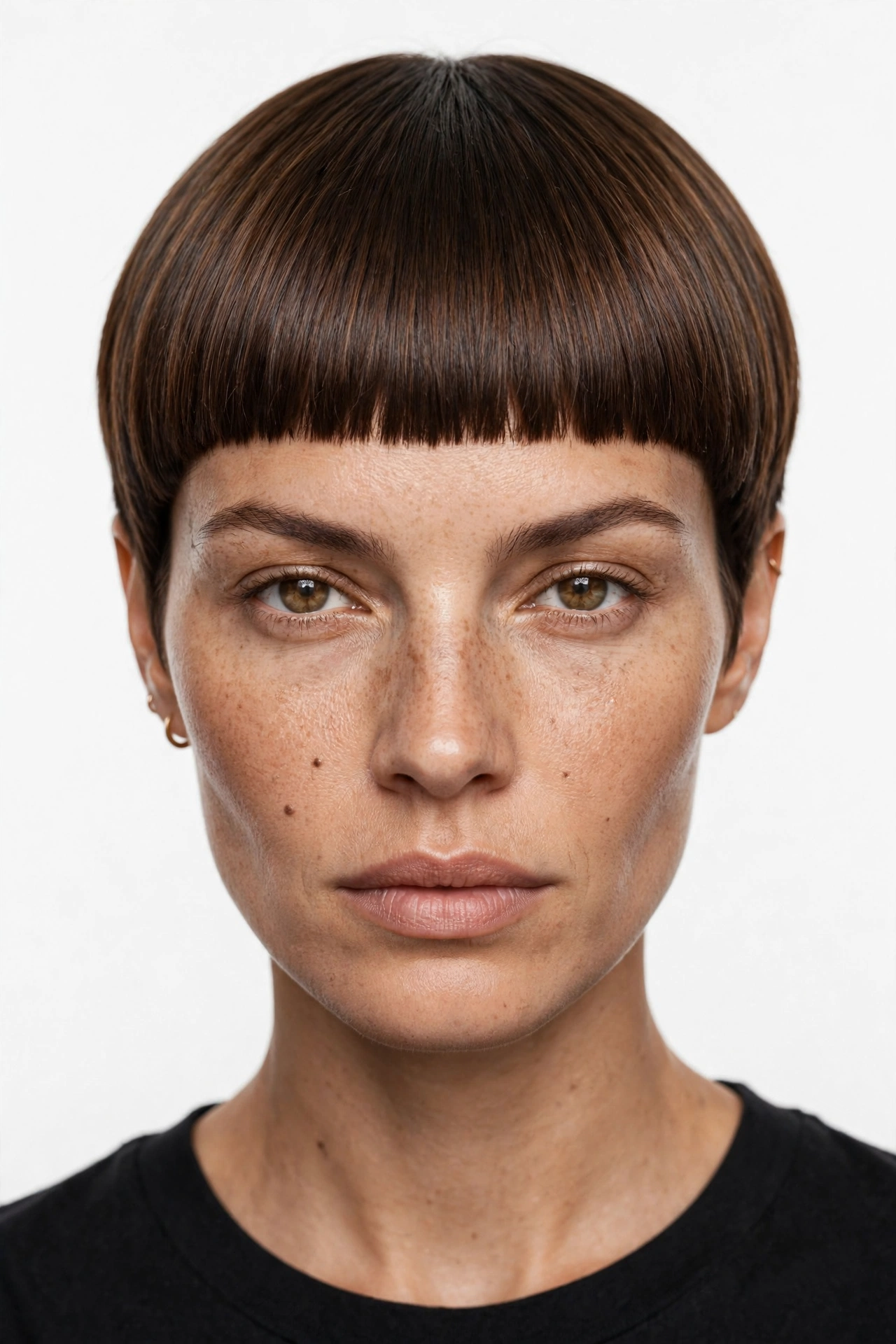
The classic blunt fringe is cut horizontally across the forehead at mid-brow, creating a clean geometric line that draws the eye directly to the eyes. The technical requirement is dry cutting — the stylist cuts the fringe on completely dry, straight hair so the final length is exactly what they see, without wet-to-dry shrinkage surprises. The fringe section should be no wider than brow-to-brow; a wider fringe begins to bleed into the side sections and loses the clean framing quality.
Ask for "a blunt fringe at mid-brow — please cut it dry so I see exactly where it falls." At home, maintain with small hair scissors and a horizontal comb: hold the comb at the desired length, cut along the comb, never freehand.
💡 Quick Win: On humid days when a blunt fringe puffs or lifts, apply a single dab of anti-humidity serum to dry fingertips and press gently through the fringe from root to tip — the serum seals the cuticle flat and keeps the blunt line intact without adding visible product.
Shop The Look
| Product | Type |
|---|---|
| Anti-humidity finishing serum | Styling |
| Small sharp haircutting scissors | Tool |
| Fine-tooth fringe comb | Tool |
| Smoothing light pomade | Styling |
| Mini flat iron for fringe touch-up | Tool |
2. Wispy Fringe Pixie
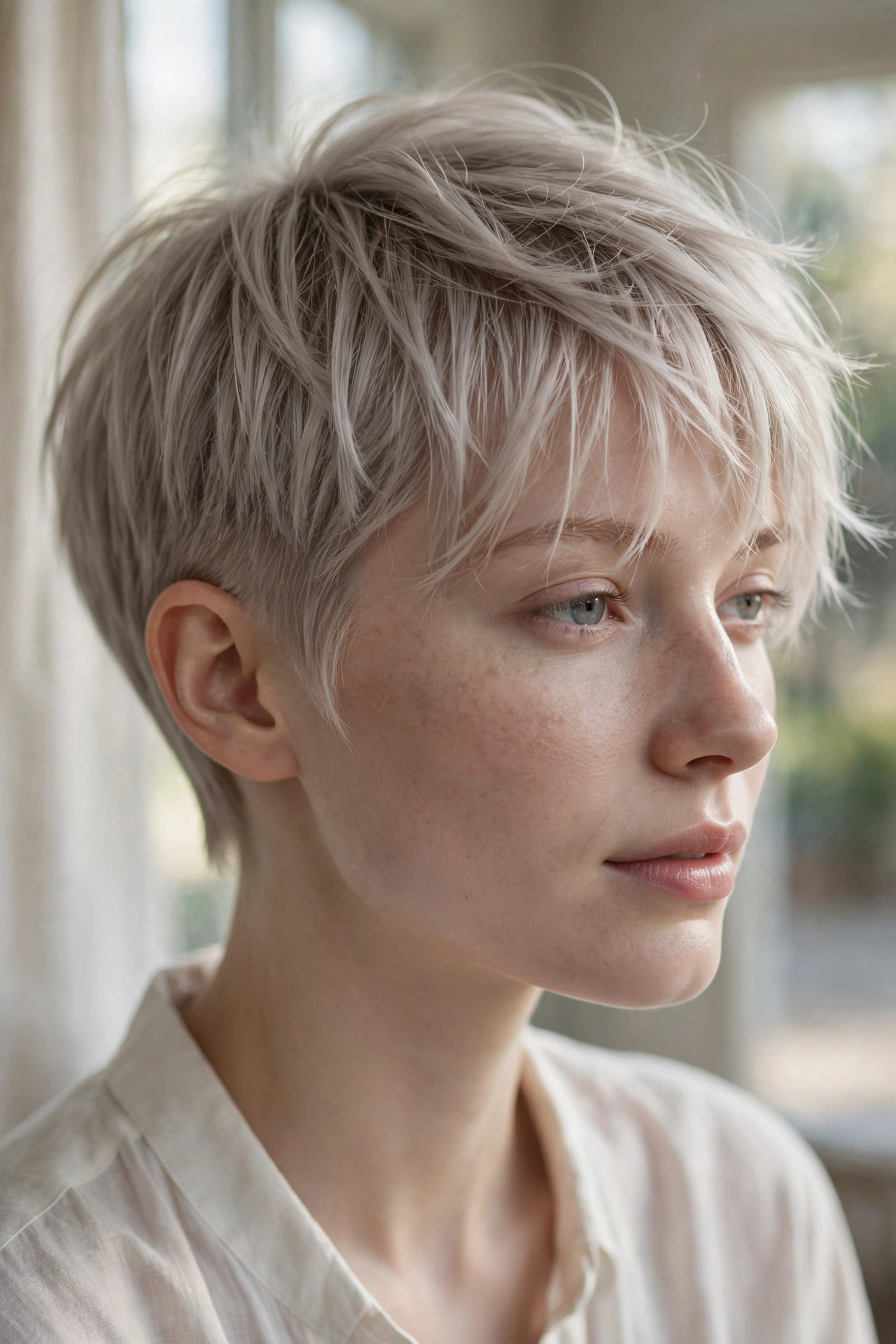
A wispy fringe is created with a razor on damp hair, cutting at a near-parallel angle to the hair section to produce fine, tapered tips rather than blunt ends. The individual tips catch light separately and create an airy effect across the forehead. On fine hair, the wispy fringe actually creates the impression of more hair because the multiple individual tips multiply the visual density at the forehead. The fringe should be cut on damp hair for the razor technique, then blow-dried to its final position.
Ask for "a wispy razor-cut fringe — I want feathered, airy ends, not a blunt line." Apply a single pump of lightweight thermal serum to the damp fringe section, blow-dry with a small round brush rolling slightly forward, and avoid touching the ends once dry.
Shop The Look
| Product | Type |
|---|---|
| Lightweight thermal serum for fringe | Styling |
| Small round brush for fringe blow-dry | Tool |
| Razor styling comb for maintenance | Tool |
| Featherweight finishing mist | Styling |
| Volumising mousse fine hair | Styling |
3. Curtain Bangs Pixie

Curtain bangs on a pixie are cut with a centre part, longer in the middle (brow level) and graduated shorter toward the temples where they connect with the side taper. The characteristic inward curve at the tips is achieved with a small round brush during blow-drying — rolling the brush under the fringe and curling it slightly inward for the last 3 seconds of each section. On straight hair, this curve holds through the day; on wavy hair, the natural wave creates the curve without intervention.
Ask for "curtain bangs on my pixie — centre-parted, brow length in the middle, I want the ends to curve in." Blow-dry the curtain fringe in two sections from the centre part outward, rolling the brush inward at the tips.
Shop The Look
| Product | Type |
|---|---|
| Light-hold serum for curtain fringe | Styling |
| Small round brush for inward curve | Tool |
| Flexible-hold curtain fringe spray | Styling |
| Smoothing conditioner for fringe | Haircare |
| Mini flat iron for fringe touch-up | Tool |
4. Micro Bang Pixie
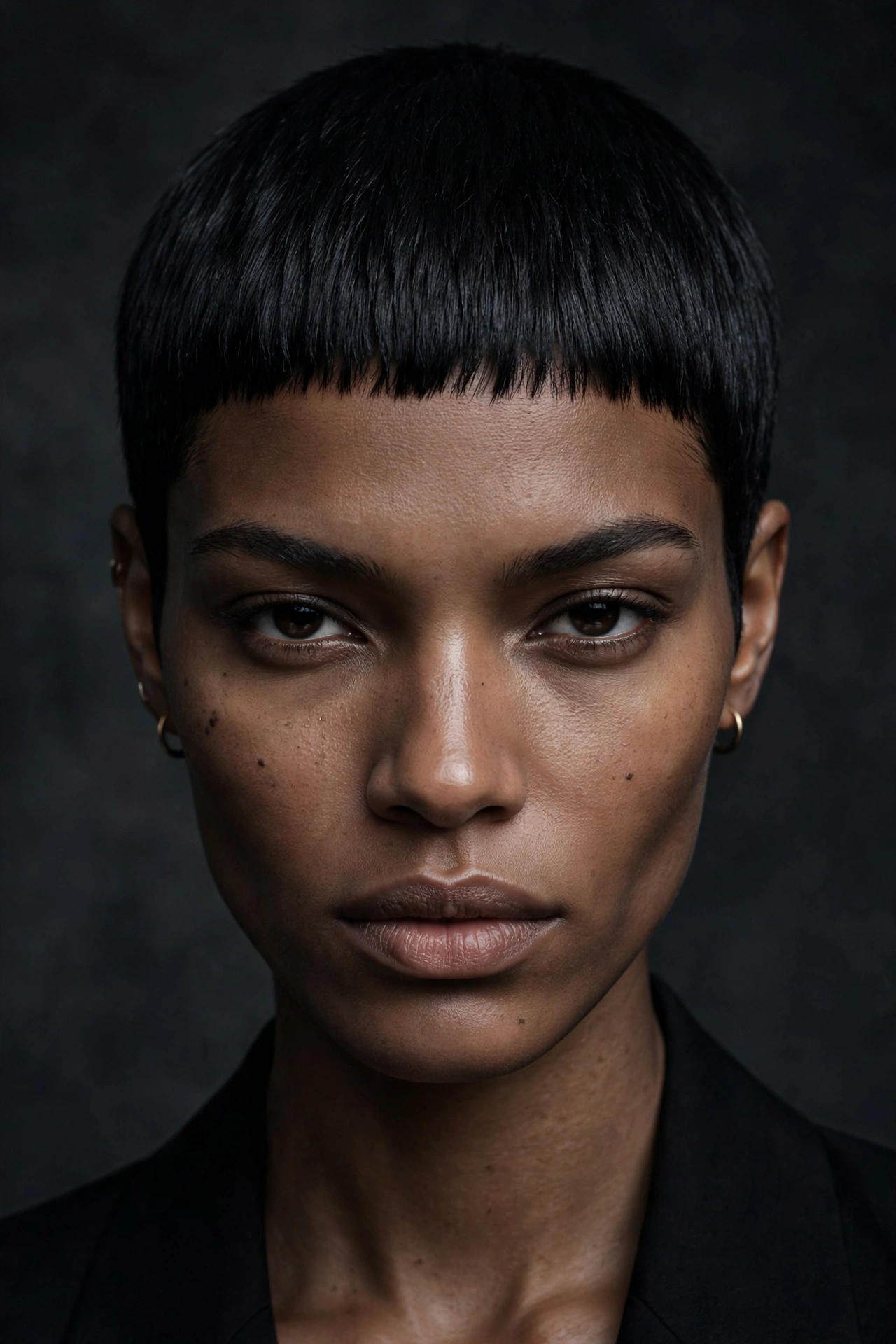
A micro bang sits at 1–1.5 centimetres from the hairline — far shorter than a standard fringe, sitting just at the upper forehead rather than falling to the brows. This exposes the majority of the forehead as a design surface and creates a graphic, editorial frame for the eyes. The technical execution is precise: the micro fringe must be cut absolutely straight across on dry hair, and because it's so short, even 2 millimetres of inconsistency is visible. Maintenance is every 2–3 weeks as the fringe grows down quickly at this length.
Ask for "a micro bang at about 1.5 cm — very short, straight across, cut dry." Use a very small amount of edge-smoothing gel on fingertips and press through the micro fringe to keep every strand lying flat and straight.
💡 Quick Win: Photograph your micro fringe immediately after your appointment, straight-on against a white wall — this image becomes your reference for future appointments and for at-home touch-ups, because the precise length of a micro bang is almost impossible to communicate in words.
Shop The Look
| Product | Type |
|---|---|
| Edge-smoothing gel for micro bang | Styling |
| Precision small scissors for touch-ups | Tool |
| Fine-tooth fringe comb | Tool |
| Anti-frizz serum for flat finish | Styling |
| Clear edge gel for hairline | Styling |
5. Diagonal Side-Swept Bang Pixie
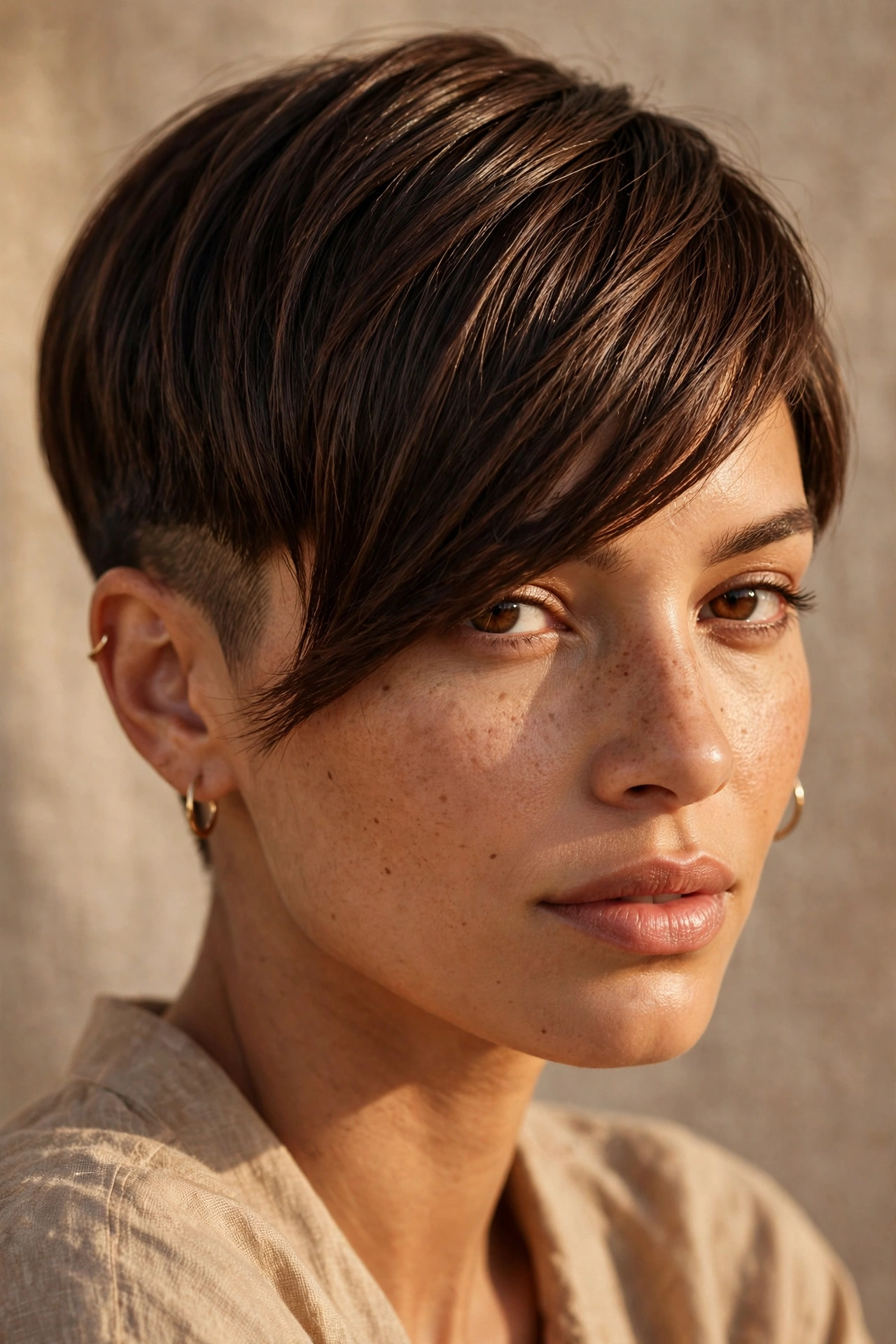
A diagonal side-swept bang uses asymmetric length — longer at one corner of the fringe (approximately 3 inches), graduating shorter toward the opposite temple where it meets the taper. The diagonal line this creates across the forehead introduces movement and asymmetry simultaneously, making it the most universally flattering fringe variation for face shapes that benefit from breaking horizontal symmetry. The sweep is trained during blow-drying with a round brush following the diagonal direction from root to tip.
Ask for "a diagonal bang that sweeps across — longer on the left, graduating shorter where it meets my right taper." Apply a small amount of light-hold pomade to the fringe section, blow-dry following the diagonal direction with a medium round brush.
Shop The Look
| Product | Type |
|---|---|
| Light-hold directional pomade | Styling |
| Medium round brush for diagonal blow-dry | Tool |
| Anti-humidity diagonal set spray | Styling |
| Smoothing daily conditioner | Haircare |
| Satin pillowcase for fringe direction | Accessory |
6. Textured Piece-y Fringe Pixie
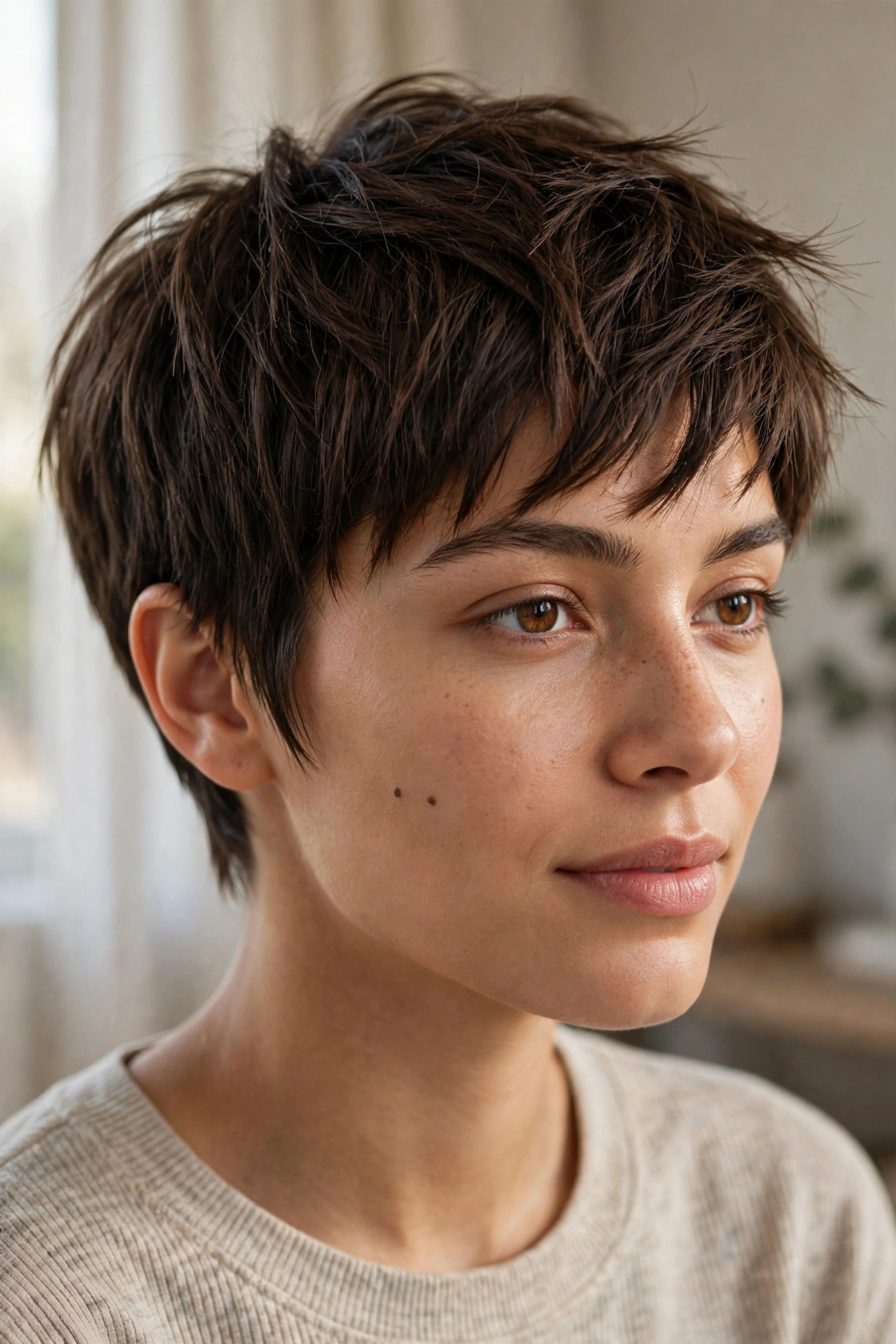
A piece-y fringe uses point-cutting throughout the fringe section — cutting upward into the ends at a 45-degree angle rather than straight across — to create irregular, separated tips that catch light individually rather than lying as a solid block. The result is a fringe that has shape and direction but reads as textured and touchable rather than architectural. The finish is a matte paste applied to dry fingers and worked through the fringe section in a pinching-and-separating motion, creating defined but irregular pieces.
Ask for "a piece-y textured fringe — point-cut ends throughout, I want visible separation, not a solid line." Apply a pea-sized matte paste to dry fingertips, pinch small sections of the fringe, and separate — work quickly before the paste sets.
Shop The Look
| Product | Type |
|---|---|
| Matte styling paste for piece-y finish | Styling |
| Point-cut thinning scissors | Tool |
| Texturising dry spray for fringe | Styling |
| Sulphate-free daily shampoo | Haircare |
| Fine-tooth comb for fringe reset | Tool |
7. Curly Fringe Pixie
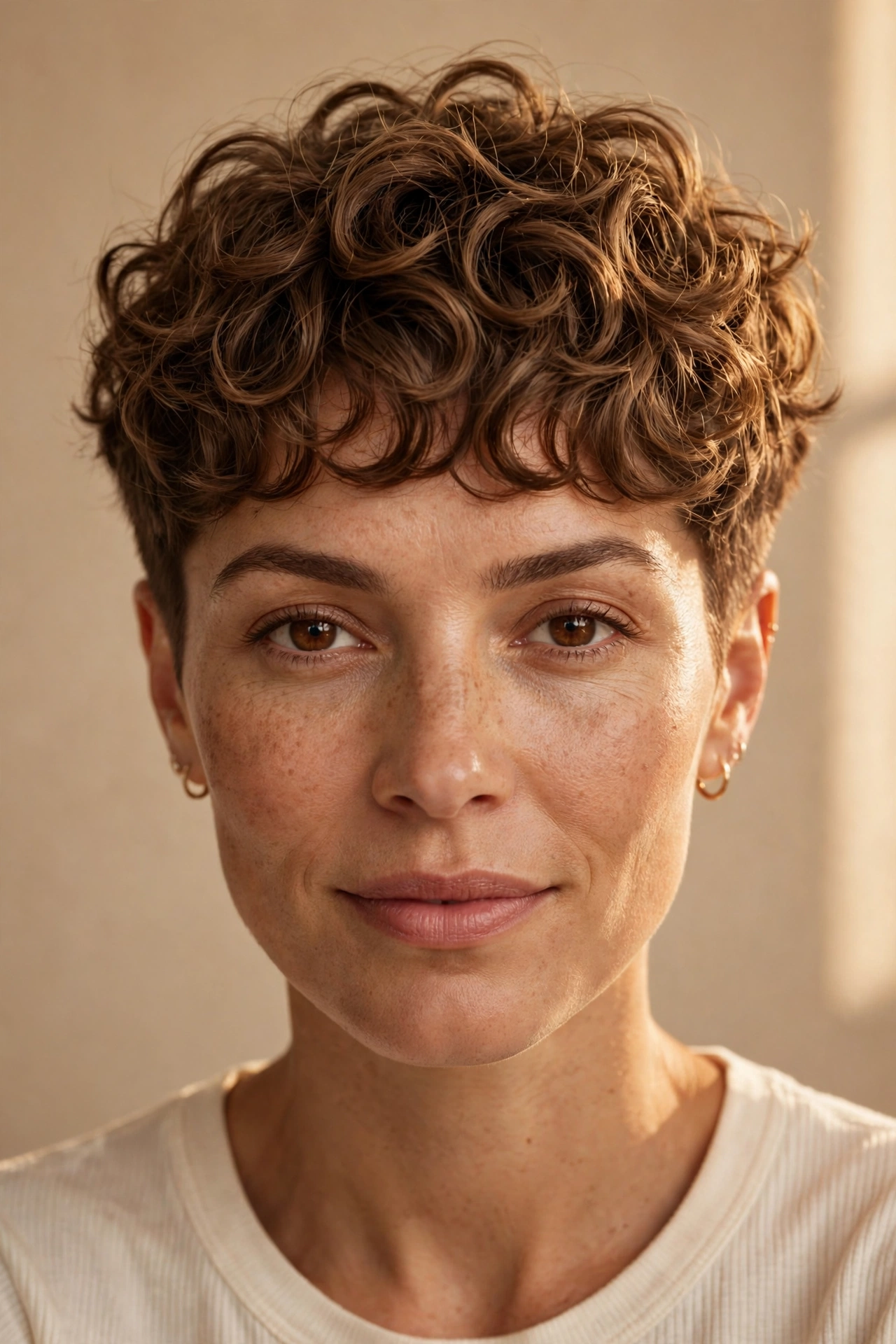
A curly fringe requires the stylist to account for shrinkage: curly hair at 2.5 inches cut length will spring up to approximately 1.5–2 inches once dry, depending on curl tightness. The stylist must cut the fringe longer than the intended final position — add 30–50% to the desired dry length. A DevaCut or dry-cut approach is recommended so the stylist sees exactly where each curl will fall. The fringe section is defined with a small amount of curl mousse applied before diffusing.
Ask for "a curly fringe on my pixie — please cut it dry accounting for shrinkage, I want it to fall to mid-brow when dry." Apply curl mousse to the damp fringe section, scrunch gently, and diffuse on low heat for 2–3 minutes to set the curl direction.
💡 Quick Win: On days when the curly fringe loses definition, mist with a water-and-aloe-vera spray (50/50 mix in a small bottle), scrunch the fringe upward once, and let it re-dry without touching — this resets the curl pattern in about 20 minutes without a full wash.
Shop The Look
| Product | Type |
|---|---|
| Curl mousse for fringe definition | Styling |
| Diffuser attachment for fringe setting | Tool |
| Aloe vera curl refresh spray | Styling |
| Sulphate-free curl shampoo | Haircare |
| Microfibre towel for fringe drying | Accessory |
8. French Crop Pixie with Horizontal Fringe

The French crop positions the fringe as a forward-falling horizontal element rather than a swept or styled feature — it lies flat across the forehead at mid-brow with minimal or no product, directed by the cut's natural fall. On straight hair, this fringe needs nothing but air-drying to land correctly. The sides are tapered closely (1-guard) and the nape is kept clean. This is the lowest-maintenance fringe on this list.
Ask for "a French crop — forward-falling fringe at mid-brow, 1-guard taper sides, clean nape. Cut the fringe dry." Apply a single drop of anti-frizz serum to damp hair, comb the fringe forward, and air dry completely.
Shop The Look
| Product | Type |
|---|---|
| Anti-frizz drop serum | Styling |
| Fine-tooth horizontal fringe comb | Tool |
| Small scissors for fringe maintenance | Tool |
| Gentle daily sulphate-free shampoo | Haircare |
| Satin pillowcase for fringe shape | Accessory |
9. Silver Pixie with Blunt Fringe
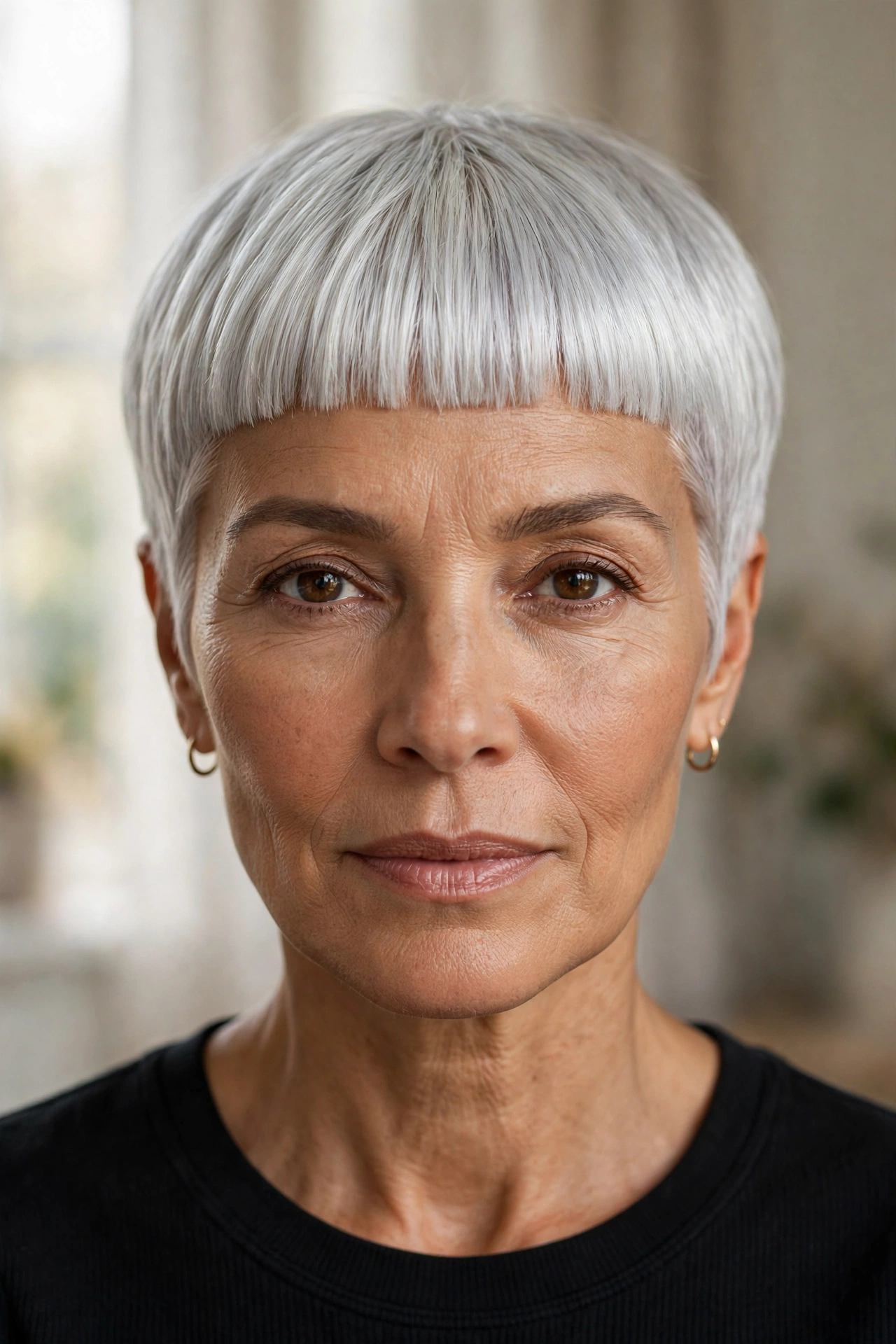
A blunt fringe on a silver pixie uses the same dry-cut horizontal technique as any blunt fringe, but the silver or white colour amplifies the fringe's graphic quality — the bright colour against the skin reads as a stronger line than a darker fringe would. Silver hair's slightly coarser texture means the fringe holds its horizontal shape particularly well. A weekly purple toning conditioner (3 minutes) keeps the fringe's silver-white bright without a yellow cast.
Ask for "a blunt fringe on my silver pixie — mid-brow, cut dry." Apply a silicone-free smoothing serum to the damp fringe before blow-drying flat with a fine-tooth comb.
Shop The Look
| Product | Type |
|---|---|
| Silicone-free smoothing serum | Styling |
| Purple toning conditioner silver hair | Haircare |
| Fine-tooth fringe comb | Tool |
| Silver-brightening shampoo | Haircare |
| Anti-frizz finishing spray | Styling |
10. Pixie with Long Side Bang
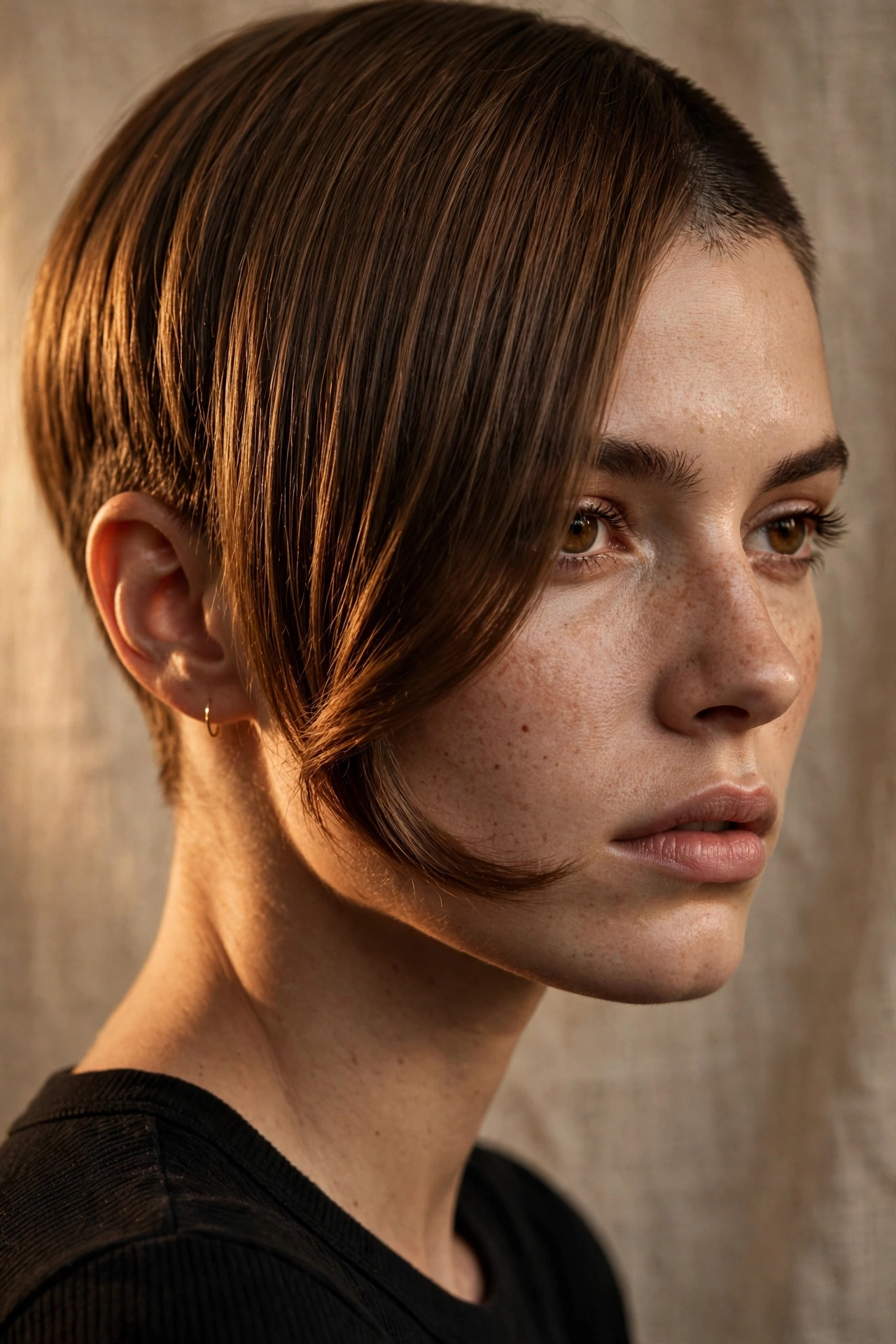
A long side bang is a disconnected element — cut at 3.5 inches on one side, completely separate from the close crop of the rest of the cut. On straight hair, this piece falls cleanly and flat, creating a bold asymmetric face frame that draws the eye along its length toward the jaw. The technical execution requires the bang to be cut on dry hair in its natural fall position; the stylist must confirm the final landing point before cutting, as straight hair doesn't spring back like curly hair.
Ask for "a long side bang on my pixie — approximately 3.5 inches falling to my cheek, everything else short." Style the long bang with a mini flat iron for a perfectly smooth fall, applying a small amount of serum before ironing.
Shop The Look
| Product | Type |
|---|---|
| Mini flat iron for long bang smooth | Tool |
| Smoothing serum for bang finish | Styling |
| Heat protectant for flat iron | Styling |
| Strong-hold light spray for bang | Styling |
| Tail comb for precise separation | Tool |
11. Choppy Fringe Pixie
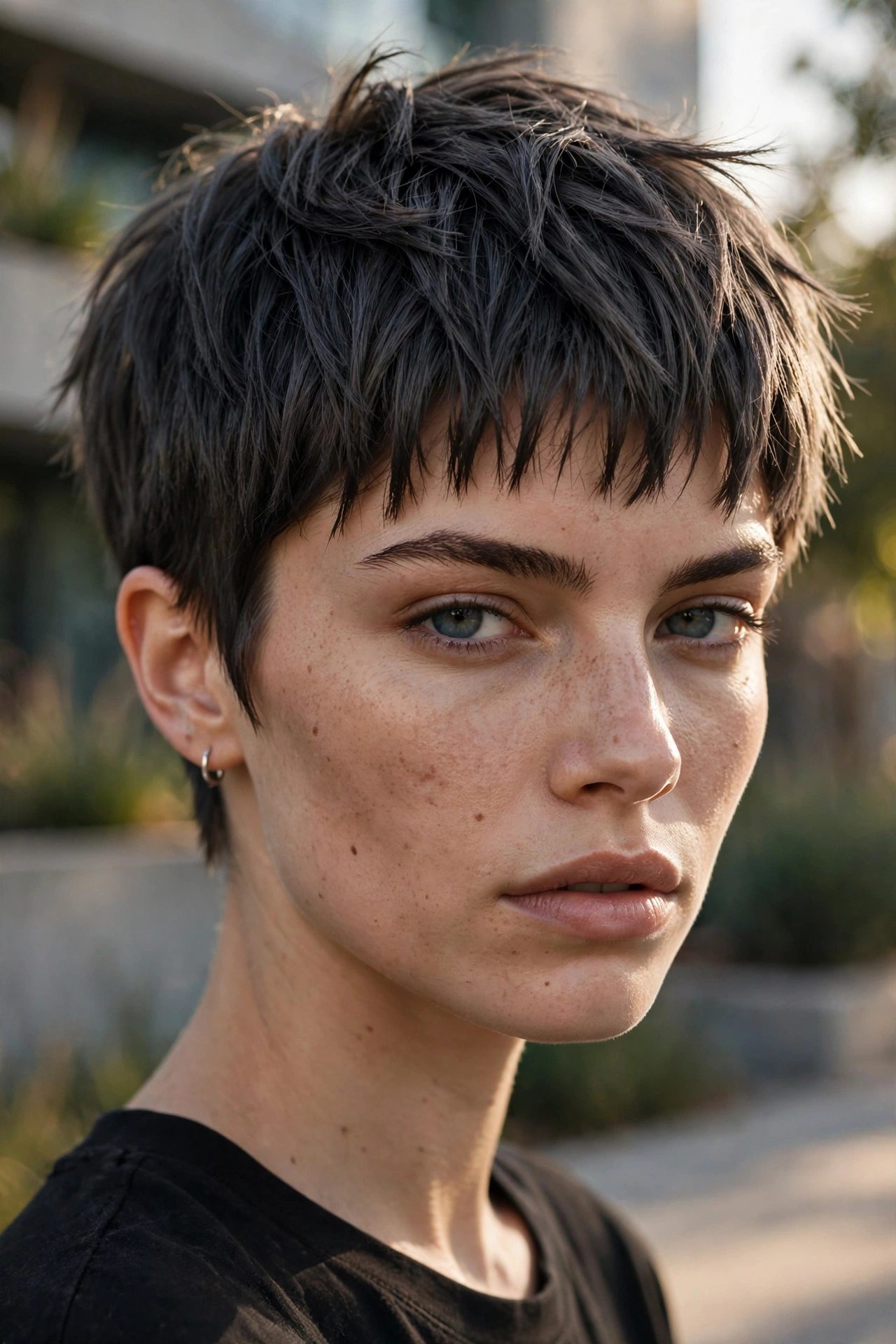
A choppy fringe is point-cut throughout — the stylist holds the fringe section and cuts upward into the ends at various angles and depths, creating an irregular edge where some strands are fractionally shorter or longer than others. The result is a fringe that has a general position (mid-brow) but an irregular, textured edge rather than a clean horizontal line. On straight hair, the choppy ends remain individually visible and hold the textured quality through the day.
Ask for "a choppy fringe — point-cut ends throughout, I want an irregular texture, not a clean line." Apply a matte clay to dry fingertips, press through the fringe in a gentle forward motion to separate individual pieces slightly, and leave without further combing.
Shop The Look
| Product | Type |
|---|---|
| Matte clay for piece separation | Styling |
| Texturising sea salt spray | Styling |
| Point-cut thinning scissors | Tool |
| Sulphate-free daily shampoo | Haircare |
| Dry shampoo for fringe refresh | Styling |
12. Platinum Pixie with Blunt Bang
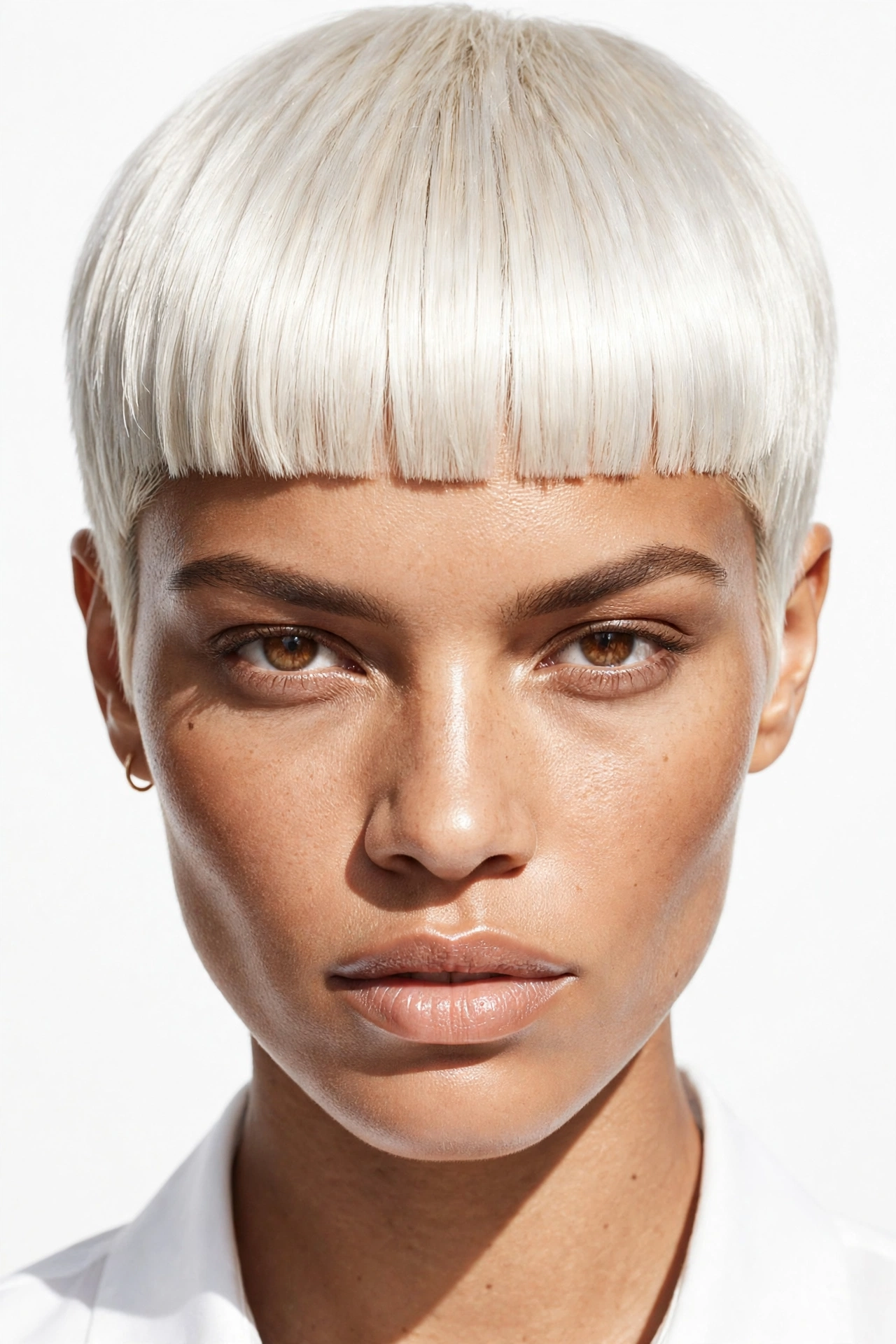
Platinum blonde amplifies the graphic quality of a blunt fringe — the bright white against the skin creates the sharpest possible horizontal line at the brow. On a pixie length, the platinum-with-blunt-fringe combination is one of the most immediately recognisable and fashion-forward looks in short hair. Maintenance requires both fringe trimming every 2–3 weeks (straight hair grows quickly and the blunt edge softens fast) and purple toning shampoo twice weekly to keep the platinum from going brassy.
Ask your colourist for "a full platinum lift with a cool toner, and ask your stylist to cut a blunt fringe dry at the same appointment." Always cut the fringe after the colour service — wet hair from the colour rinse will change the length reading.
💡 Quick Win: Keep a small pair of nail scissors in your bathroom and trim just the fringe straight across against a horizontal comb held at mid-brow every 2 weeks — it takes 90 seconds and extends the blunt fringe's precision by 3–4 weeks between salon appointments.
Shop The Look
| Product | Type |
|---|---|
| Purple toning shampoo platinum | Haircare |
| Bond-strengthening treatment bleached | Haircare |
| Smoothing serum platinum fringe finish | Styling |
| Moisturising conditioner bleached hair | Haircare |
| Small scissors for fringe maintenance | Tool |
13. Pixie with Curtain Bangs on Wavy Hair
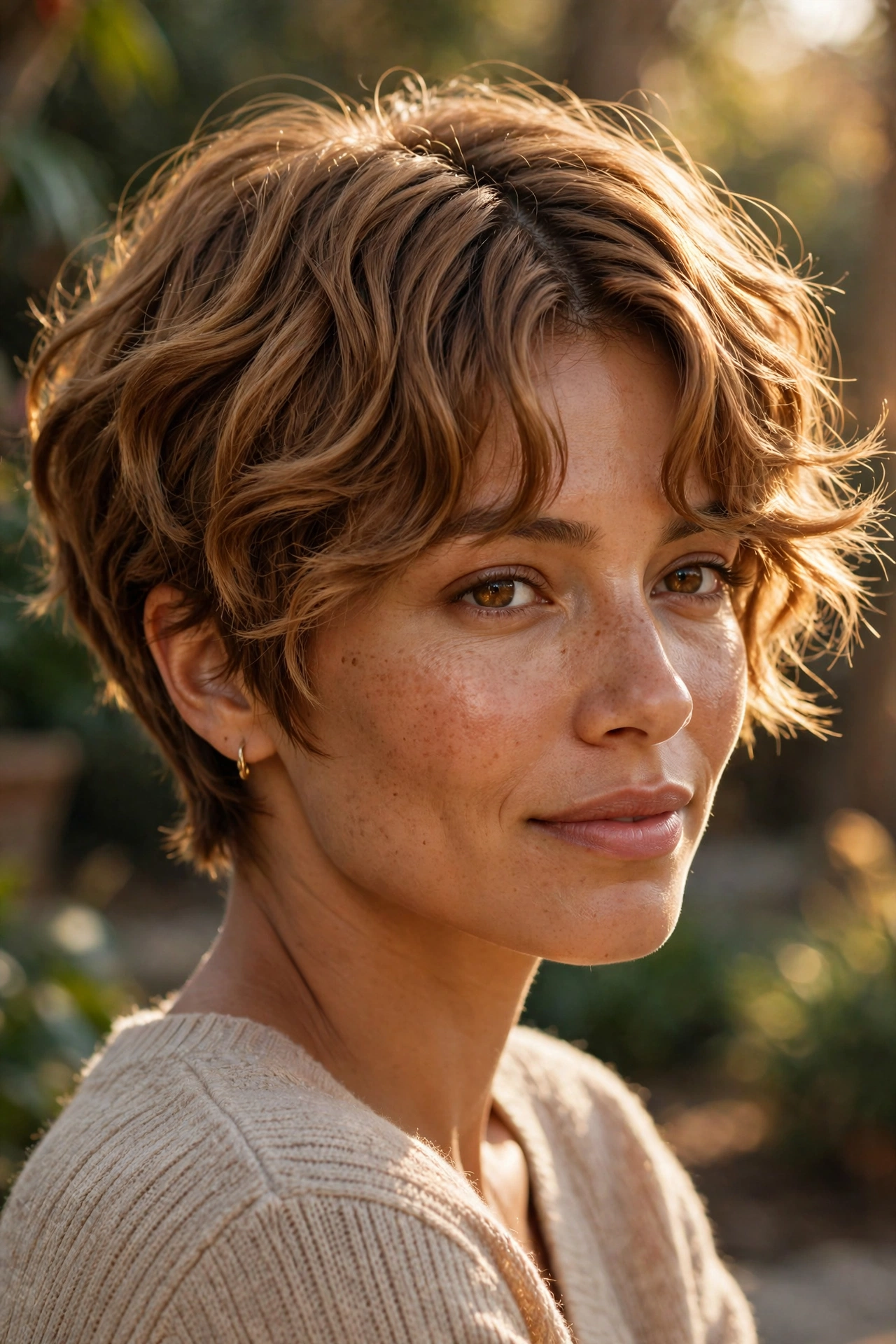
Curtain bangs on wavy hair are the lowest-maintenance version of this style because the natural wave creates the characteristic inward-curving tips without any blow-dry intervention. The stylist must cut the curtain fringe slightly longer than the intended final position to account for wave shrinkage, then check the final length after air-drying. The centre part and the wave's natural movement create the curtain shape organically.
Ask for "curtain bangs on my wavy pixie — cut them with my natural wave in mind, longer than final length to account for shrinkage." Apply a light mousse to the damp curtain fringe, part in the centre, and let air dry completely without touching.
Shop The Look
| Product | Type |
|---|---|
| Lightweight curl mousse curtain fringe | Styling |
| Curl refresher mist for day-2 fringe | Styling |
| Leave-in conditioner wavy fringe | Haircare |
| Diffuser for wave setting | Tool |
| Anti-frizz serum for wavy finish | Styling |
14. Bold Colour Pixie with Blunt Bang
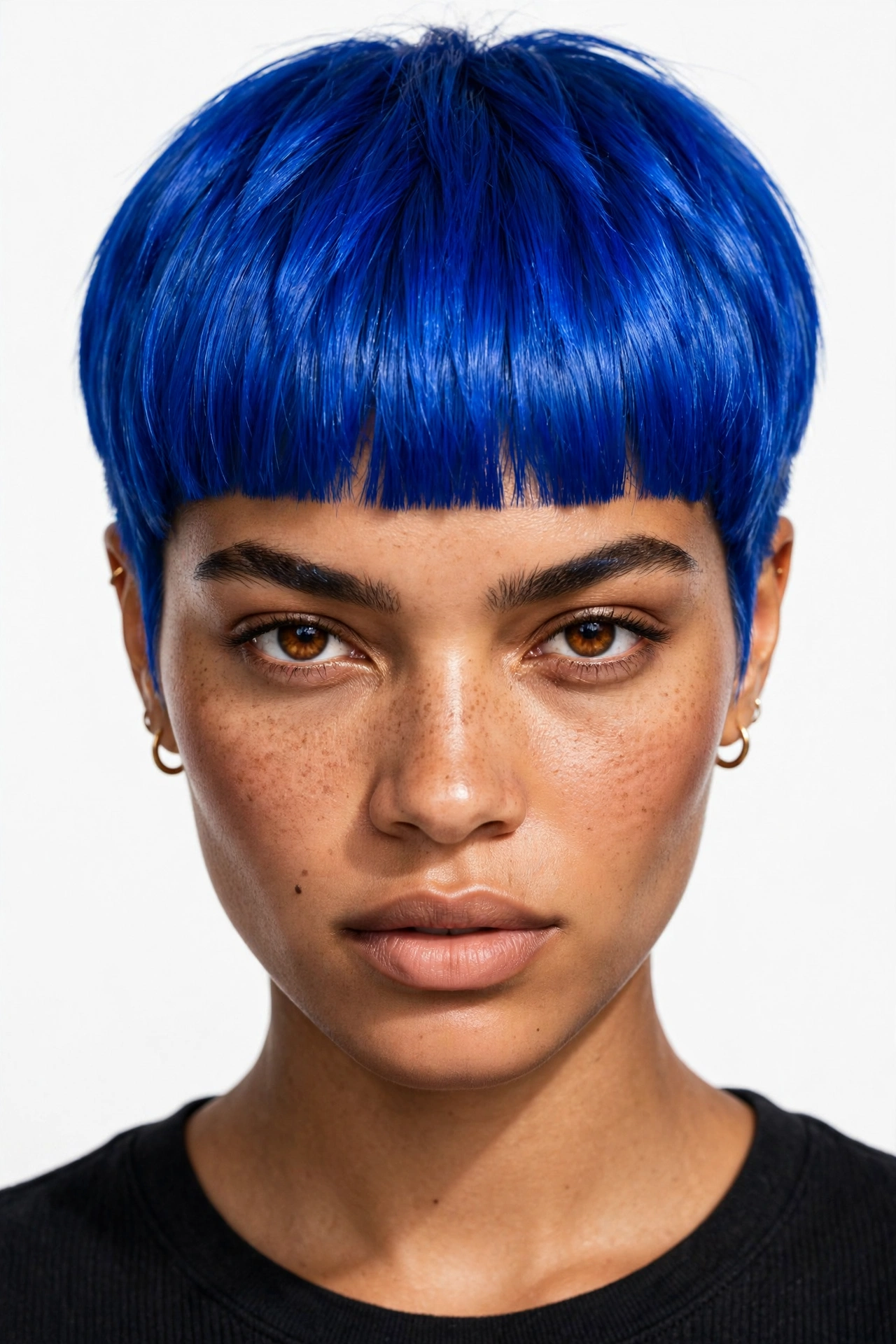
A vivid bold colour (cobalt blue, deep violet, bright red) combined with a blunt fringe creates two independent statement elements that reinforce each other — the colour draws the eye to the crown and face, and the blunt fringe frames the eyes as the precise focal point. On a pixie length, the colour covers entirely and the fringe line is the cut's most visible feature from the front. Colour maintenance is the main ongoing investment: colour-depositing conditioner weekly, sulphate-free washing, and cool-water rinsing.
Ask your colourist for "a vivid [cobalt/violet/red] all-over, and ask your stylist to add a blunt fringe at mid-brow cut dry." The fringe must be cut after the colour service, on completely dry hair.
Shop The Look
| Product | Type |
|---|---|
| Vivid colour-depositing conditioner | Haircare |
| Sulphate-free colour-protecting shampoo | Haircare |
| Colour-sealing UV spray | Styling |
| Shine-enhancing finishing mist | Styling |
| Fine-tooth comb for fringe maintenance | Tool |
15. Pixie with Baby Fringe
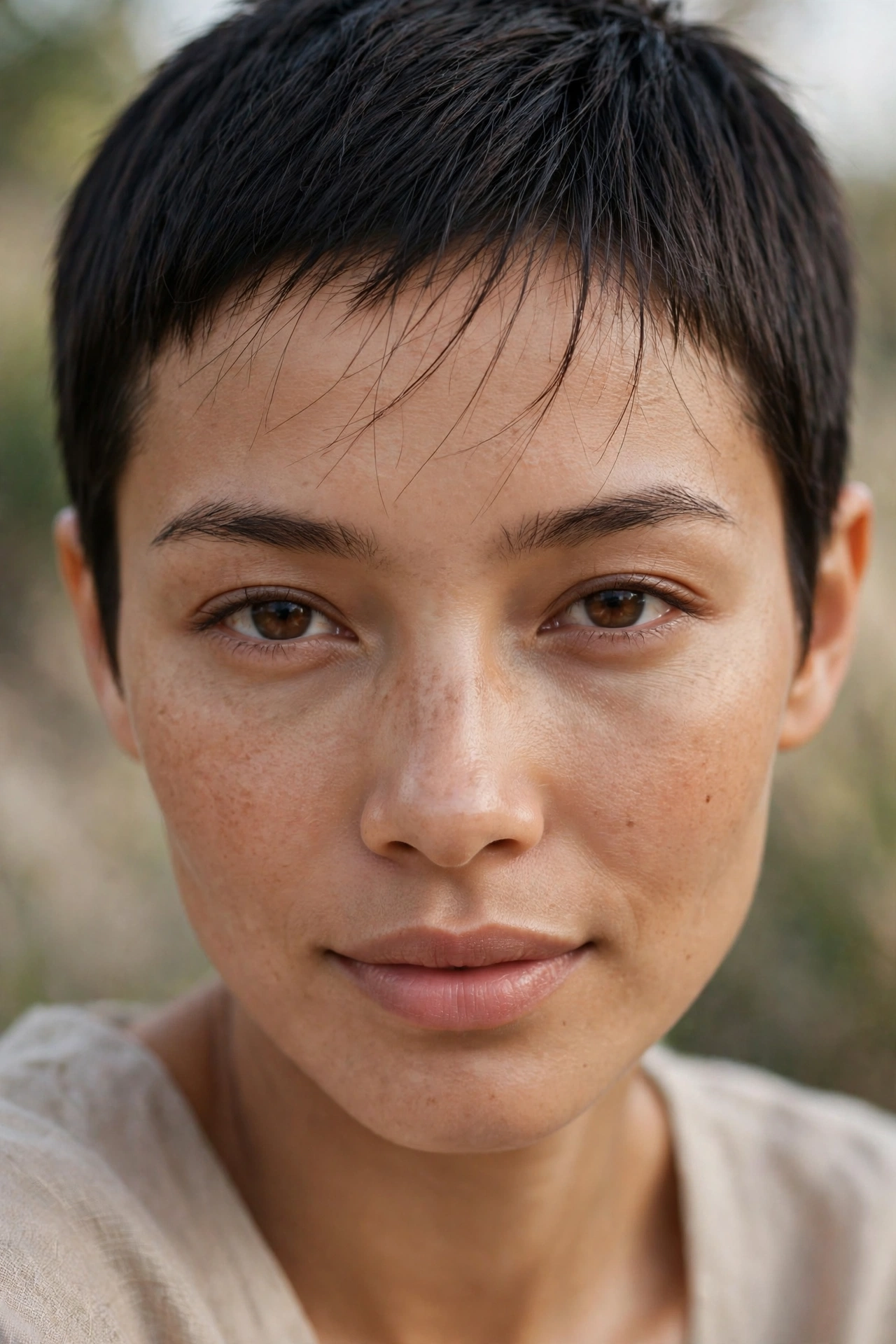
A baby fringe uses just the outermost layer of the front hairline — approximately 5–8 strands isolated and left at upper-forehead length while the rest of the front section is cut with the crown. The technique is to isolate the very front hairline strands during the cut, leave them deliberately longer, and razor-finish the ends so they feather naturally. The result reads as barely-there and functions to soften an abrupt hairline rather than frame the forehead in the traditional fringe sense.
Ask for "just a baby fringe — a few strands from my hairline left long and wispy, everything else cut normally." Smooth a tiny amount of clear edge gel through the baby fringe strands with a fingertip, and direct them forward — they should look accidental.
💡 Quick Win: A baby fringe is the perfect testing ground before committing to a full fringe — it uses the same front hairline section and can be grown into a fuller fringe or cut back with the crown at the next appointment with zero consequence.
Shop The Look
| Product | Type |
|---|---|
| Clear edge gel for strand direction | Styling |
| Fine-tip detail brush for strand control | Tool |
| Razor styling comb for end feathering | Tool |
| Lightweight anti-frizz serum | Styling |
| Gentle daily shampoo | Haircare |
16. Pixie with Thick Blunt Fringe
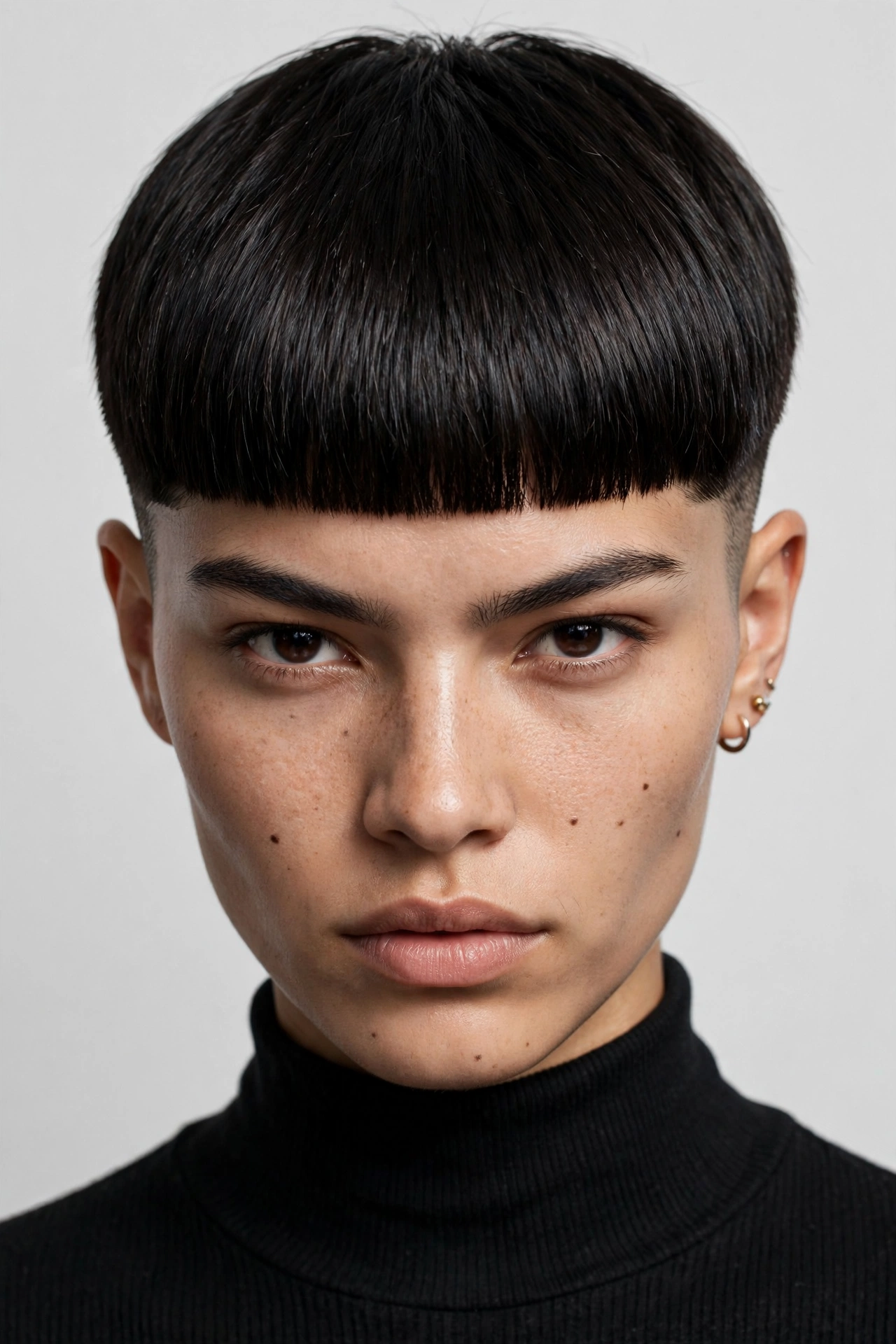
A thick blunt fringe on straight thick hair requires internal thinning — the stylist uses thinning scissors through the fringe section from the underside to remove bulk without changing the surface length. Without internal thinning, a thick fringe on dense hair creates a heavy, puffed fringe that lifts away from the forehead rather than lying flat. The thinning is done before the final blunt cut, removing approximately 30% of the fringe's internal bulk while preserving the clean horizontal surface line.
Ask for "a thick blunt fringe — please thin it internally first so it lies flat, then cut the blunt line dry." Finish with a light pomade pressed flat through the fringe with palms — a tiny amount controls the bulk without shine.
Shop The Look
| Product | Type |
|---|---|
| Thinning scissors for internal bulk removal | Tool |
| Light pomade for thick fringe control | Styling |
| Anti-frizz flat serum | Styling |
| Clarifying shampoo for fringe buildup | Haircare |
| Fine-tooth comb for fringe flat finish | Tool |
17. Pixie with Fringe for Round Faces
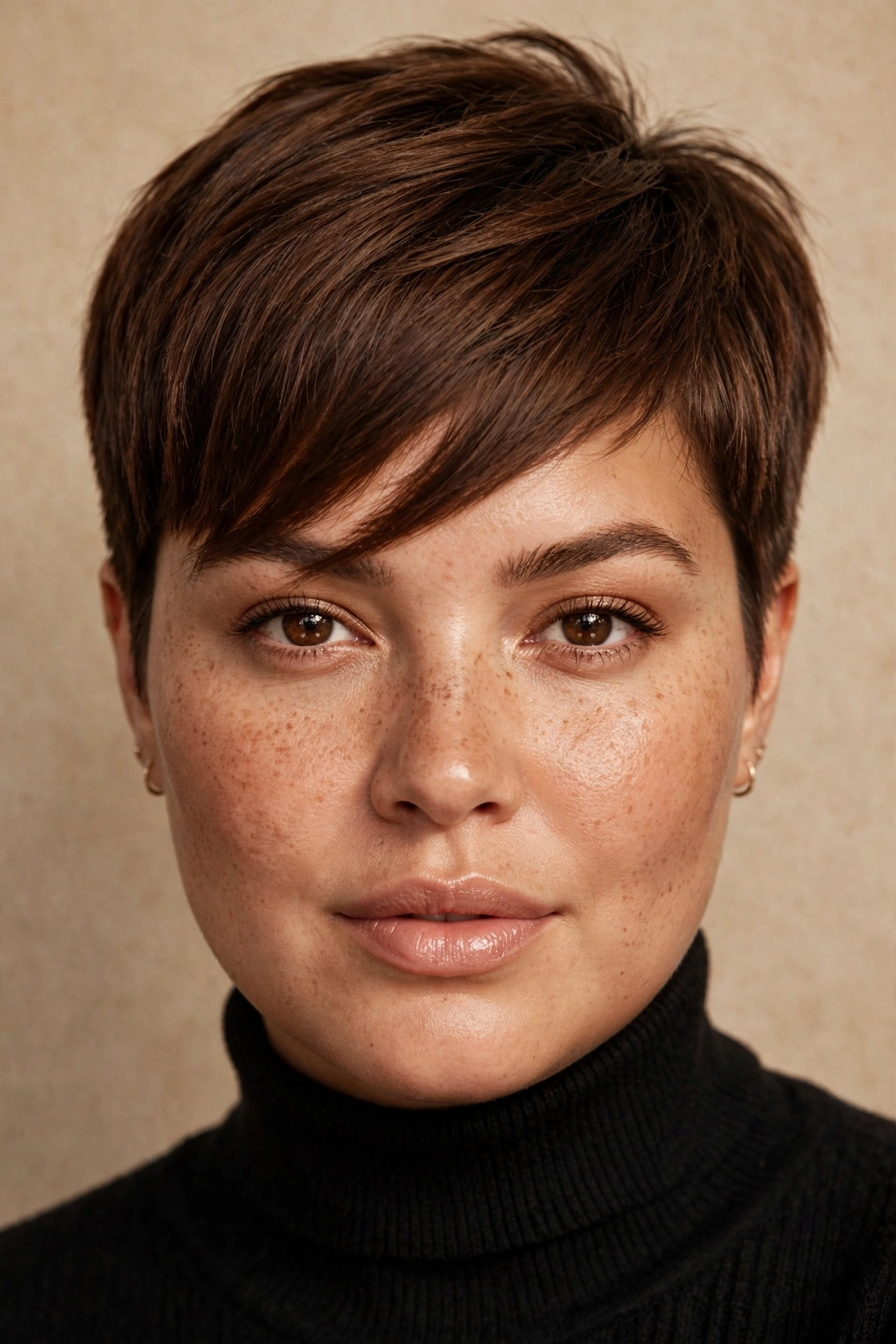
For round face shapes, a diagonal or side-swept fringe is strongly preferred over a straight-across blunt fringe — the horizontal blunt fringe on a round face creates a second horizontal line that reinforces the face's widest dimension. A diagonal fringe instead introduces an angular direction that interrupts the roundness. Combined with maintained crown height (at least 2.5–3 inches) and close sides, this fringe creates the most flattering overall proportion for a round face.
Ask for "a pixie with a diagonal fringe for a round face — I need the height at the crown and a fringe that sweeps rather than sits straight." Blow-dry the crown section upward first, then blow-dry the diagonal fringe in its sweep direction second.
Shop The Look
| Product | Type |
|---|---|
| Root-lift spray for crown height | Styling |
| Round brush for crown and fringe | Tool |
| Light-hold directional spray | Styling |
| Volumising thickening shampoo | Haircare |
| Flexible hold finishing spray | Styling |
18. Low-Maintenance Fringe Pixie
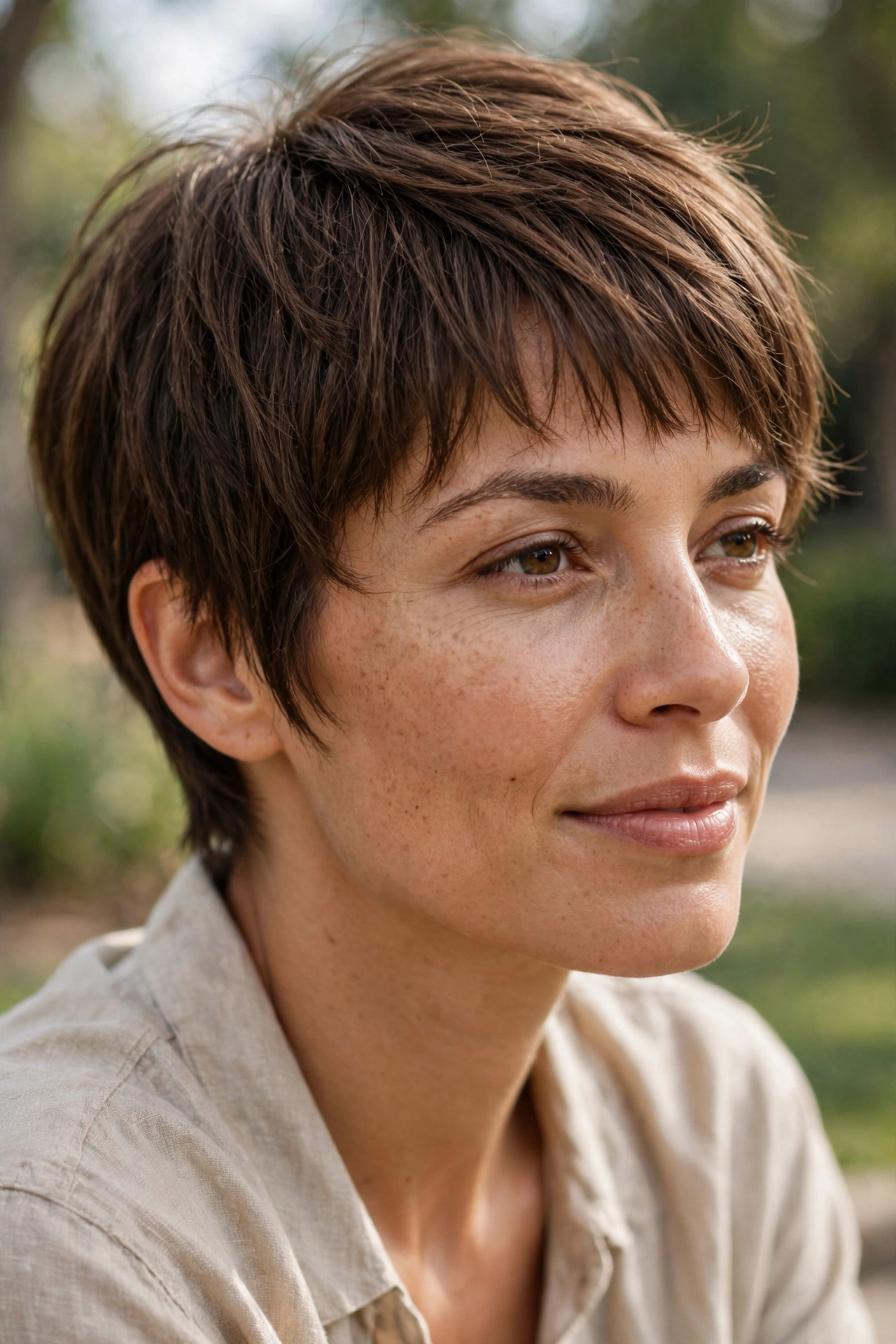
A low-maintenance fringe pixie uses a soft, point-cut fringe — slightly irregular ends that fall naturally toward the forehead without requiring daily blow-drying or pinning. The fringe is designed around the hair's natural growth direction at the hairline, which determines how it falls when left to its own devices. On straight hair with a forward-growing hairline, this fringe air-dries directly into position without any intervention. The tradeoff with low-maintenance fringes is wider maintenance windows — soft fringes need trimming every 6–8 weeks rather than the blunt fringe's 2–3 weeks.
Ask for "a soft natural fringe — point-cut ends, designed to fall forward naturally without me having to style it." Apply a drop of anti-frizz serum to damp hair before air-drying — this is the complete daily routine.
Shop The Look
| Product | Type |
|---|---|
| Featherweight anti-frizz air-dry serum | Styling |
| Gentle daily shampoo | Haircare |
| Moisturising conditioner | Haircare |
| Microfibre towel for natural drying | Accessory |
| Satin pillowcase for fringe shape | Accessory |
19. Pixie with Curly Micro Bang
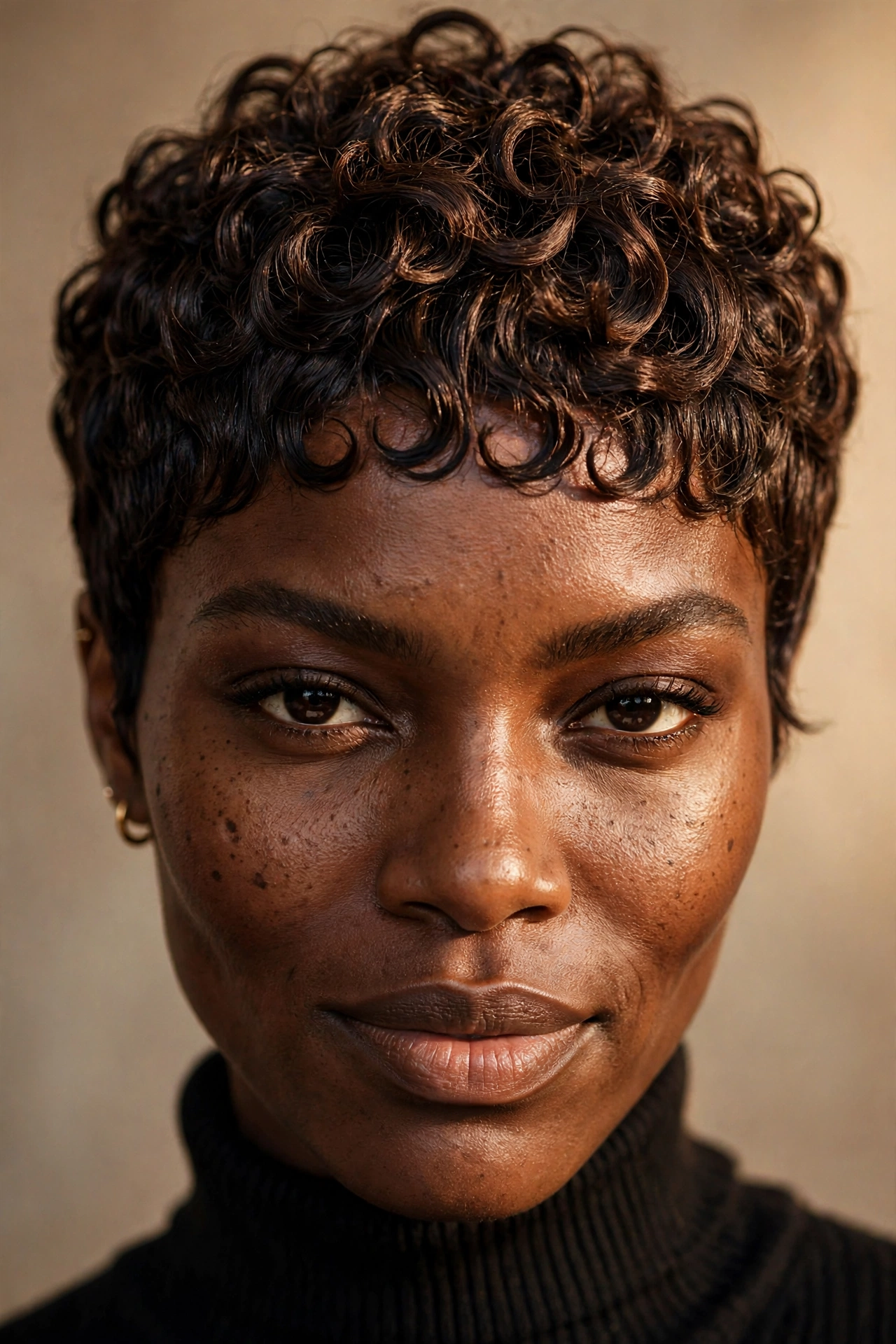
A curly micro bang requires cutting the fringe section to approximately 3–4 cm when stretched, accounting for the curl's spring reducing it to 1.5–2 cm at the forehead when released. The stylist must cut this section on a stretched individual curl, then release it to check the final coiled position. Gel-defining the micro fringe section separately from the crown curls gives it a distinct, intentional look — the mini defined coils at the forehead contrast with the fuller crown curls behind them.
Ask for "a curly micro bang — cut stretched for shrinkage, I want it to sit at my upper forehead when curled." Apply gel to the micro bang section separately from the rest of the curls, coiling each strand with a finger before releasing.
Shop The Look
| Product | Type |
|---|---|
| Strong-hold curl gel for micro bang | Styling |
| Finger-coiling pick tool | Tool |
| Curl cream for crown definition | Styling |
| Leave-in conditioner curl base | Haircare |
| Aloe vera mist for day-2 refresh | Styling |
20. Pixie with Fringe for Heart Face
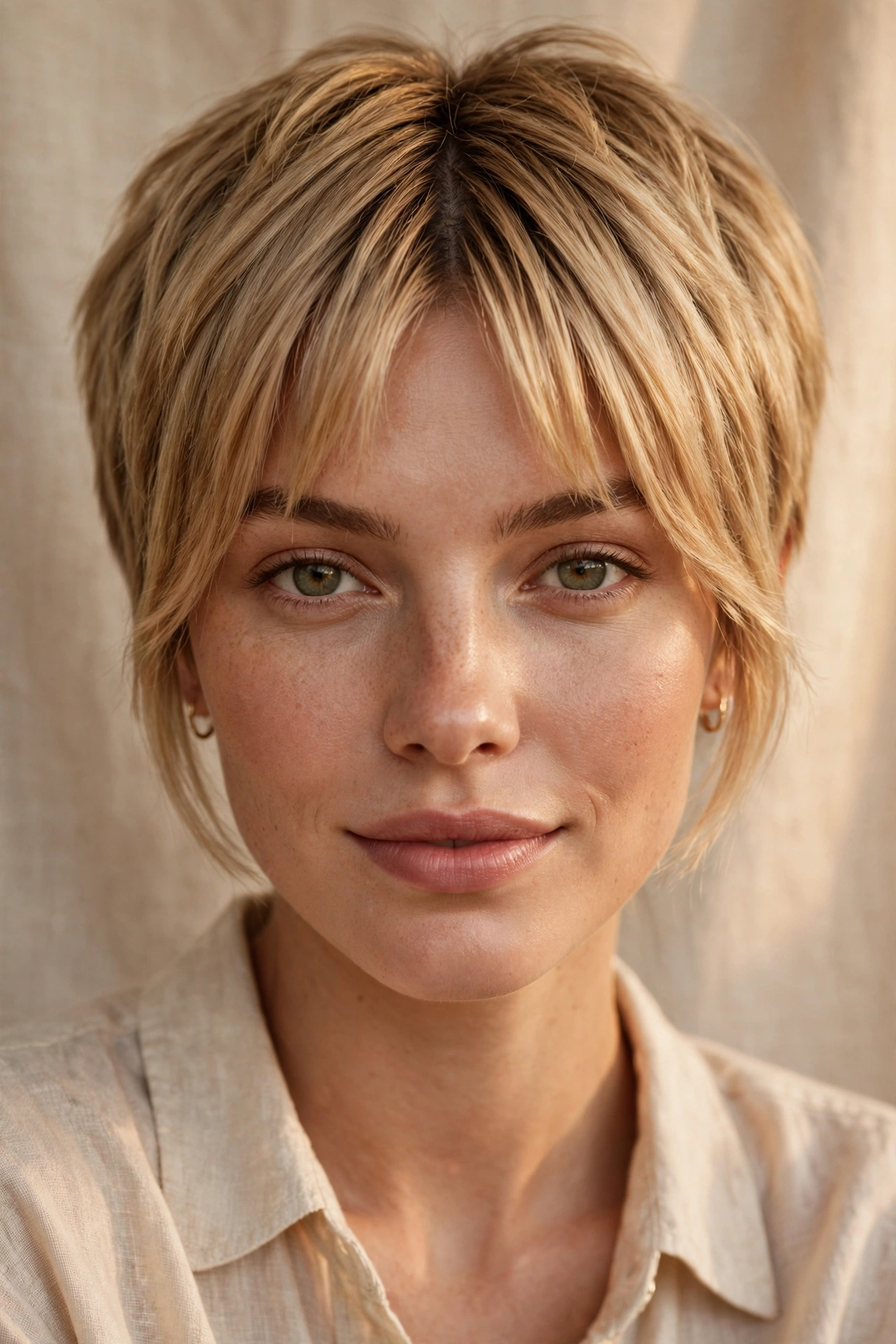
For heart-shaped faces (wider forehead, narrower chin), curtain bangs are the most specifically flattering fringe choice — the parted fringe reduces the visible forehead width while the fringe's inward curve and face-framing pieces add visual width at the cheekbone and jaw level. The crown is kept shorter (1.5–2 inches) and face-framing pieces at cheek level are maintained. The combination of curtain fringe and face-framing pieces addresses both the heart face's wider top and narrower bottom simultaneously.
Ask for "curtain bangs with face-framing pieces for a heart-shaped face — fringe at the brow, framing pieces to my cheeks." Style the curtain fringe centrally parted and the framing pieces directed slightly inward toward the jaw.
Shop The Look
| Product | Type |
|---|---|
| Light serum for curtain fringe shape | Styling |
| Mini flat iron for framing pieces | Tool |
| Smoothing conditioner for fringe | Haircare |
| Flexible-hold fringe spray | Styling |
| Round brush for curtain fringe curve | Tool |
21. Vintage-Inspired Fringe Pixie
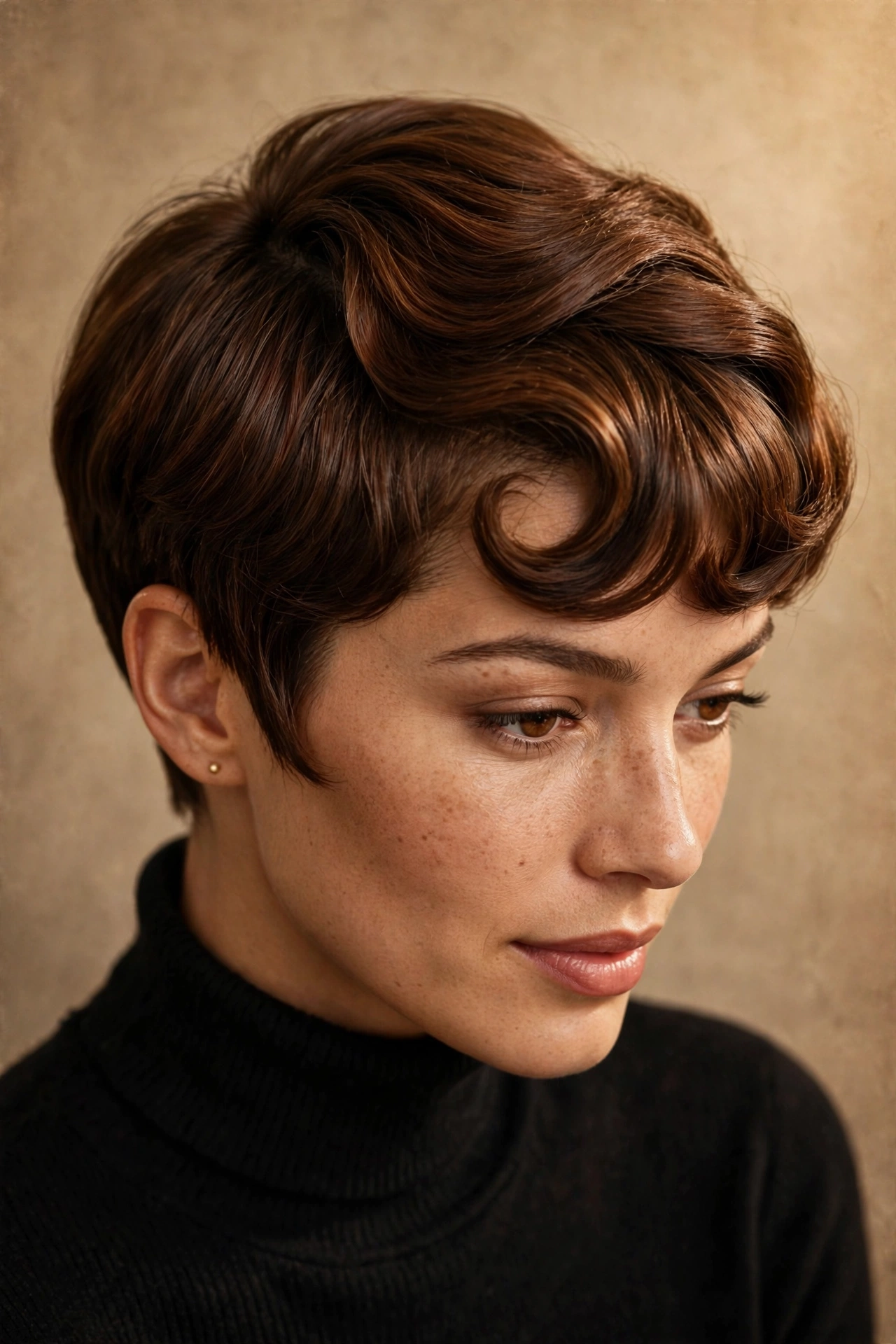
A vintage-inspired fringe uses a round brush to roll the fringe slightly under during blow-drying, creating a subtle curl-under at the ends that references 1960s styling. The fringe is fuller than a standard blunt fringe — slightly wider, covering more of the forehead — and the curl-under gives the edge a soft, rounded quality rather than the sharp horizontal line of a modern blunt fringe. A light-hold water-based pomade worked through the finished fringe with a comb creates the polished vintage surface quality.
Ask for "a fuller fringe with a slight curl-under — vintage-inspired, rolled under at the ends." Blow-dry the fringe section using a medium round brush, rolling the brush forward and under at the ends, holding for 5 seconds before releasing.
Shop The Look
| Product | Type |
|---|---|
| Light water-based pomade for vintage finish | Styling |
| Medium round brush for curl-under | Tool |
| Flexible-hold shine spray | Styling |
| Smoothing conditioner for fringe | Haircare |
| Fine-tooth setting comb | Tool |
22. Pixie with Fringe for Square Faces
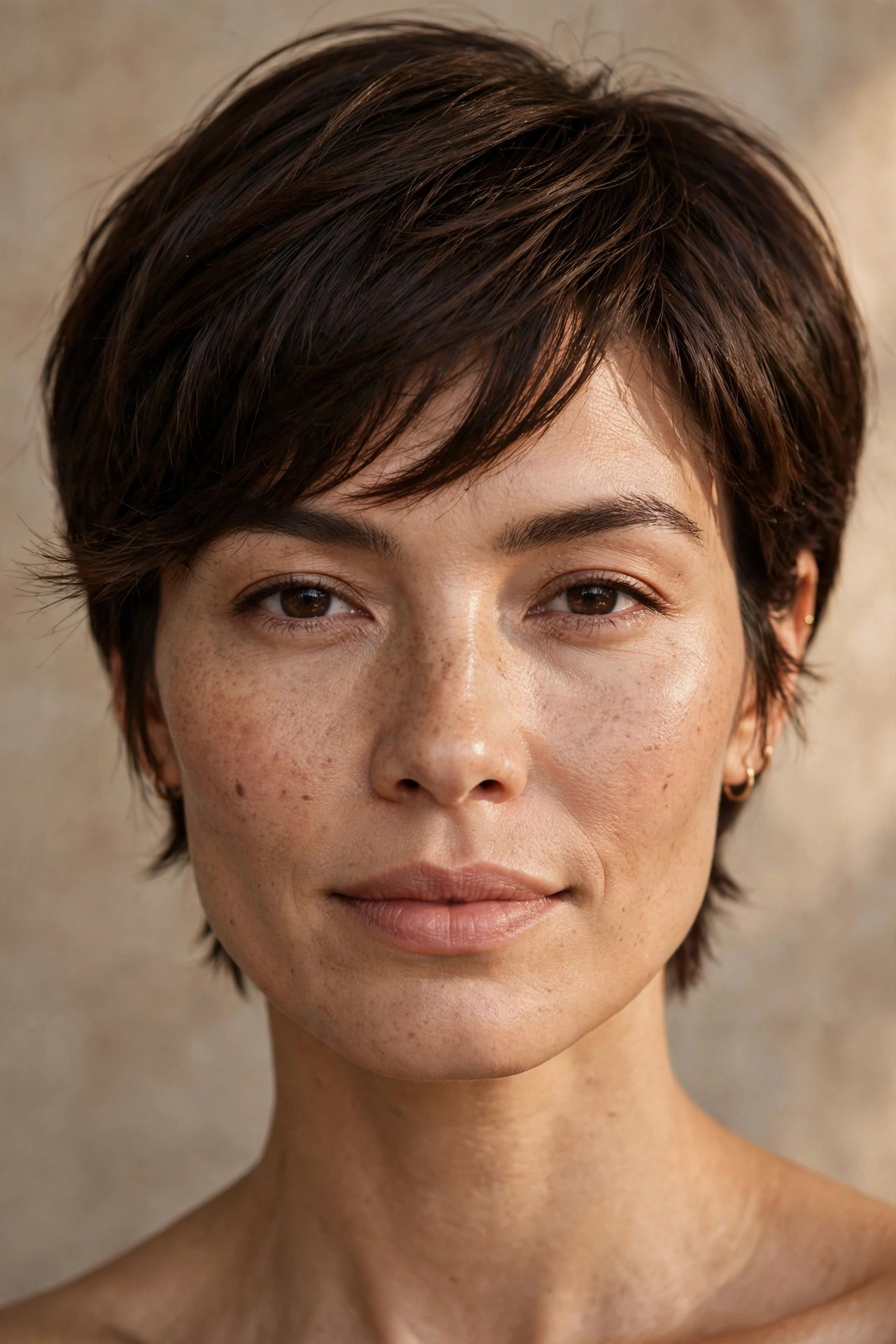
For square face shapes (strong, even jawline), the fringe choices that work best are: wispy (softens the forehead line), diagonal (introduces movement), piece-y (creates irregular texture), or curtain (adds softness at the forehead while drawing the eye inward). The specific fringe to avoid on a square face is a thick, perfectly horizontal blunt fringe — it creates a second strong horizontal line parallel to the jaw that reinforces the angular geometry rather than balancing it.
Ask for "a soft wispy or diagonal fringe for a square face — something that moves rather than sits straight across." Apply a matte clay lightly to the fringe and separate with fingertips for a soft, irregular finish.
Shop The Look
| Product | Type |
|---|---|
| Light matte clay for soft fringe | Styling |
| Sea salt spray for texture | Styling |
| Thinning scissors for soft ends | Tool |
| Anti-frizz soft hold serum | Styling |
| Wide-tooth fringe comb | Tool |
23. Colour-Blocked Fringe Pixie
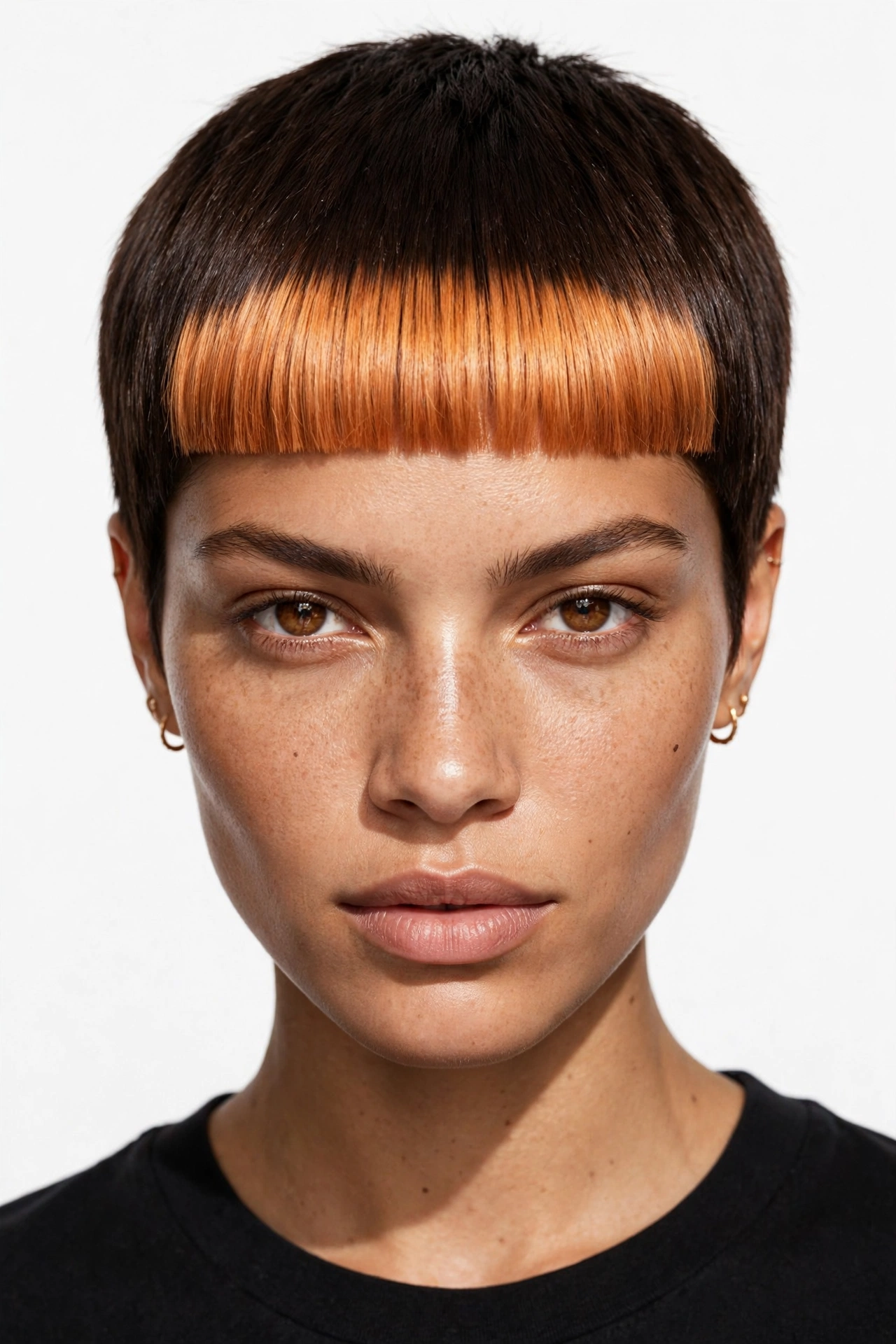
A colour-blocked fringe uses a completely different colour in the fringe section versus the rest of the cut — typically a lighter or more vivid tone at the fringe against a darker body. The colourist isolates the fringe section with foil and applies the contrasting colour precisely to that section only. On a pixie, the colour block is visible from the front as the face's primary framing element. The fringe should be blunt to maximise the colour block's graphic quality.
Ask your colourist for "a colour-blocked fringe — [contrasting colour] on just my fringe section, everything else stays [base colour]." Keep the two sections separate during washing — run fingers through each section individually rather than mixing them.
💡 Quick Win: A colour-depositing conditioner in the fringe colour, applied just to the fringe section for 3 minutes during every shower, extends the vivid fringe colour by 2–3 weeks between full colour appointments without touching the base colour.
Shop The Look
| Product | Type |
|---|---|
| Contrasting colour-depositing conditioner | Haircare |
| Sulphate-free colour-protecting shampoo | Haircare |
| Colour-sealing finishing spray | Styling |
| Bond-strengthening treatment | Haircare |
| UV-protecting hair mist | Styling |
24. Natural Afro Pixie with Curl Fringe

A natural coil fringe on an afro pixie isolates the front hairline section — approximately 2 cm of coil length — and defines it separately from the full afro crop behind. The stylist leaves this section slightly longer than the rest of the front during the cut, allowing enough coil to define and fall forward at the forehead. The coil fringe is gel-defined separately: apply a strong gel to just the fringe section after the rest of the hair is styled, coil each strand with a finger, and allow to set.
Ask for "a natural coil fringe on my afro pixie — leave the front hairline section slightly longer than the rest for a coil fringe." Apply a curl gel to the fringe section after styling the rest, finger-coil each strand forward, and leave to set.
Shop The Look
| Product | Type |
|---|---|
| Strong-hold curl gel fringe definition | Styling |
| Leave-in moisture base | Haircare |
| Finger-coiling styling comb | Tool |
| Curl refresher mist for fringe | Styling |
| Satin sleep bonnet | Accessory |
25. Pixie with Blunt Bang on Curly Hair
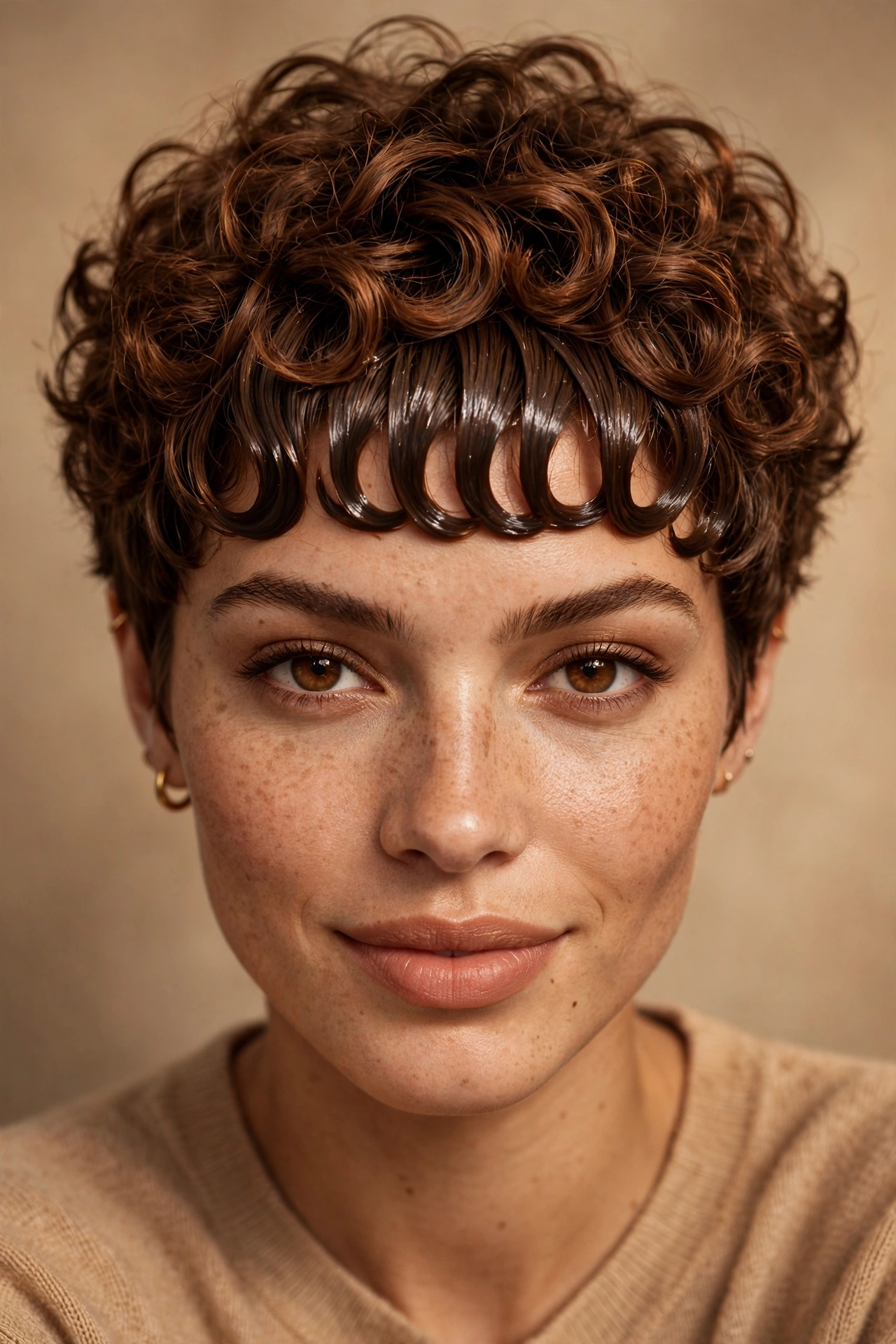
A structured curl fringe on a curly pixie uses a strong-hold gel applied to just the fringe section to create a more uniform, forward-directed curl fringe rather than curls that spring in random directions. The technique is to apply gel to the damp fringe section, rake through with fingers directing forward, and allow to dry without touching. Once dry, the gel cast is broken with a gentle scrunch to reveal defined curls that fall mostly forward at the brow — a curly fringe with more structure than a natural air-dry but less rigidity than a straight-hair blunt fringe.
Ask for "a curly pixie where the fringe section is defined and mostly forward-facing — I'll use gel at home." Apply a strong-hold gel to the damp fringe section, rake forward, air dry completely, then break the cast with a gentle forward scrunch.
Shop The Look
| Product | Type |
|---|---|
| Strong-hold gel for structured curl fringe | Styling |
| Curl rake comb for fringe direction | Tool |
| Microfibre towel for fringe drying | Accessory |
| Curl cream for crown balance | Styling |
| Sulphate-free moisturising shampoo | Haircare |
26. Pixie with Side Part and Fringe
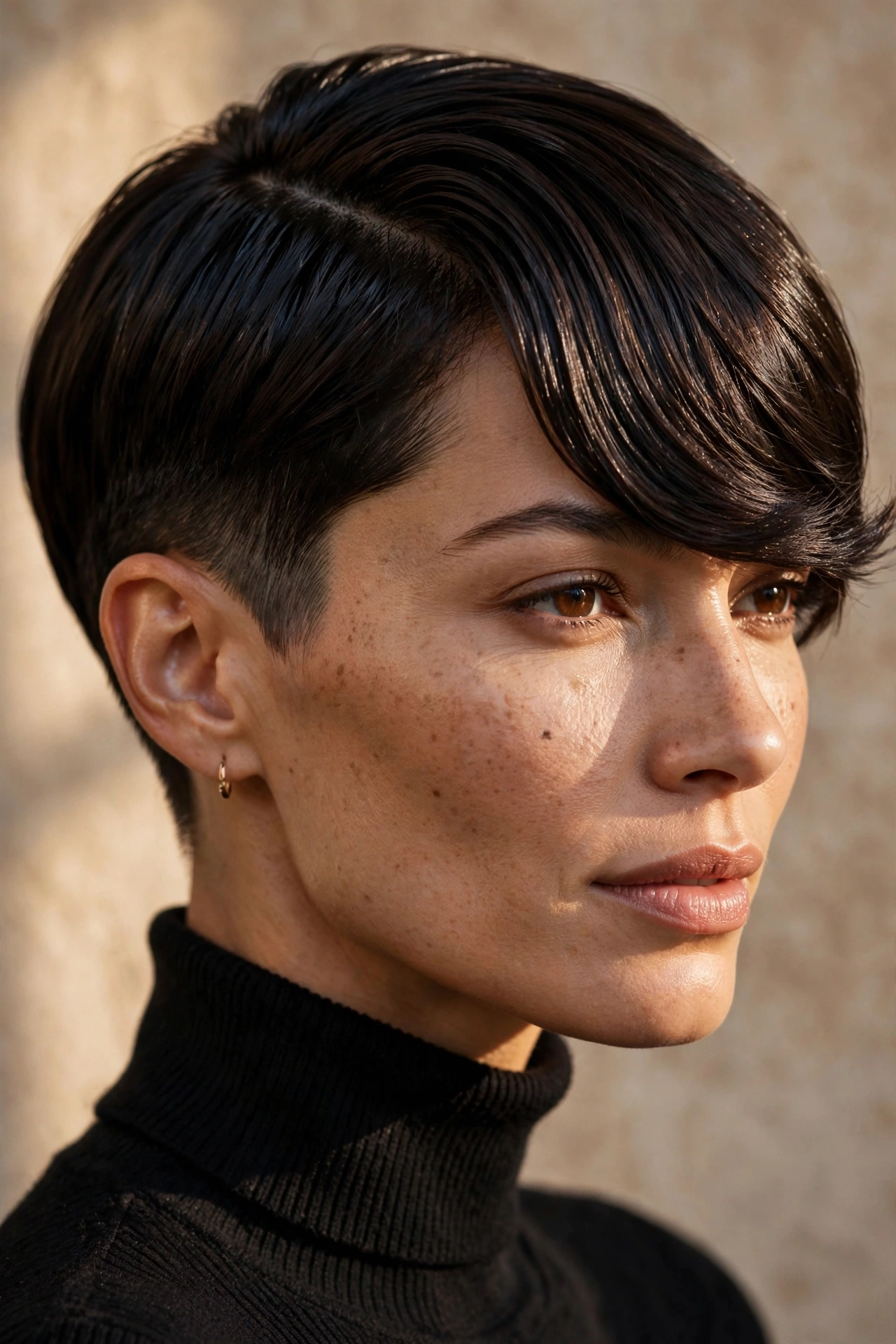
A deep side part and fully swept fringe on a pixie uses the part as the design anchor — the fringe is swept entirely to one side from the deep part position, creating a single directional movement across the forehead. The opposite side is tapered closely (1-guard) to reinforce the direction and prevent any visual competition. This is the fringe variation closest to the classic Vidal Sassoon-era pixie, and it remains one of the most reliably polished options.
Ask for "a deep side part with a swept fringe — everything on one side of the part, close taper on the other." Apply a high-shine pomade to the damp fringe section, rake through with a fine-tooth comb in the direction of the sweep, and allow to set.
Shop The Look
| Product | Type |
|---|---|
| High-shine water-based pomade | Styling |
| Fine-tooth setting comb | Tool |
| Anti-frizz finishing spray | Styling |
| Clarifying shampoo for pomade reset | Haircare |
| Shine-amplifying finishing mist | Styling |
27. Pixie with Fringe for Oval Faces
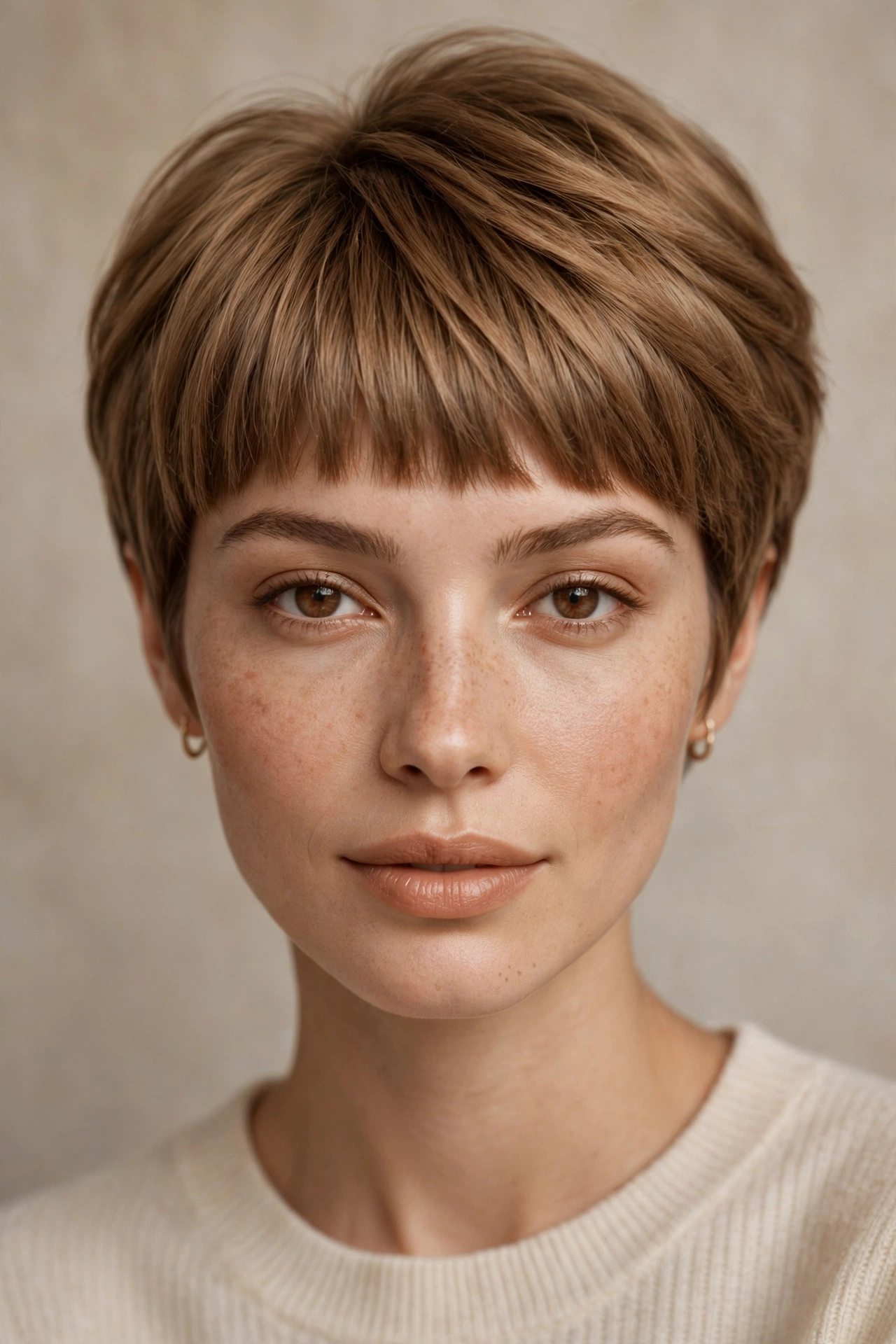
Oval faces have a naturally balanced length-to-width proportion, making them the most versatile face shape for all fringe choices. Every variation on this list works on an oval face — the face's natural proportion is already balanced, so no compensatory technique is required. The classic blunt fringe at mid-brow is the most universally flattering starting point for oval faces because it frames the eyes without needing to compensate for any directional imbalance.
Ask for "a pixie with a blunt fringe at mid-brow — I have an oval face so I'm flexible with the style." Maintain the blunt fringe with small scissors against a horizontal comb every 3 weeks.
Shop The Look
| Product | Type |
|---|---|
| Light-hold finishing serum | Styling |
| Small maintenance scissors | Tool |
| Horizontal fringe comb | Tool |
| Daily conditioner for fringe health | Haircare |
| Flexible hold fringe spray | Styling |
28. Auburn or Red Toned Pixie with Fringe
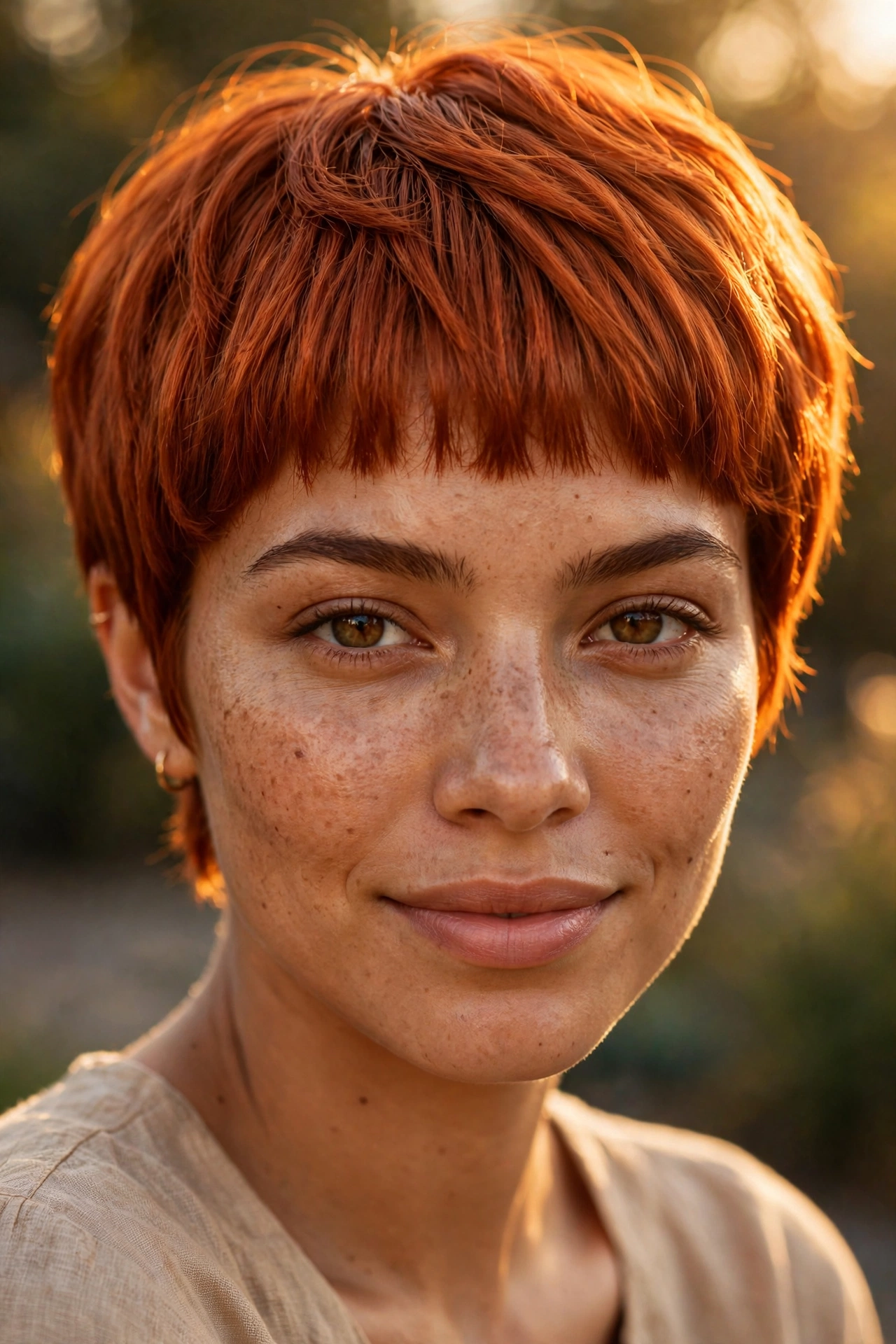
Auburn or copper on a pixie with a blunt fringe is a warm, wearable bold colour choice — the fringe specifically amplifies the colour by placing it directly at eye level as the first thing seen from the front. Red and copper pigments fade fastest of any colour family; a colour-depositing conditioner in a warm tone used weekly and cold-water rinsing after every wash are the two most impactful maintenance habits for extending colour vibrancy.
Ask your colourist for "a vivid copper auburn all-over with a blunt fringe from your stylist — cut the fringe dry after the colour service." Use a colour-depositing warm conditioner weekly to top up copper tones between appointments.
Shop The Look
| Product | Type |
|---|---|
| Warm copper-depositing conditioner | Haircare |
| Sulphate-free colour shampoo | Haircare |
| Colour-sealing gloss spray | Styling |
| Deep conditioning mask copper hair | Haircare |
| UV hair protect mist | Styling |
29. Statement Fringe Pixie — Bold Centre Bang
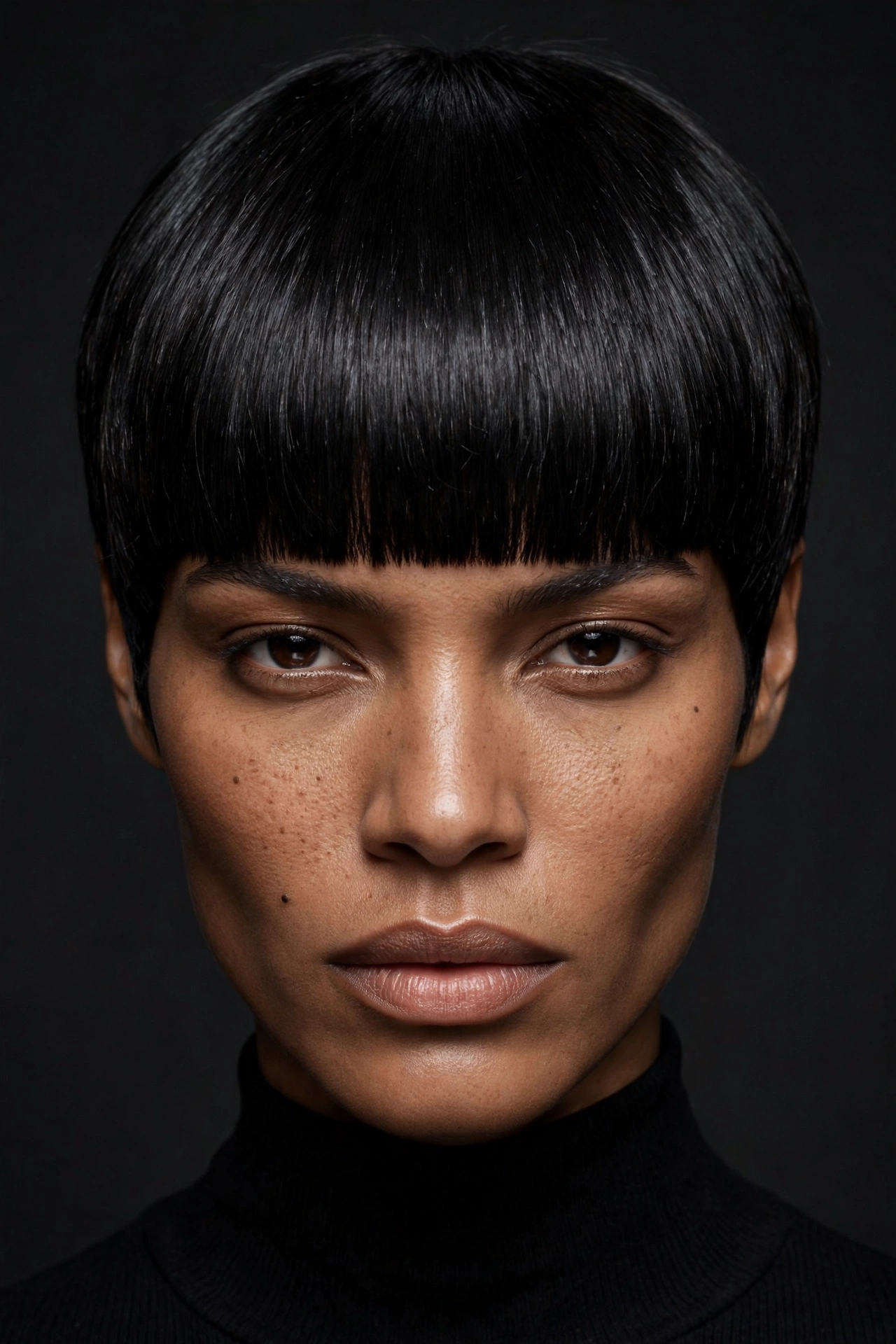
A statement centre fringe on a close-cropped pixie uses a full, wide blunt fringe that spans the entire forehead width at brow level — wider than a standard fringe, creating complete forehead coverage that draws the eye directly to the eyes as the sole visible face feature above the fringe line. The close crop at the crown and sides means the fringe is the cut's only length element visible from the front. Flat iron maintenance is essential: any lift or curl in the fringe breaks the look's entire intentionality.
Ask for "a full centre blunt fringe — wide, covering my full forehead at the brow, everything else close-cropped. Cut dry." Blow-dry the fringe flat with a paddle brush, then press once with a mini flat iron on low heat for a perfectly smooth finish.
💡 Quick Win: Keep a mini flat iron at your bathroom vanity specifically for this fringe — 30-second daily touch-up is all it takes to maintain the flat, smooth finish that makes this fringe read as deliberately editorial rather than simply untamed.
Shop The Look
| Product | Type |
|---|---|
| Mini flat iron for daily fringe control | Tool |
| Anti-frizz flat serum for fringe | Styling |
| Fine-tooth fringe pressing comb | Tool |
| Strong-hold light sealing spray | Styling |
| Clarifying shampoo for fringe reset | Haircare |
How to Ask Your Stylist for Feminine Pixie Cuts with Bangs
The single most important first move is to ask your stylist to cut your fringe dry — not wet. This applies to blunt, diagonal, wispy, and piece-y fringes in particular. Wet hair stretches under its own weight and produces a fringe that appears correctly placed when wet but is noticeably shorter than intended once it dries and contracts. The only fringes that can be cut damp are razor-cut wispy styles (because the razor technique requires some moisture) and curly fringes (where the stylist is accounting for shrinkage deliberately). For everything else, insist on dry. This single instruction prevents the most common fringe disappointment.
The most common mistake is choosing a fringe length based on the reference photo without considering the natural hairline growth direction. If your hairline grows forward (toward the face), a fringe naturally falls correctly with minimal effort; if your hairline grows backward, the fringe may resist lying flat and require daily product maintenance to stay in position. Ask your stylist: "Does my hairline work with this fringe direction?" before committing. If it doesn't, the stylist can adapt the fringe angle slightly to work with the growth pattern — a small adjustment that makes the entire maintenance burden disappear.
For under $20, three products with immediate impact: a small pair of sharp haircutting scissors (approximately 10–15) for at-home fringe maintenance between appointments; a featherweight anti-frizz serum (approximately 10–15) that keeps any fringe flat and controlled; and a fine-tooth fringe comb (approximately 5–8) which is the most important tool for both maintenance trimming and daily styling.
A blunt fringe needs professional reshaping every 3–4 weeks — it's the highest-maintenance element of any pixie cut. Curtain and soft wispy fringes can go 6–8 weeks before needing professional attention. The cost for a fringe trim alone at a salon is typically 15–30 in the US and £10–£25 in the UK — many clients learn to maintain straight blunt fringes at home between appointments with the small scissors and comb technique, reserving the salon visit for the full cut every 6–8 weeks.
Frequently Asked Questions About Feminine Pixie Cuts with Bangs
What is the difference between a pixie cut with bangs and a French crop?
A French crop is a specific pixie subtype where the fringe is the defining architectural feature — it falls forward at mid-brow as the cut's natural direction, with close-tapered sides. A pixie with bangs is a broader category where the fringe is an added element to a pixie base that could be structured in various ways (swept back crown, taller crown, textured crop) — the bangs are styled in relation to the base cut rather than being the cut's primary purpose. French crops are always forward-directed; pixies with bangs can be forward, swept, diagonal, or curtain-parted.
Which fringe is most flattering for different face shapes on a pixie cut?
Round faces: diagonal or side-swept fringe — avoids horizontal lines that add width; a quiff-style crown adds the vertical height round faces benefit from. Heart faces: curtain bangs with face-framing pieces — reduces forehead width, adds jaw-level visual width. Square faces: wispy, piece-y, or diagonal — avoids the horizontal blunt line that echoes a strong jaw. Oval faces: any fringe variation works — the balanced proportion needs no compensation. Oblong/long faces: a fuller, wider blunt fringe reduces the visible forehead length, which actually benefits an oblong face more than almost any other shape.
How much does a pixie cut with bangs cost at a salon?
A pixie cut with bangs at a quality salon costs 65–120 in the US and £55–£90 in the UK for an initial precision cut. The fringe doesn't typically add to the base cut cost if done at the same appointment. However, blunt fringe maintenance trims (every 3–4 weeks) cost an additional 15–30 per visit, which adds up over time. Learning to trim a blunt fringe at home with small scissors and a horizontal comb significantly reduces this cost — the technique takes about 90 seconds and is straightforward enough that most people can maintain it between salon visits after one demonstration.
How often does a pixie fringe need trimming?
Blunt fringes need reshaping every 3–4 weeks — straight hair grows approximately half an inch per month at the fringe, and even small growth disrupts the precision of a blunt horizontal line. Micro bangs need touching up every 2–3 weeks because they're so short that a millimetre of growth is proportionally significant. Curtain bangs, wispy fringes, and soft fringes are more forgiving — they can go 6–8 weeks between trims because their soft, irregular edges absorb small amounts of growth naturally. Curly fringes also extend to 6–8 weeks because the curl's spring counteracts the growth's effect on length.
Can you have a pixie cut with bangs on curly hair?
A pixie cut with bangs on curly hair is absolutely achievable, but requires a stylist experienced in curly cutting — specifically the ability to account for shrinkage when setting the fringe length. Curly fringes need to be cut 30–50% longer than the intended dry length, and should be cut dry (DevaCut approach) so the stylist can see exactly where each curl falls. The best curly fringe variations are: soft curtain bangs (the natural curl creates the inward curve without styling), a natural coil fringe (gel-defined forward-falling coils), and a curly side-swept fringe. Blunt fringes on curly hair require daily flat-ironing to maintain the straight edge — viable, but a significant maintenance commitment.
Ready to Try Feminine Pixie Cuts with Bangs?
These 29 ideas cover the complete range of what a fringe on a pixie can be — from the graphic precision of a blunt centre bang and the boldness of a colour-blocked fringe section, to the effortless naturalness of a soft curtain bang on wavy hair and the expressive energy of a curly coil fringe. Finding the right fringe for your specific face, hair texture, and styling tolerance is usually a two-appointment process — the first reveals how your hairline grows and how the fringe behaves, and the second refines the length, weight, and angle accordingly. Start today by saving one or two of these images that felt immediately right — your instinct about the fringe that spoke to you is more accurate than any face-shape rule. Once the cut and fringe are right together, the two create a composition that a pixie without bangs simply doesn't have. Pin your favourites and come back to this list every time your fringe needs a fresh direction.