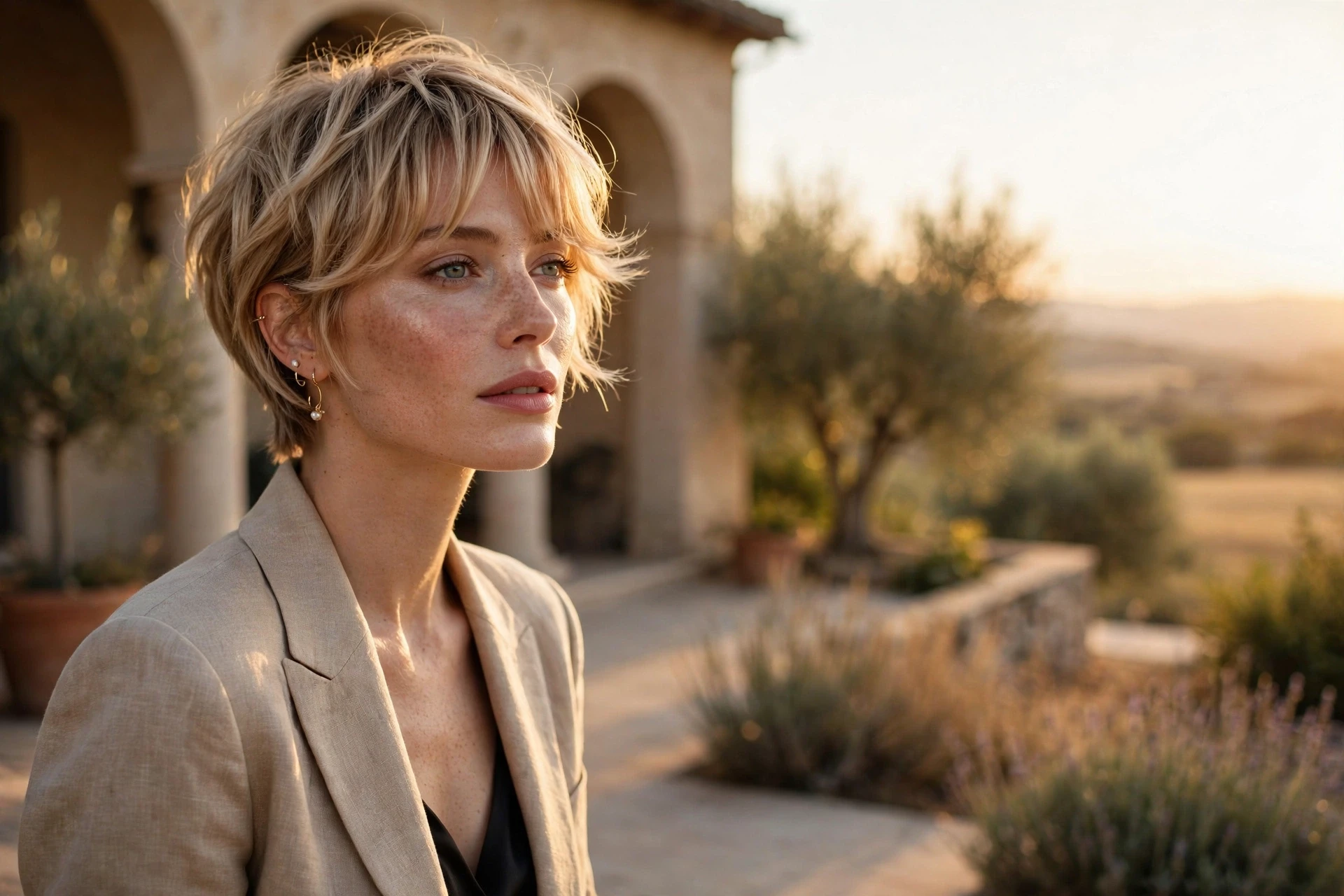
A feminine pixie cut is a short style that uses deliberate styling choices — softening techniques, colour, fringe work, and accessories — to create a cut that reads as decidedly feminine rather than androgynous or masculine. This article gives you exactly 34 ideas across every category of feminising approach: from face-framing techniques and fringe choices to product finishes, colour strategies, and styling tools.
Cutting your hair short doesn’t mean cutting its femininity — the pixie cut has been one of fashion’s most feminine statements since Audrey Hepburn wore hers in 1953. What makes a pixie cut look more feminine is always a combination of the right cut architecture, the right finish, and the right framing choices for your specific face. Here are 34 ideas worth trying — and a few worth showing your stylist.
Why Feminine Pixie Cuts Work So Well
The pixie cut’s reputation as androgynous is a styling problem, not a structural one. The cut itself is neutral — what reads as masculine or feminine is almost entirely about proportion, texture, finish, and framing. A close-cropped, skin-faded, smooth pixie reads differently than a layered, curtain-fringed, face-framing pixie in the same way that a tailored blazer reads differently than a draped cardigan: same basic concept, completely different effect. Understanding which specific elements shift the register from sharp to soft, from minimal to feminine, is what this list is actually about.
The four levers that control femininity in a pixie cut are: framing (how the cut relates to the face — does it open it, soften it, or frame it?), texture (smooth and precise vs soft and irregular — softer reads as more feminine), proportion (where the length and volume sit — closer to the face and front vs close-cropped all over), and finish (the products and tools used — light hold, natural movement, warmth all read as more feminine than high-shine, rigid hold, and hard lines).
The 34 Ideas
1. Add a Curtain Fringe
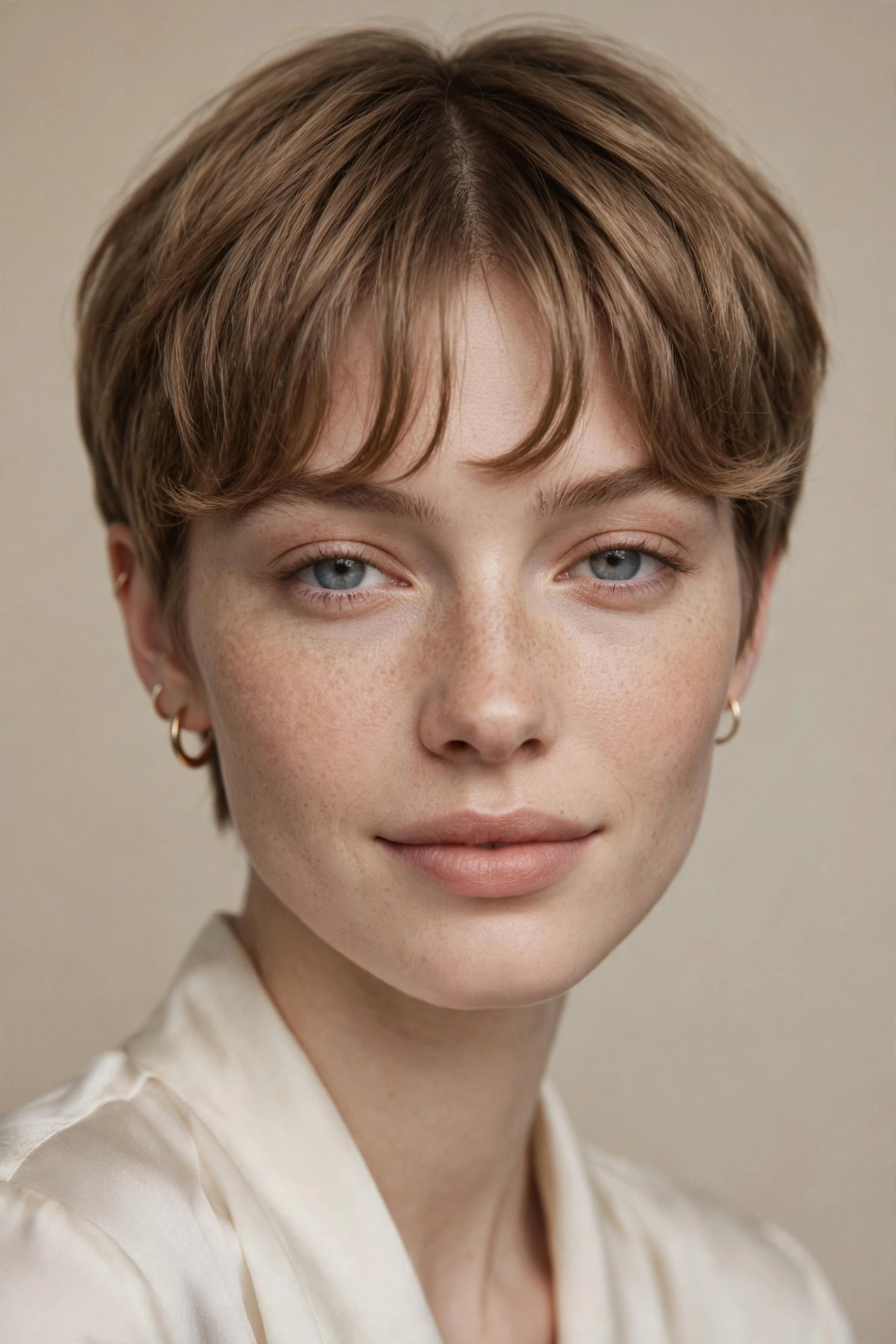
The single most requested feminising addition to any pixie cut. A centre-parted curtain fringe falling to brow level softens the forehead, frames the eyes, and creates the gentle inward curve at the tips that reads as inherently soft and feminine. It works on straight, wavy, and even loosely curly hair. Ask your stylist to cut it dry so you see the exact landing position; blow-dry in two sections with a small round brush rolling inward at the tips.
2. Leave Face-Framing Pieces Longer
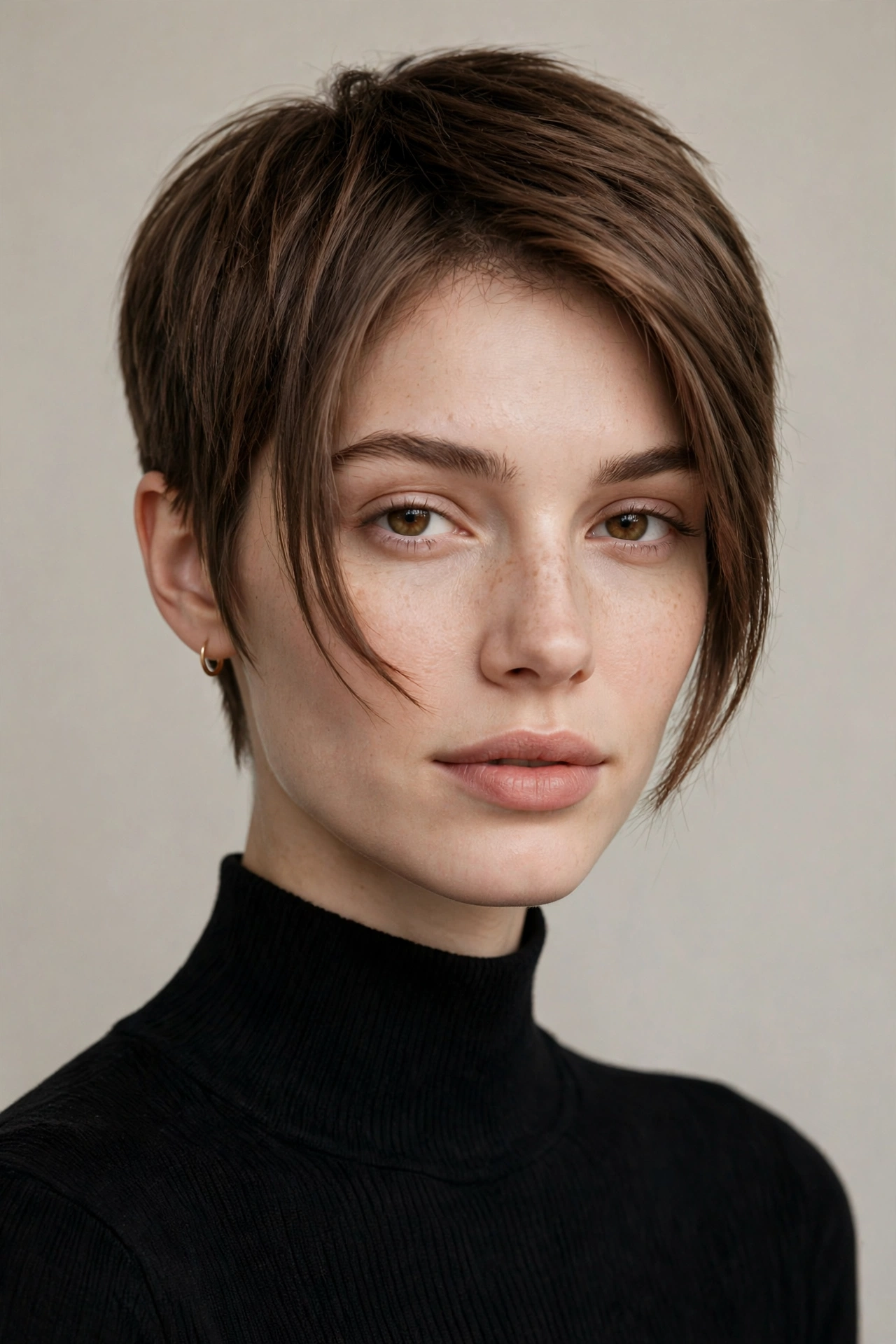
The front sections of a pixie — the pieces that fall around the face at the temples and cheekbones — can be left noticeably longer than the crown and back. Even an extra half-inch at the front changes the entire impression of the cut: the face becomes framed rather than simply exposed. Pieces at cheekbone level read as soft and feminine; pieces tucked behind the ear read as clean and minimal. Keep them forward.
3. Choose a Soft Taper Over a Skin Fade

This is the technical adjustment that makes the biggest single difference to femininity in a pixie cut. A skin fade (0-guard close to the scalp) at the nape and temples reads as barbershop-masculine — the stark skin-to-hair transition has a hardness that soft styling choices struggle to overcome. A 2-guard soft taper creates a gentle graduated transition instead, keeping the nape and sides clean and neat while softening the cut’s overall impression considerably. Tell your stylist specifically: “soft taper, not a skin fade.”
4. Use a Round Brush Blow-Dry
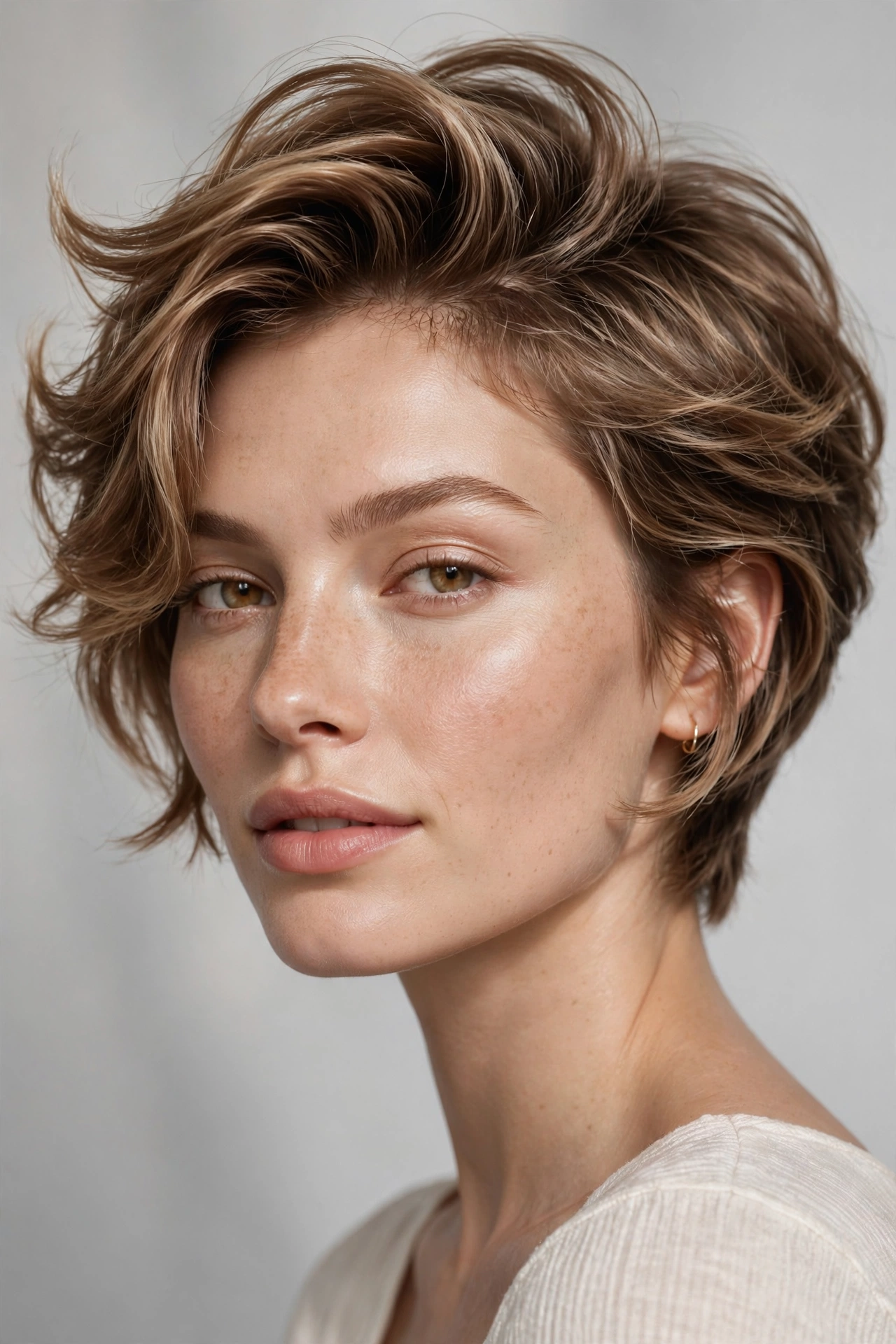
How you dry a pixie cut changes its character more than almost any other styling decision. A rough-dry with fingers produces a relaxed, tousled result; a round brush blow-dry produces soft volume, movement, and a lifted quality that reads as feminine. The round brush lifts the hair away from the scalp as it dries, creating roundness at the crown and at the face-framing pieces that close-to-the-head drying cannot achieve. Use a medium ceramic round brush on the crown and a small round brush on the face-framing pieces and any fringe section.
5. Add a Soft Wispy Fringe

A wispy fringe is the alternative to the blunt fringe for women who want softness at the forehead rather than graphic precision. Razor-cut ends create individual, feathered tips that fall lightly across the forehead rather than as a solid mass. The result reads as genuinely delicate — the wispy fringe appears almost accidental in the most flattering possible way. Ask for “a wispy razor-cut fringe — I want feathered, airy tips, not a straight line.”
6. Wear Earrings

This sounds simple because it is, and it works every time. Long, delicate earrings — drop earrings, hoops, chandelier styles — immediately feminise a pixie cut because they extend the visual line of the neck downward, adding length and jewellery-specific femininity at the most visible point. With short hair, earrings become the primary accessory that the face and neck present; they have more visual impact at pixie length than at any longer style. Gold drops, pearl hoops, or delicate chain earrings are the highest-impact choices.
7. Choose Warm Blonde or Copper Colour
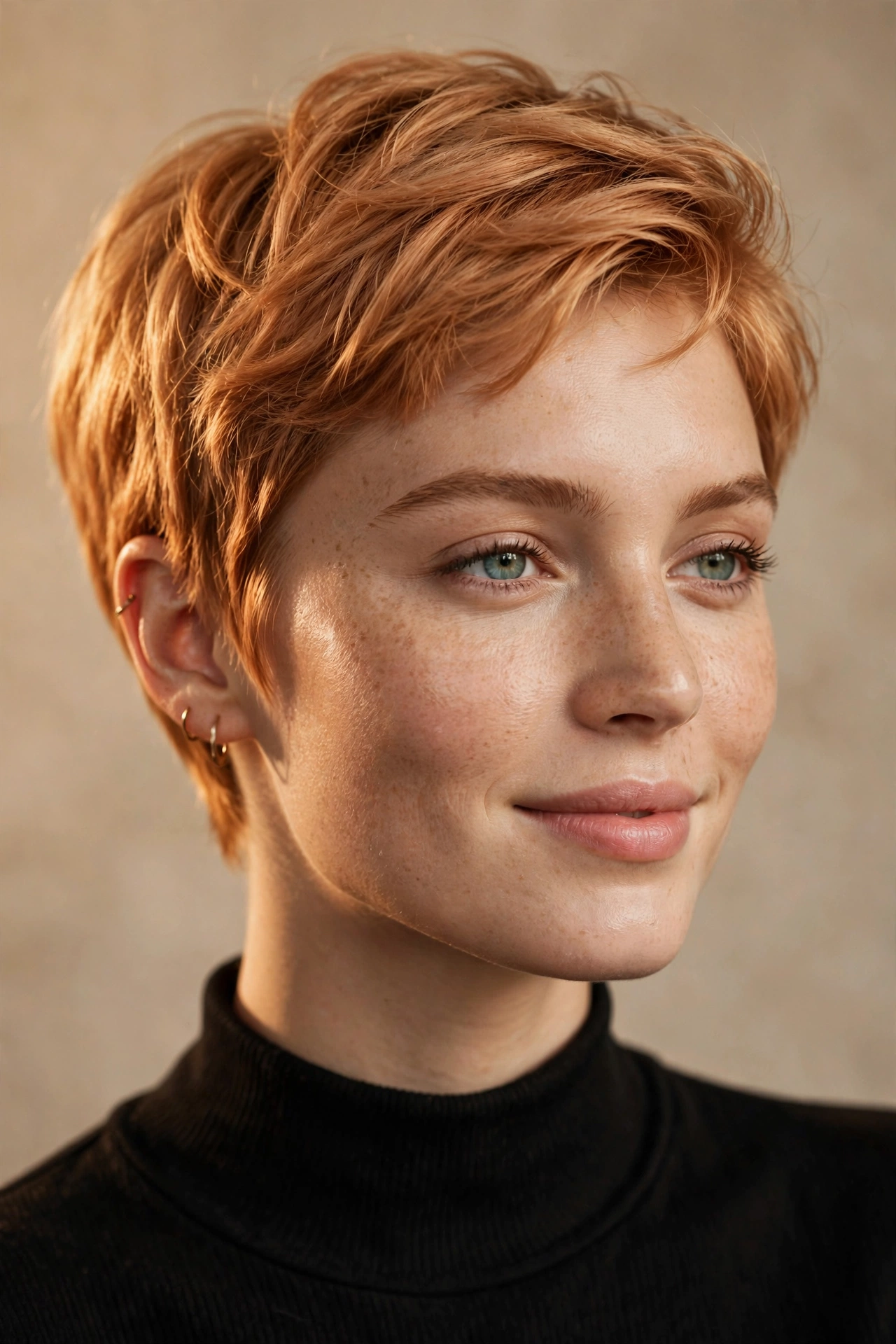
Colour has a significant effect on how feminine a pixie reads. Warm tones — honey blonde, copper, auburn, caramel — add warmth to the face and create a softness that cool tones (ash blonde, platinum, cool brown) don’t provide. The warmth of the colour reflects onto the skin and creates an impression of gentleness that cooler, more graphic tones deliberately avoid. If you’re choosing a colour for your pixie and femininity is the priority, the warm side of the colour wheel is the specific choice to make.
8. Add Internal Layers for Volume
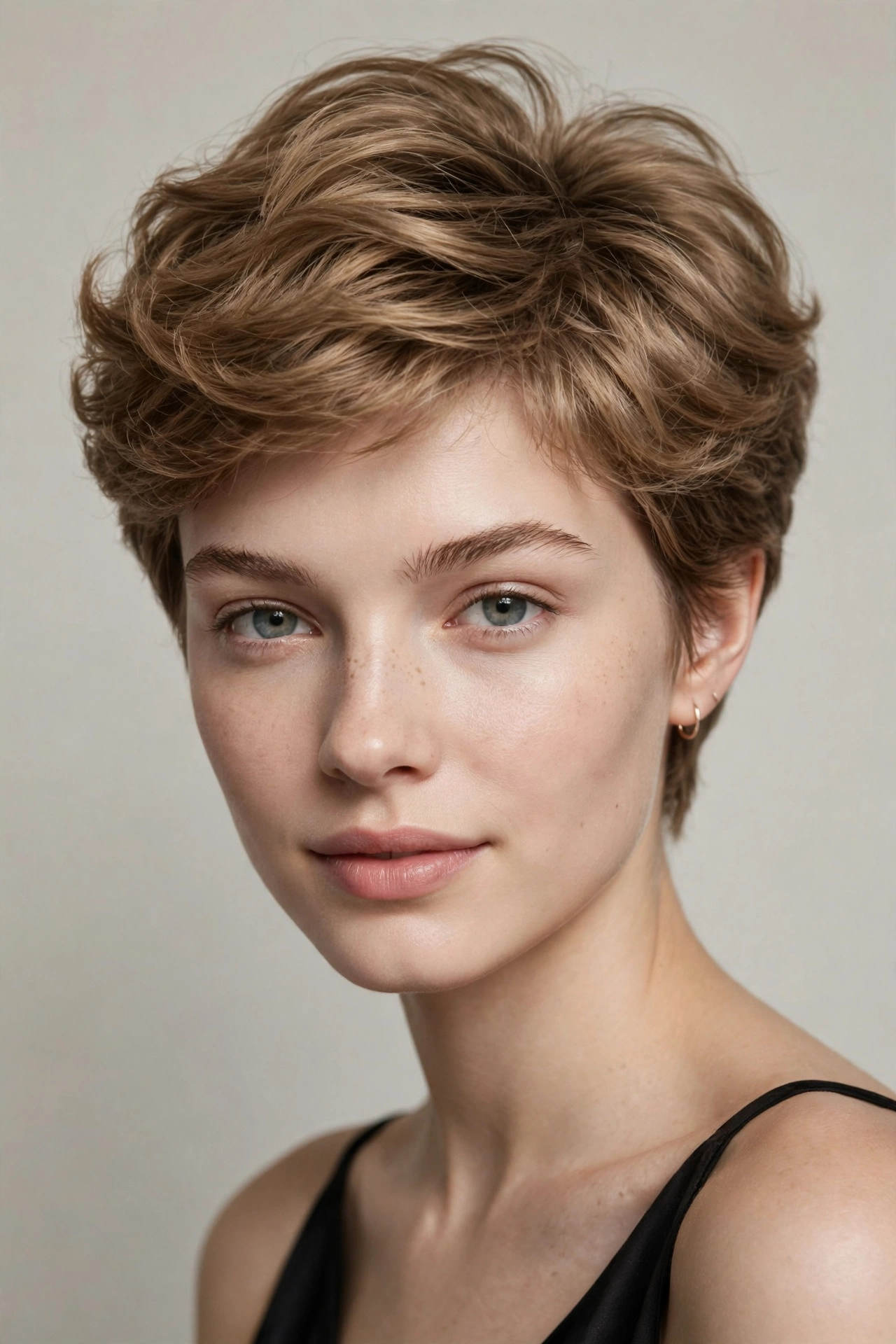
A flat, close-lying pixie with no internal graduation reads as minimal and sharp. A pixie with internal layers — the underlayers cut shorter than the surface to push the top upward — creates volume, roundness, and a softness at the crown that the flat version lacks. Internal layers are an invisible technique: you can’t see where they are, but you can see what they do. Ask your stylist for “internal graduation for volume — I want lift at the crown.”
9. Keep the Nape Soft and Feminine

The nape is seen by everyone behind you and influences the overall impression of the cut. A razor-shaped pointed or curved nape (a V-shape or soft curve at the hairline) reads as deliberately feminine — it’s a decorative finishing detail that replaces the irregular natural nape with a clean, intentional shape. Ask for “a feminine V-shape at the nape” or “a soft rounded nape shape.” This single detail, taking 2 minutes to execute, significantly shifts the cut’s register.
10. Use a Light-Hold Product Rather Than High Shine

Product choice is a direct lever on femininity. High-shine pomades and hard-hold waxes produce a glossy, sculpted finish that reads as architectural and masculine. A light-hold mousse, a sea salt spray, a featherweight serum, or a flexible-hold cream produces a soft, natural-movement finish that reads as feminine. The rule: anything that makes the hair look wet or rigid is less feminine; anything that makes it look natural and touchable is more so.
11. Grow Out the Top Section Slightly

If your current pixie reads as too masculine, growing the top section to 3–4 inches is the most effective structural change you can make without a full regrow. Extra length at the crown creates visible movement and styling versatility that a close-cropped crown doesn’t have. It also allows for the face-framing and fringe additions that feminise a pixie most effectively. You don’t need to grow everything — just the top and front sections, while maintaining the clean nape and taper that give the cut its structure.
12. Add a Floral or Embellished Hair Clip

A small floral clip, a pearl-embellished barrette, or a delicate gold slide worn at the temple or the side of the crown is one of the most immediate feminising additions to a pixie cut with no cutting required. The accessory adds a decorative element that draws attention to the face and signals intentional, feminine styling. A single small clip worn consistently becomes a signature; a changing selection keeps the style fresh.
13. Create a Side Part
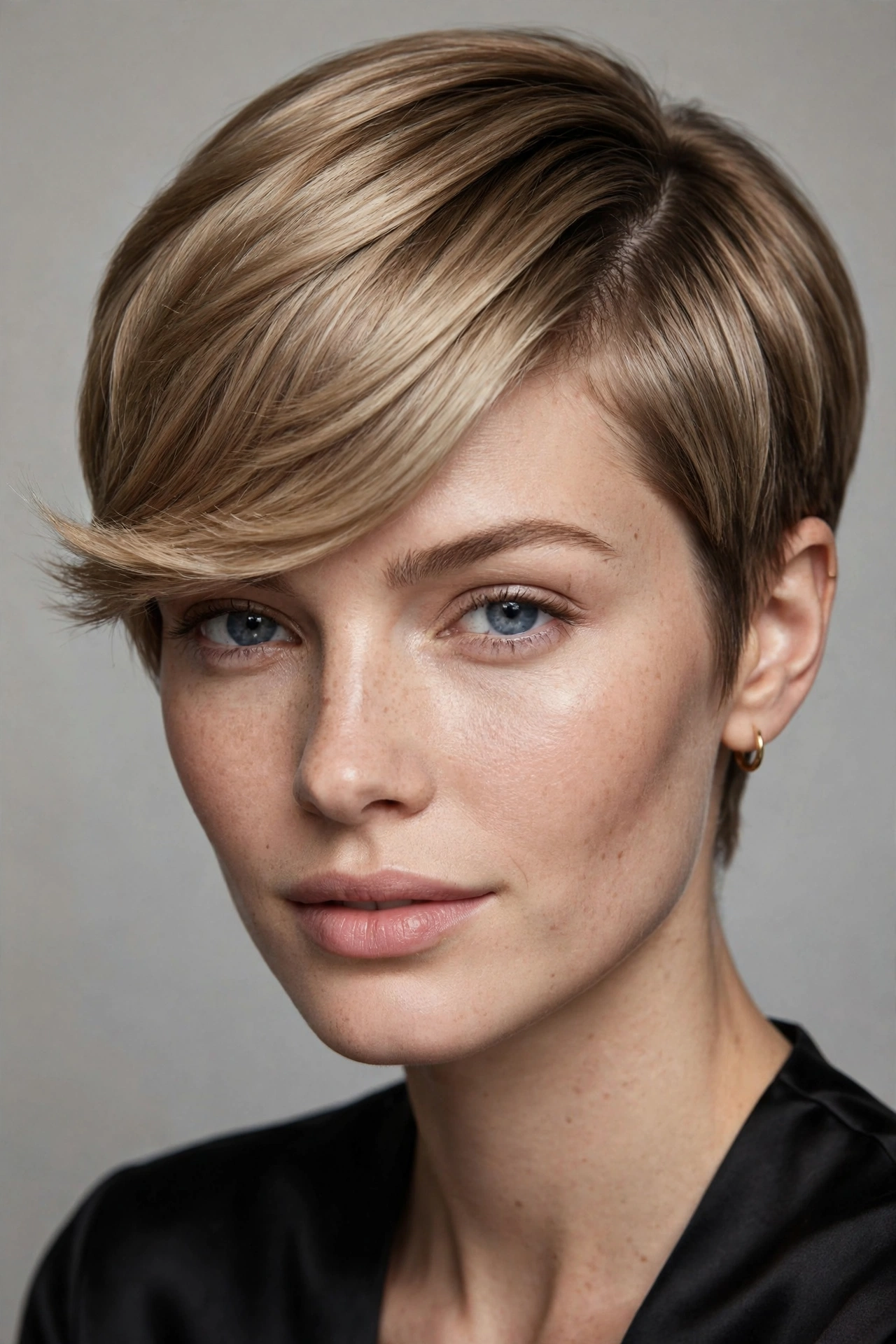
A side part introduces asymmetry and a directional movement that reads as more feminine than a centre part or no part. The part itself creates a longer visual sweep on one side of the face, softening the cut’s symmetry. Combined with face-framing pieces directed to the longer side, a side part creates the most complete feminising framing effect available without changing the cut at all — it requires only a comb and a small amount of light-hold product.
14. Choose Soft Wavy or Curly Texture Over a Sleek Finish

If your hair has any natural wave or curl, working with it rather than smoothing it out reads as more feminine. Natural texture creates organic movement and softness that a smooth, sleek finish can’t replicate — and at pixie length, those qualities are the primary feminising forces. A sea salt spray on damp hair and a diffuse or air-dry produces the most feminine possible result on naturally wavy or curly pixie cuts. Reserve the flat iron and pomade for days when polished precision is the specific goal.
15. Use a Flat Iron on Face-Framing Pieces Only

If your hair is straight and needs directional help, a mini flat iron on just the face-framing pieces creates a deliberate, feminising effect with very little effort. Pressing the face-framing pieces with a slight inward tilt at the tips — angling the iron inward toward the jaw as you pull through — creates a smooth, slightly curved piece that falls against the cheekbone in a classic, feminine face-frame. Apply a heat protectant first; the actual ironing takes 30 seconds per piece.
16. Add Balayage or Highlights at the Crown
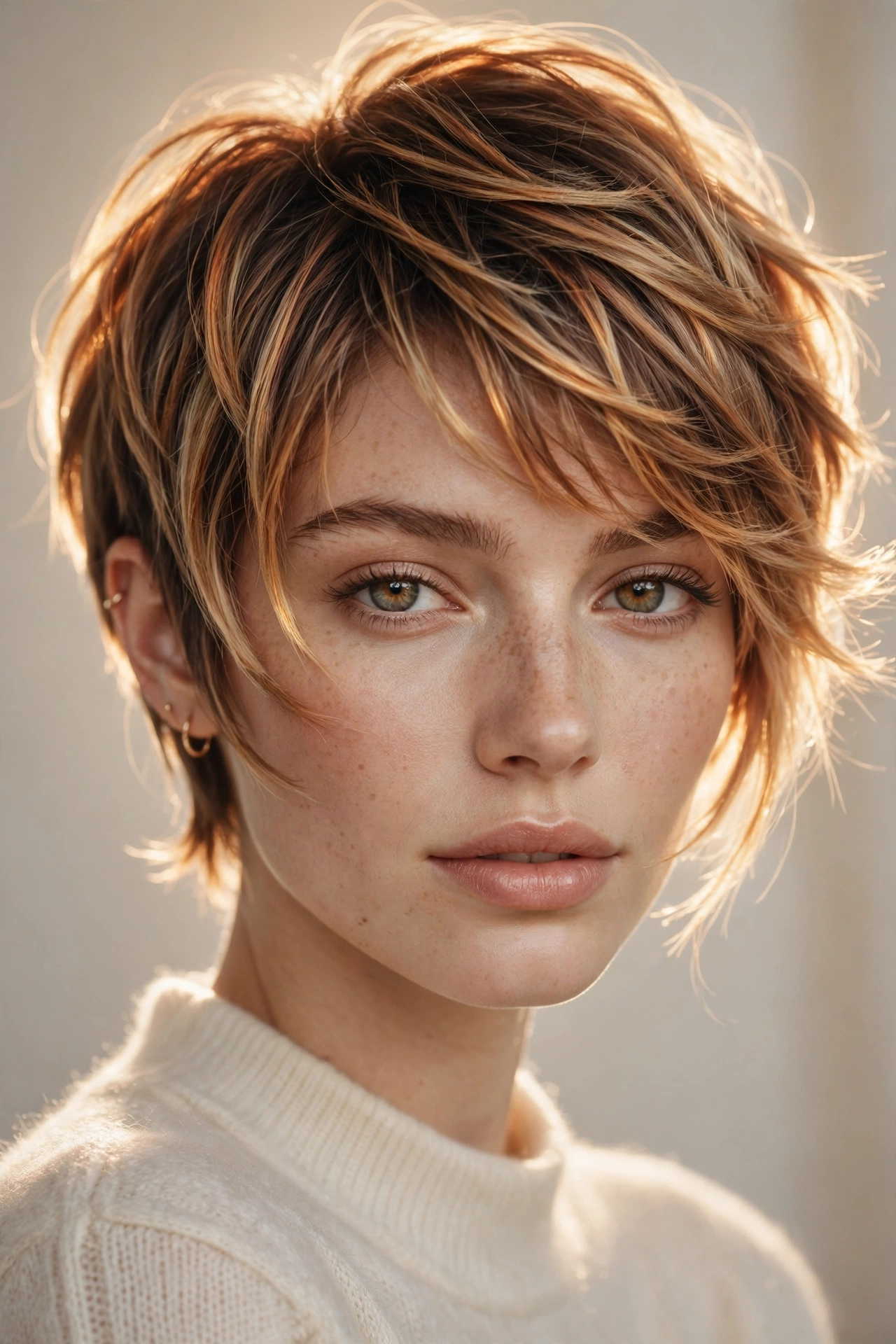
Colour dimension — particularly lighter highlights or balayage concentrated through the crown and face-framing sections — adds a warmth and brightness to the cut that makes it read as more feminine. Light naturally reflects more variably off multi-toned hair than single-process colour, creating a softness and dimension that monochromatic colour doesn’t provide. Ask your colourist for “a few highlights through my crown and face-framing pieces” — even 4–5 foils on a pixie length make a visible difference.
17. Grow Your Brows and Fill Them In

Short hair draws attention immediately to the brows — they become the face’s primary framing element, working harder than they ever do with longer hair. Fuller, well-shaped brows with a soft arch feminise the face significantly and complement a pixie cut in a way that sparse or over-plucked brows don’t. A brow pencil or tinted brow gel used lightly to enhance (not overdraw) your natural brow shape is the single fastest face-level feminising change you can make alongside any pixie styling choice.
18. Keep the Fringe Longer Than You Think
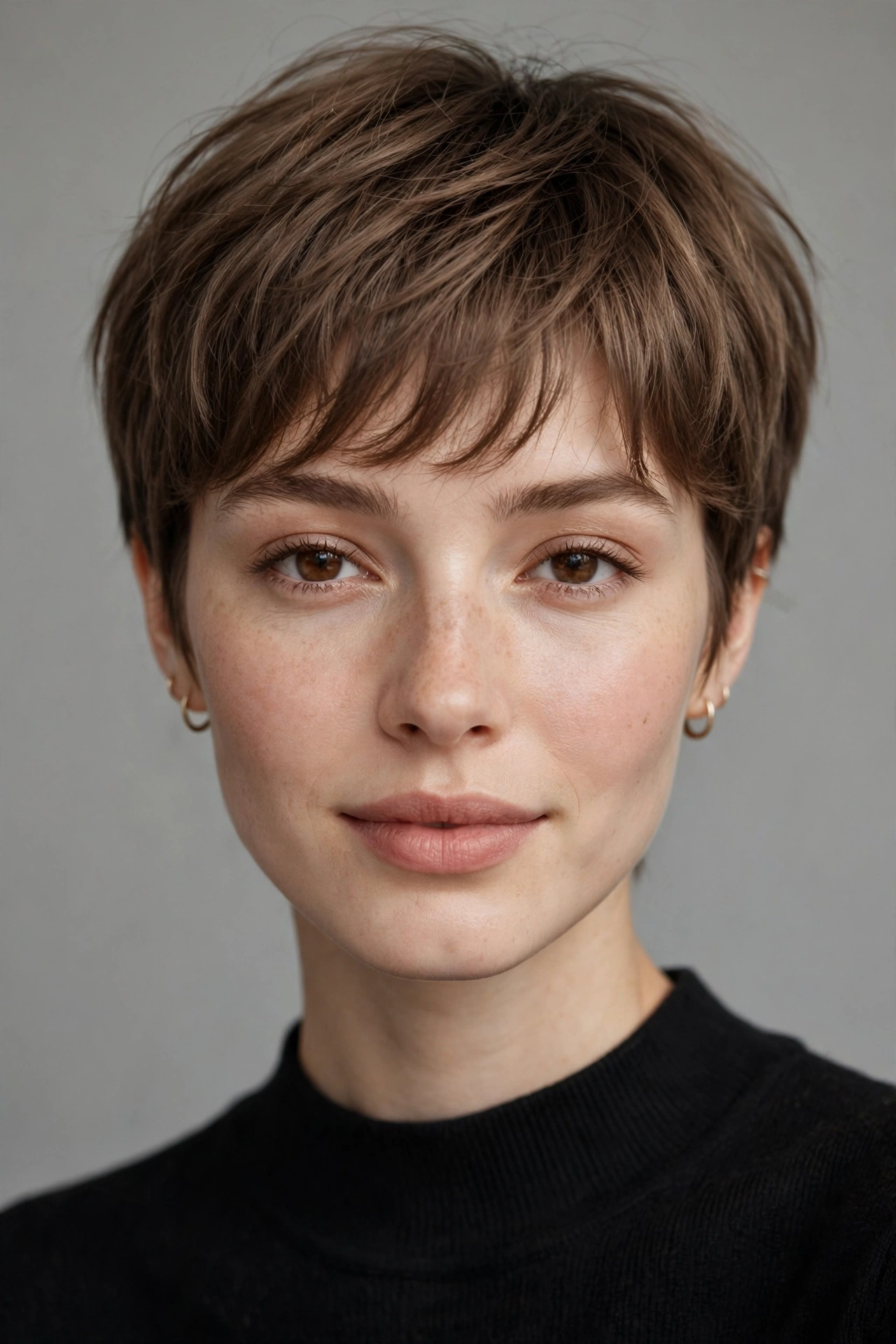
When requesting a fringe on a pixie, the instinct is often to ask for something short — but a slightly longer fringe reads as more feminine than a very short one. A fringe that grazes the brow or falls just below it has a softness and mobility that a very short above-the-brow fringe doesn’t. The fringe moves slightly with the head, which creates a living, organic quality. Ask your stylist to cut to brow level or just below — never above the brow if femininity is the specific goal.
19. Try a Pixie Bob Hybrid Length

If the standard pixie read as too short and too minimal, the bixie (pixie-bob hybrid) provides the pixie’s side and nape structure with a longer top and face-framing sections. The face-framing pieces at cheekbone or chin level create the most feminine framing possible at short length, and the extra top section length provides full curtain fringe and styling versatility. It reads as deliberately feminine rather than minimally short.
20. Sleep on a Satin Pillowcase

Femininity in a pixie cut is partly about consistent, maintained shape — and a satin or silk pillowcase significantly reduces the overnight friction that roughens hair cuticles and creates frizzy, undefined morning shape. The smoother surface preserves blow-dried direction, fringe placement, and face-framing piece shape overnight. The morning styling time drops to under 3 minutes because the satin has done the maintenance work while you slept.
21. Add a Thin Gold Headband
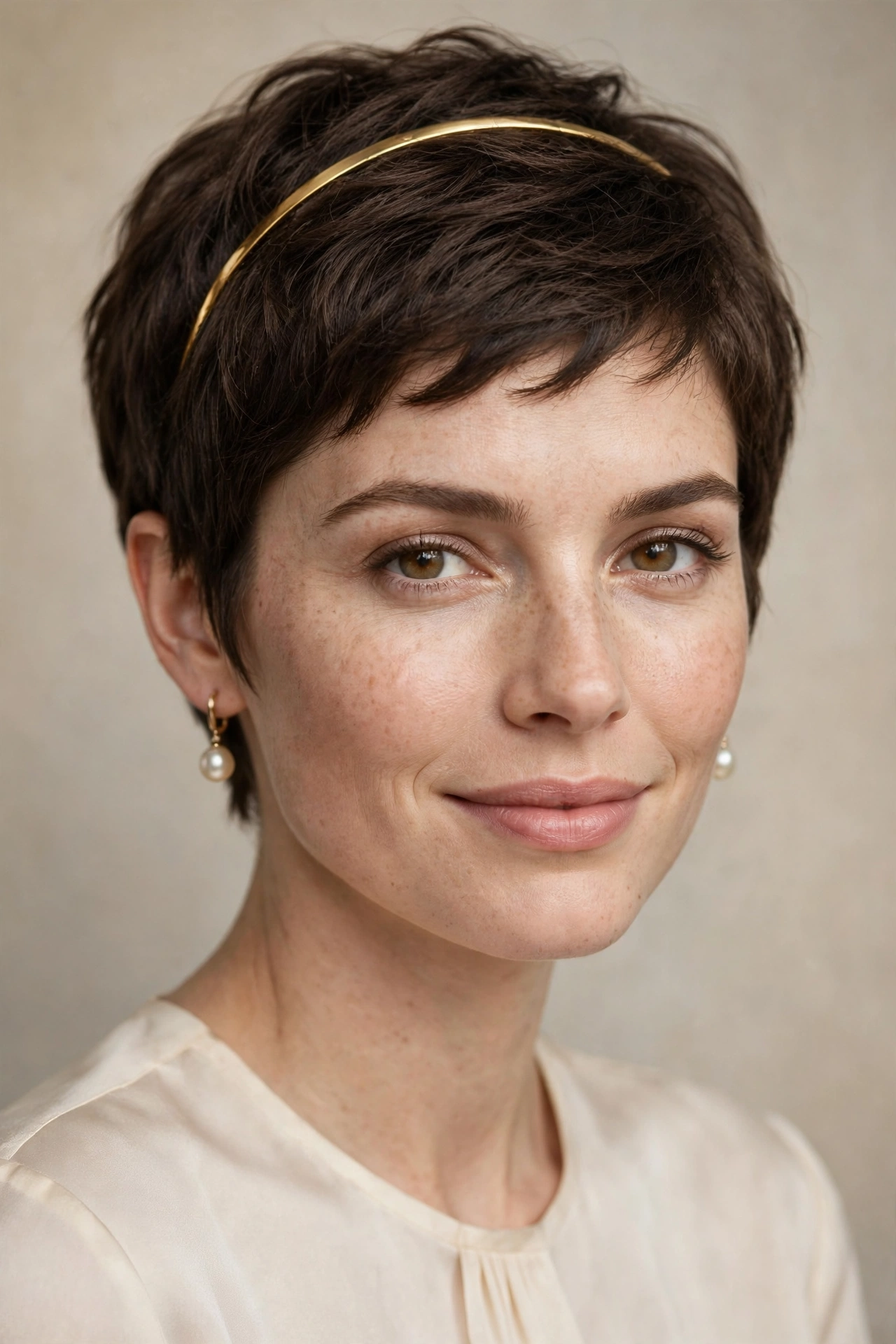
A thin gold or pearl-embellished headband worn pushed slightly back from the hairline is one of the most classic, instantly recognisable feminising accessories for a pixie cut. It adds a jewellery-level decoration to the hair without competing with the cut’s structure, and it works across all pixie lengths and textures. A thin metal headband in gold reads as polished and feminine; a velvet or fabric headband reads as softer and more casual.
22. Use a Diffuser When Drying
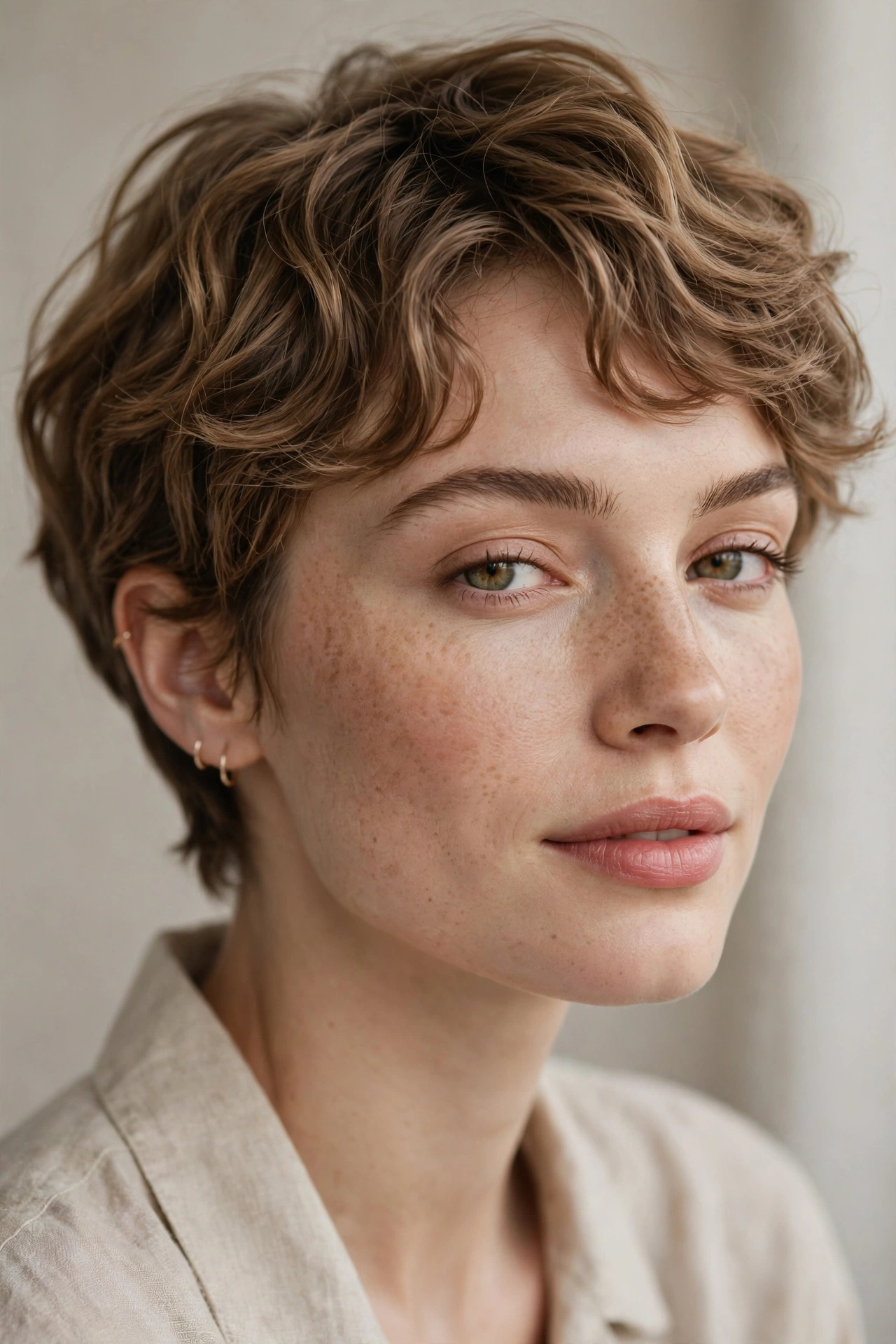
A diffuser attachment on a blow-dryer is the single tool most likely to feminise a pixie cut with textured or wavy hair. It dries the hair in a cupped, downward-facing bowl rather than with a direct stream of air, preserving natural wave and curl patterns that direct drying disrupts. On a pixie cut, this means the hair dries with natural movement, soft texture, and organic body — the qualities that a direct-heat rough-dry destroys. Even 3 minutes of diffusing produces a noticeably softer, more feminine result.
23. Choose a Diagonal Fringe Over a Blunt One
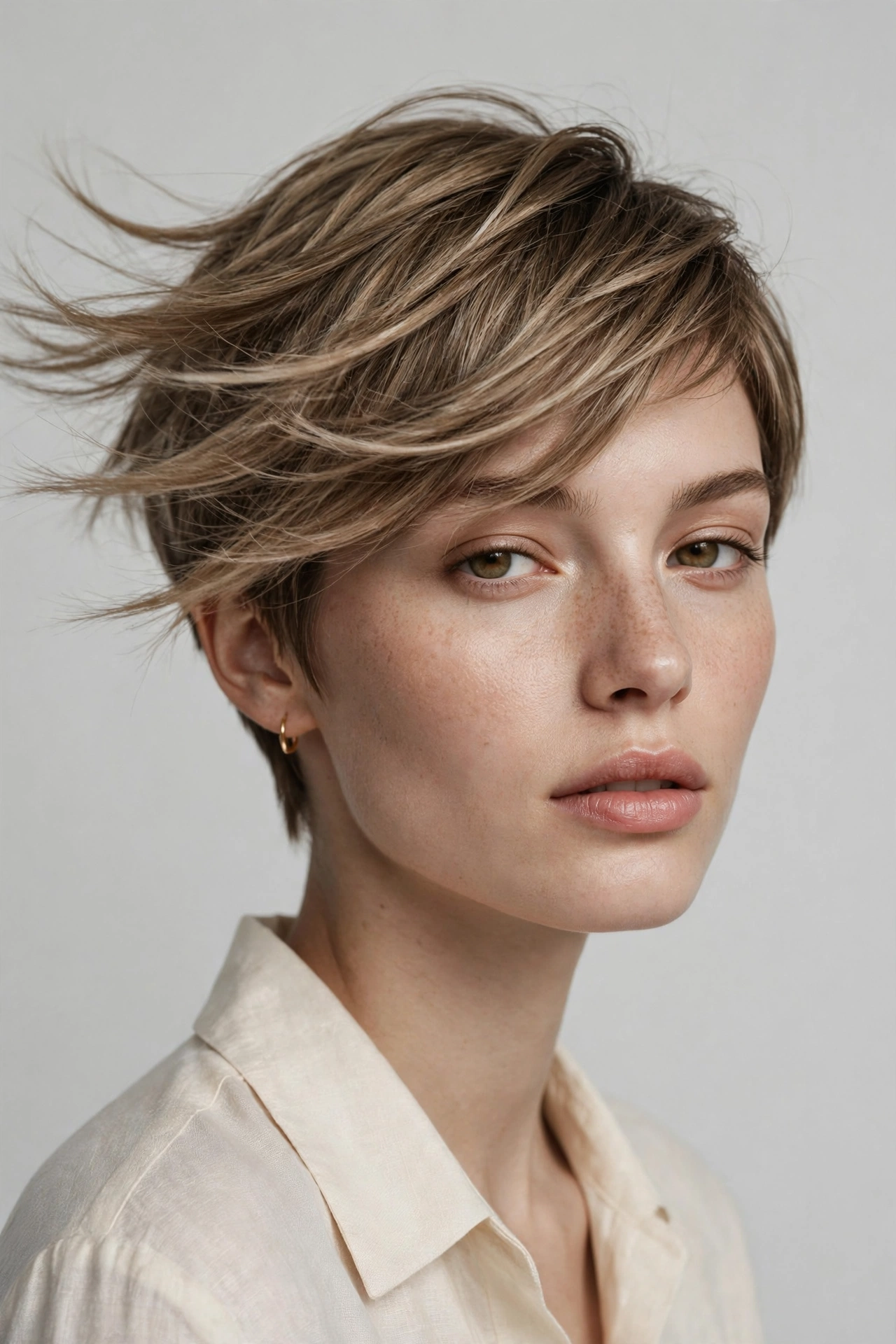
A blunt, straight-across fringe on a pixie reads as geometric and precision-forward — more architectural than feminine. A diagonal fringe that sweeps across the forehead reads as dynamic and soft simultaneously — the movement of the diagonal creates a visual flow that the static horizontal line of a blunt fringe doesn’t provide. If you currently have a blunt fringe and want a more feminine result, ask your stylist to angle the fringe on the next trim to create a diagonal sweep.
24. Apply a Gloss Treatment Quarterly

A professional or at-home gloss treatment every 3–4 months adds a translucent warmth and shine to any blonde, brunette, or grey pixie that makes the colour read as richer, softer, and more dimensional. Gloss treatments don’t change the colour — they add a transparent tonal warmth (typically warm golden for brown hair, champagne for blonde, or brightening for grey) and significant shine that makes the hair look healthy and carefully maintained. A well-glossed pixie reads as inherently more feminine than the same cut with dull, flat colour.
25. Try a Slightly Longer Side Piece

One face-framing piece on one side of the cut left deliberately longer than the rest — falling to the cheekbone while the rest of the cut is shorter — creates an asymmetric face-frame that is both modern and feminine. The single longer piece draws the eye along its length toward the cheekbone, creating a directional elegance that a symmetric short cut doesn’t have. This requires only a few extra centimetres of length on one front section — a detail to request at your next appointment.
26. Use Moisturising Products, Not Drying Ones

Dry, dull hair at any length reads as less feminine than healthy, moisturised hair with natural sheen. For pixie cuts specifically, where every strand is individually visible, the condition of the hair is completely exposed — there’s no length to hide dry ends or faded mid-lengths. A sulphate-free shampoo, a weekly deep conditioning mask, and a leave-in conditioner or hair oil for daily moisture are the foundation. Healthy hair has a natural movement and softness that dry hair loses; restoring moisture restores femininity.
27. Frame the Cut with Statement Makeup

A pixie cut moves the face’s visual centre from the hair down to the features, making the eyes and lips more prominent than they are with longer hair. This is a feminising opportunity: a bold lip, defined eyes, or a strong brow in combination with a pixie cut creates a striking, genuinely feminine composition. Many women report that they started wearing more makeup after cutting their hair short — not because they needed to compensate, but because the face suddenly had more presence to frame.
28. Ask for Longer Layers at the Temple
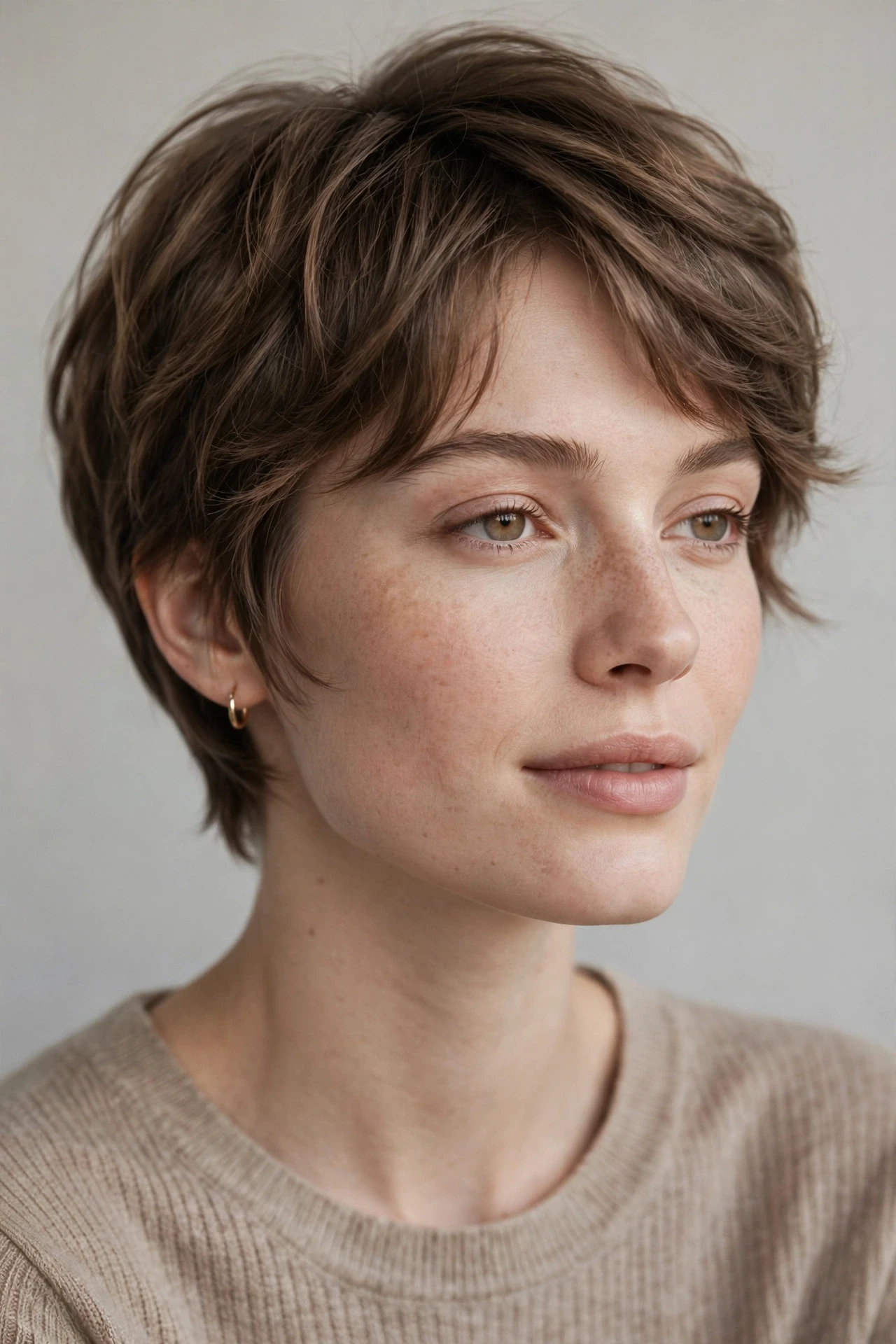
The temple area — where the hairline meets the sides of the forehead — is a key feminising zone in a pixie cut. Leaving the temple section slightly longer (2.5–3 inches) rather than cutting it close with the side taper creates a natural, soft frame at the outer edges of the forehead. These longer temple pieces move with the head, softening the face’s perimeter and contributing to the face-framing quality that distinguishes a feminine pixie from a minimal close-crop.
29. Add a Floral or Bow Hair Pin at the Crown
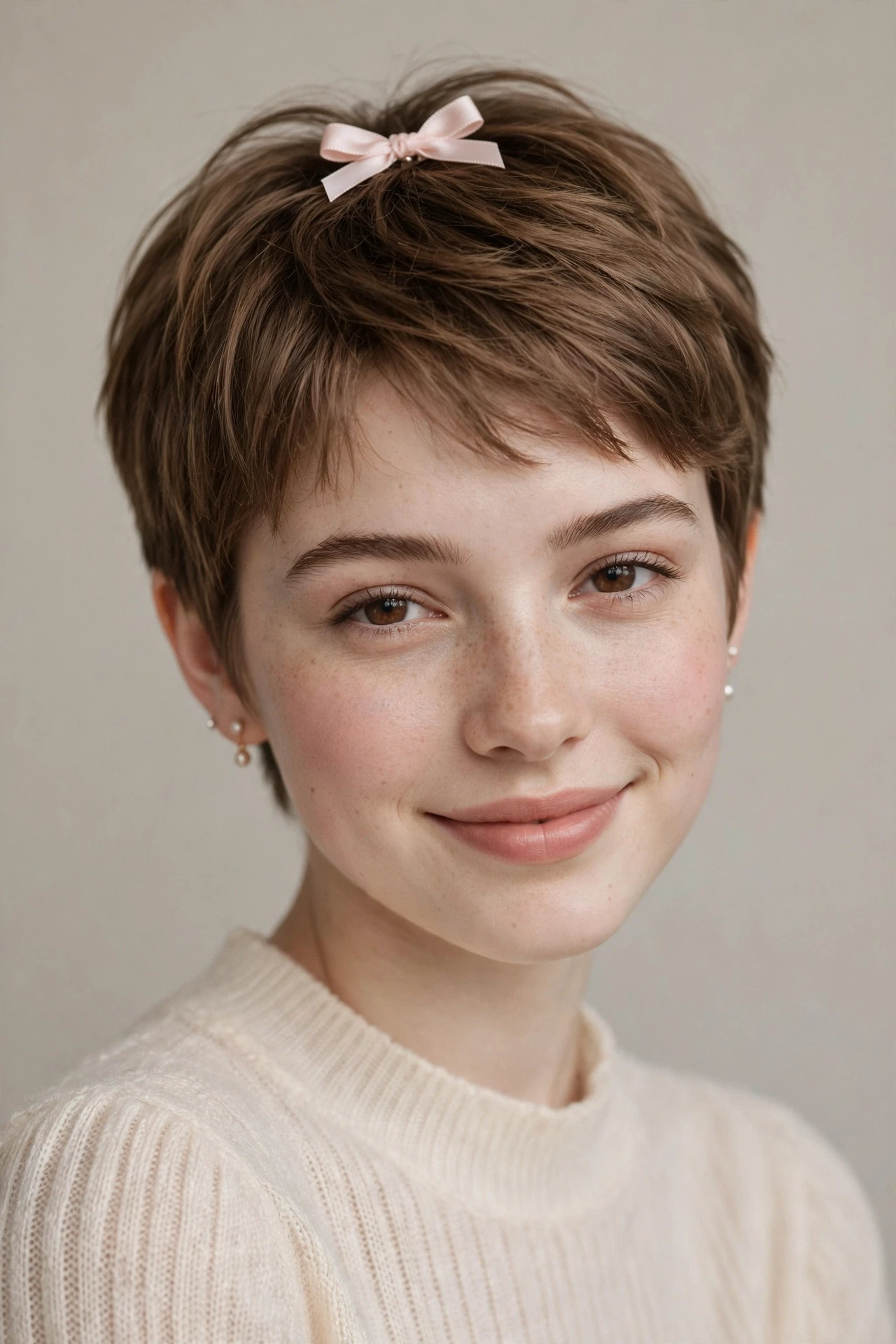
A small decorative pin — a delicate bow, a floral motif, or a jewelled slide — placed at the crown or behind one ear on a pixie cut is an immediately feminine addition that requires no styling and no cutting. It functions as a punctuation mark on the cut: the decoration signals intention and softness in a way that bare hair doesn’t. A simple tortoiseshell bow clip, a small crystal hairpin, or a gold leaf slide at the temple each creates a complete, intentionally feminine look.
30. Request Razor-Finished Ends at the Nape
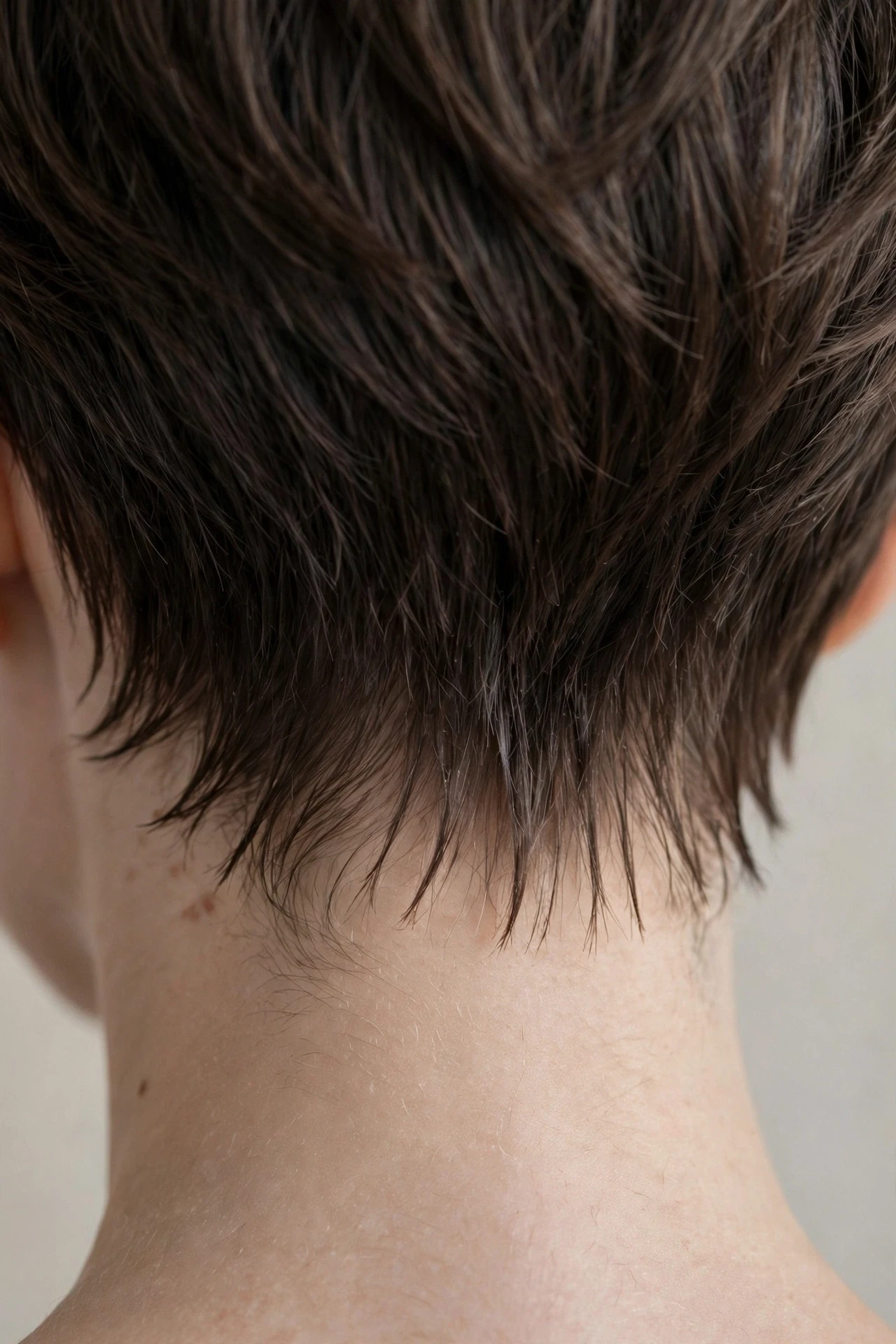
The way the cut ends at the nape — whether with blunt scissor edges or feathered razor edges — affects how feminine the overall cut reads. Razor-finished ends at the nape create wispy, feathered tips that soften the nape’s perimeter and make the cut fade out gently rather than ending with a precise, hard edge. This single finishing technique takes 2 minutes and shifts the entire feel of the cut’s back section from sharp to soft.
31. Use a Pearl or Rose Gold Hair Cuff
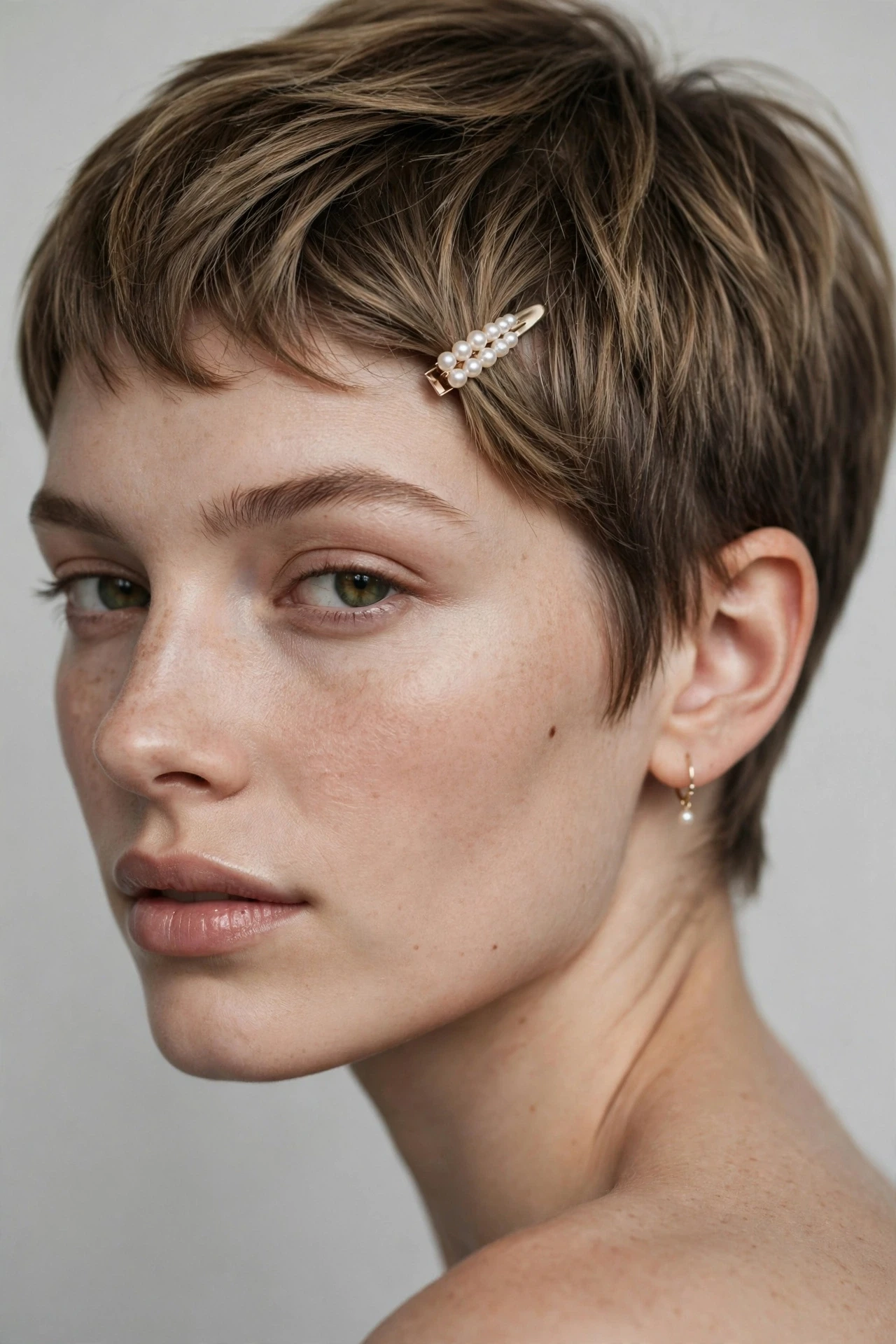
A small pearl or rose gold hair cuff clipped onto a face-framing piece or a front section of a pixie cut is a jewellery-level addition that is entirely specific to short hair — it only works when the pieces are short enough to be visually isolated. This is an accessory that longer hair physically can’t display in the same way. A single delicate cuff on one face-framing piece at the temple reads as deliberately, quietly feminine.
32. Avoid Hard Geometric Lines at the Forehead
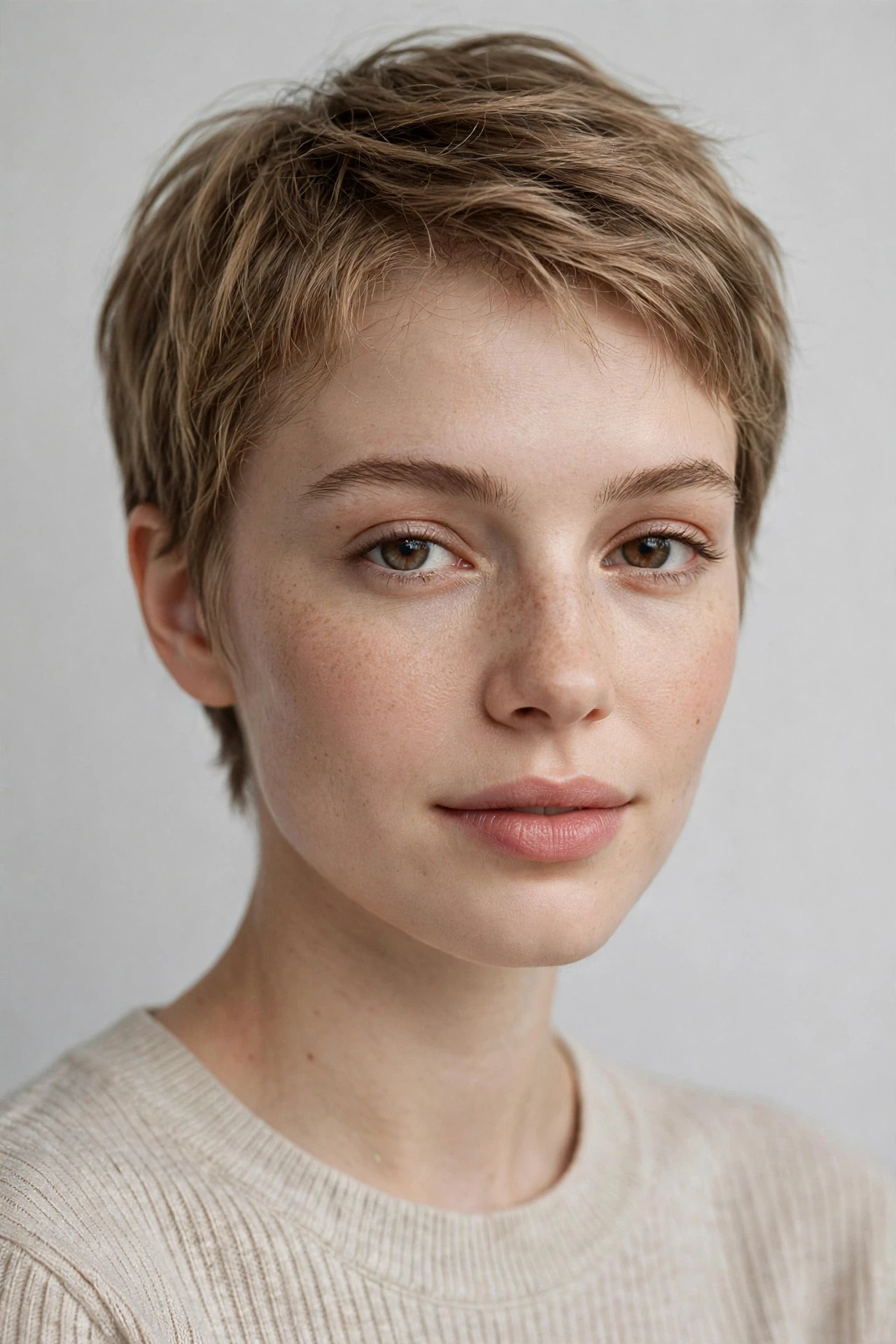
The forehead hairline on a pixie cut — the boundary between skin and hair at the top of the face — significantly affects how feminine the cut reads. A hard, lined, precisely edged forehead hairline reads as barbershop-masculine. A soft, unlined forehead hairline that retains the natural irregular edge (including any baby hairs or slight wispy growth) reads as soft and feminine. Tell your stylist specifically: “please don’t line the forehead — I want the natural hairline.”
33. Layer on Delicate Necklaces
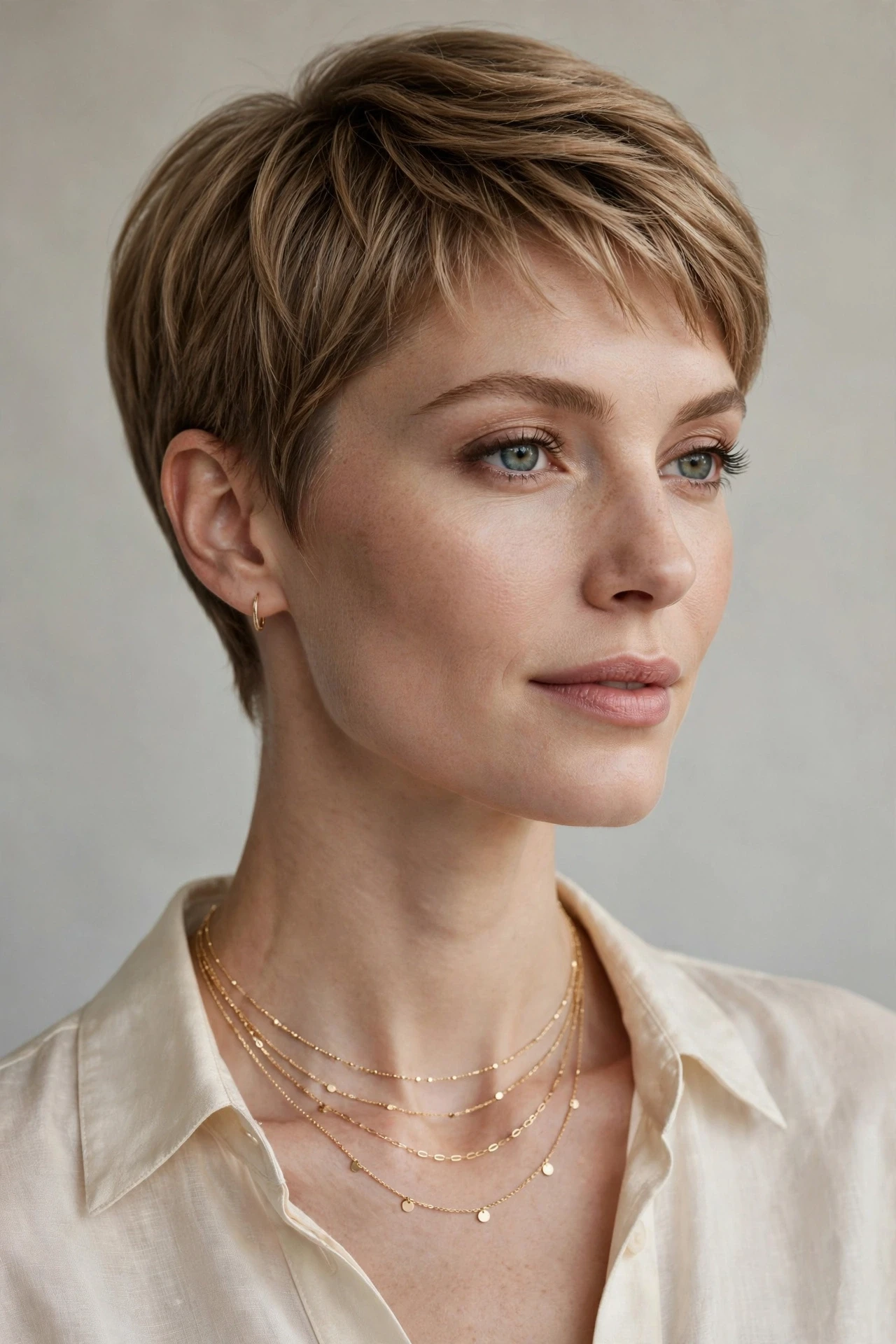
Short hair and a visible neck create the perfect conditions for delicate necklaces to make a genuine style statement. A fine gold chain at the collarbone, a pearl pendant at the throat, or two or three layered delicate chains at different lengths create a jewellery composition that longer hair would partially obscure. With a pixie cut, the neck and collarbone are fully on display — the necklaces read as part of the total look in a way that’s specific to short hair.
34. Book a Curly Specialist or DevaCut Stylist
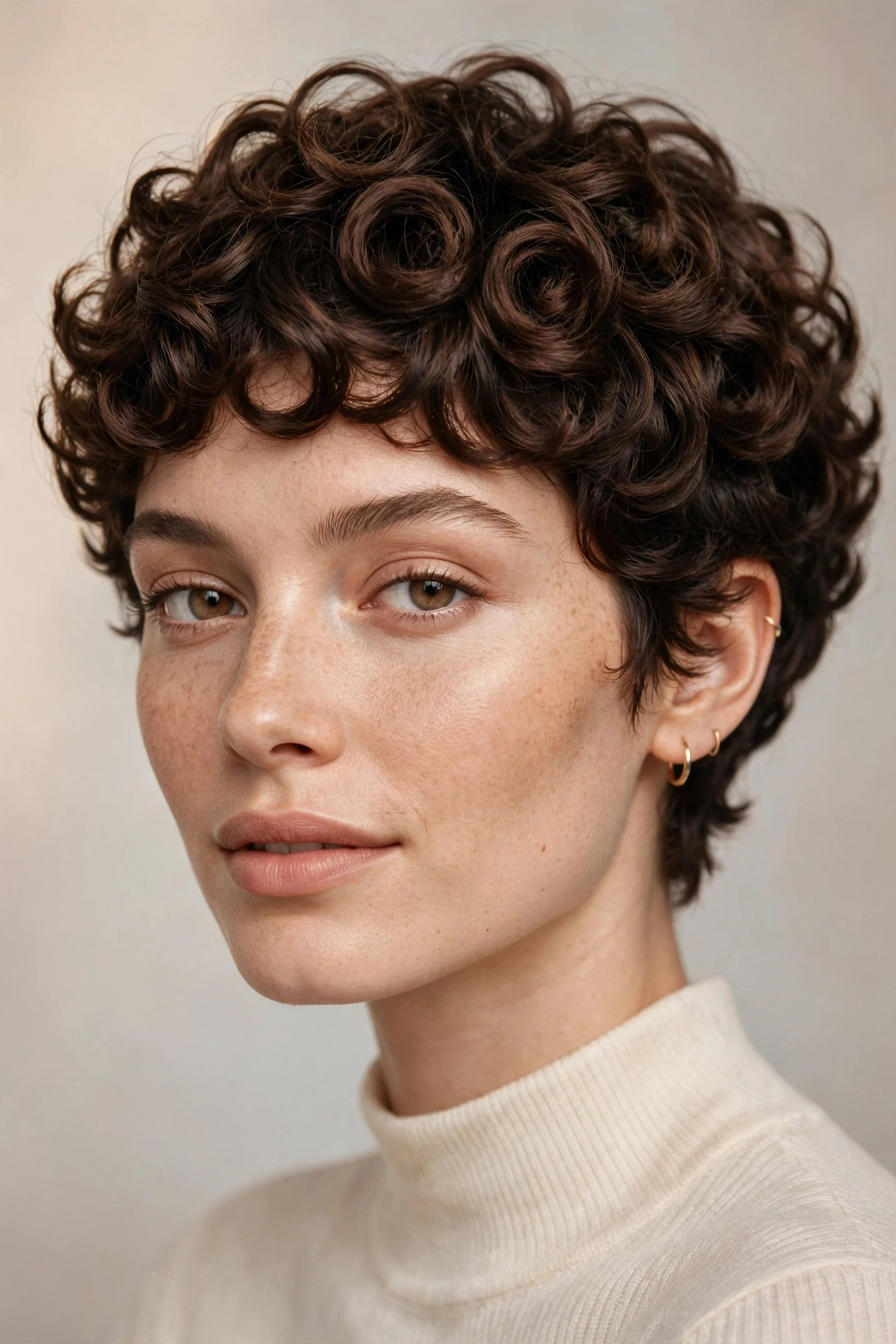
If your hair has any natural wave or curl and your pixie currently reads as less feminine than you’d like, the most impactful single change is often booking a stylist who specialises in cutting curly or wavy hair. Standard scissor techniques used on curly hair at pixie length frequently produce an unintended result — the curls spring up unevenly, the shape is neither structured nor softly rounded, and the cut looks like it’s fighting the hair. A DevaCut or curl-specialist approach cuts each curl individually at its dry position, creating a shape engineered to work with the curl’s natural movement — and curly or wavy pixies shaped this way are among the most feminine short cuts available.
Quick Reference: The Five Highest-Impact Changes
If you implement only five of these 34 ideas, make them these:
- Request a soft 2-guard taper instead of a skin fade — the single biggest structural shift toward femininity, requiring only a conversation with your stylist before the cut begins.
- Add a curtain fringe or diagonal fringe — the most transformative fringe choice for femininity, working on virtually all face shapes and most textures.
- Wear earrings consistently — the fastest, zero-commitment change with the most immediate visual impact.
- Switch to a light-hold or natural-finish product — removes the stiffness and gloss that read as masculine and replaces them with the natural movement that reads as feminine.
- Ask for face-framing pieces kept longer at the front — even a small increase in the front section length creates a frame around the face that shifts the cut’s entire impression.
None of these five require growing your hair out, booking an appointment, or spending significant money. Four of them can be implemented today.